 SolarCalculators
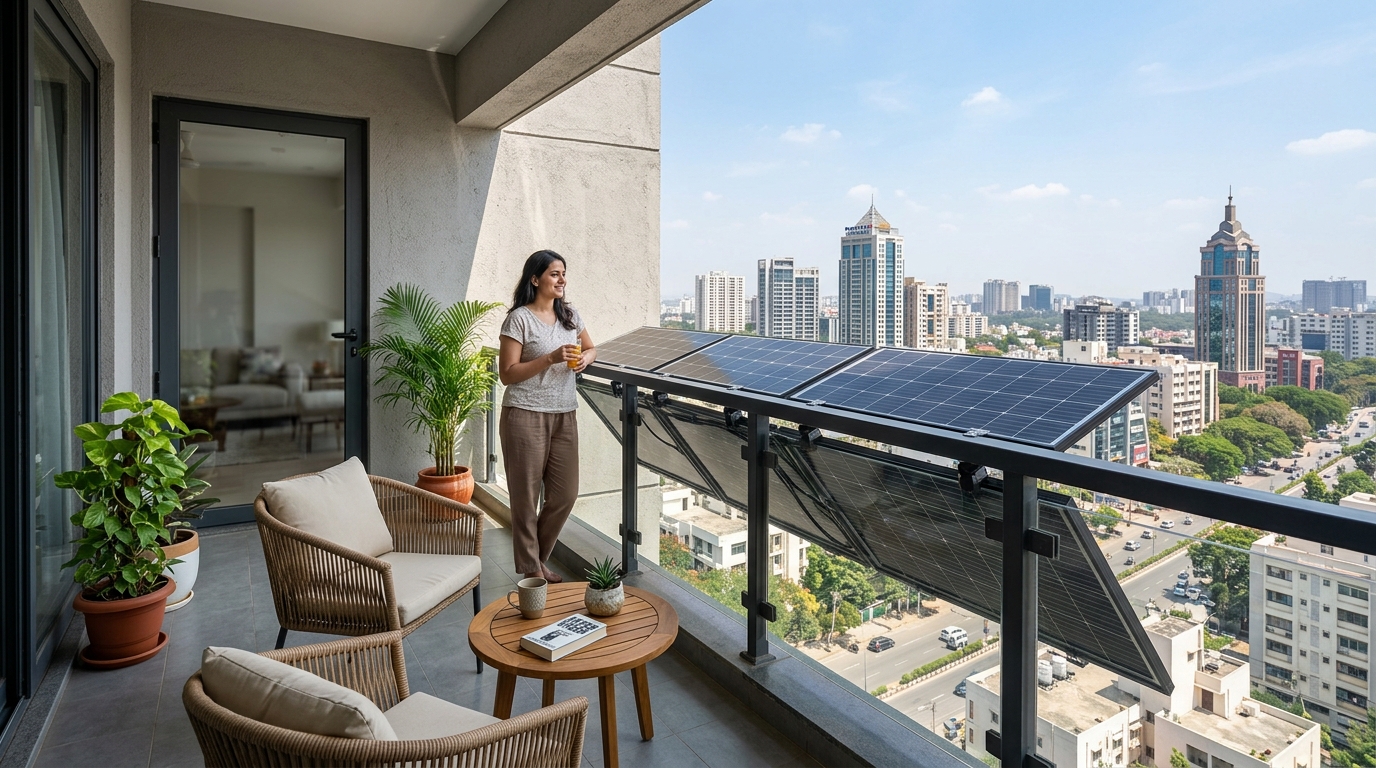
The Rise of High-Rise Balcony Solar in Indian Metros
For millions of urban Indians living in high-rise apartments across Delhi-NCR, Bengaluru, Mumbai, Pune, Chennai, and Hyderabad, rooftop solar has historically been out of reach due to shared roof ownership disputes in housing societies (AOAs/RWAs). In late 2026, Plug-and-Play Balcony Solar Kits have emerged as the fastest-growing urban renewable energy trend.
By securing lightweight, high-efficiency bifacial panels to apartment balcony railings or terrace parapets, homeowners and long-term tenants can generate their own clean solar energy and plug directly into standard wall sockets.
30-Second Quick Takeaways
Key facts for apartment dwellers considering balcony solar in 2026
- Apartment Solar Revolution: Compact 800W to 1.6kW plug-and-play solar systems allow high-rise apartment tenants and owners to generate clean solar power directly from balcony railings.
- Safety Microinverters: Utilizes IP67 outdoor microinverters with certified IEEE 1547 & CEA anti-islanding protection, eliminating high-voltage DC hazards on balconies.
- Zero Export & DISCOM Rules: Grid-tied balcony setups use smart current transformers (CT) with zero-export limiters to consume power internally without tripping reverse-power relay alarms.
- Rapid ROI: A dual 550W bifacial panel setup cuts monthly residential power bills by ₹1,000–₹1,500, recovering initial costs within 3.5 to 4.5 years.
How Balcony Solar Systems Work: Components & Architecture
A typical apartment balcony solar kit is engineered for maximum space efficiency, safety, and rapid DIY installation. The complete setup consists of four core building blocks:
Lightweight Bifacial Solar Modules
Two 400W to 550W N-Type TOPCon bifacial panels mounted on heavy-duty anodized aluminum tilt brackets. Bifacial technology captures reflected sunlight from the balcony floor and building walls, boosting power output by 12% to 18%.
IP67 Smart Microinverter (600W–1200W)
Mounted directly behind the solar panels. The microinverter instantly converts 36V–48V DC power into 230V single-phase AC electricity with built-in Wi-Fi monitoring and MPPT tracking per panel.
Zero-Export Current Transformer (Smart CT Limiter)
Clamped around the main incoming phase wire in your sub-distribution board. It dynamically throttles solar inverter production to match your apartment's exact instantaneous load, ensuring zero watts feed back into the building grid.
Certified 16A AC Plug with Anti-Islanding Protection
Equipped with sub-20ms relays that immediately disconnect power if the building grid loses power, preventing any risk of electric shock to utility linemen.
Balcony Solar Kit Sizing & Price Comparison (India 2026)
| System Sizing | Panel Configuration | Daily Generation | Estimated Cost (₹) | Ideal Appliances |
|---|---|---|---|---|
| 400W Starter Kit | 1x 450W TOPCon Bifacial | 1.6 – 2.0 Units | ₹26,000 – ₹32,000 | Laptop, Wi-Fi, LED lights, 1 Ceiling Fan |
| 800W Standard Kit | 2x 440W Bifacial Panels | 3.2 – 4.0 Units | ₹45,000 – ₹55,000 | Refrigerator + Work-from-Home Setup + TV |
| 1200W Pro Kit | 2x 600W High-Watt Panels | 4.8 – 6.0 Units | ₹65,000 – ₹78,000 | Double Door Fridge, Washing Machine, 0.8T AC |
| 1600W Max Kit | 3x 550W Panels + 1.6kW Inv | 6.5 – 8.2 Units | ₹82,000 – ₹98,000 | Complete Base Load + 1.5 Ton Inverter AC |
💡 Pro Installation Tip: Balcony Tilt Angle Optimization
For vertical balcony railings in India (latitudes between 12°N to 28°N), angling panels at 30° to 45° from the vertical using adjustable stainless steel struts increases annual solar capture by over 38% compared to hanging panels flat at 90°.
Legal Status, DISCOM Regulations & Society (RWA) Guidelines
Before installing balcony solar panels on your high-rise railing, follow these regulatory best practices:
- RWA / Society Clearance: Submit a structural load certificate confirming that the clamp brackets are certified for wind speeds up to 140 km/h (IS 875 Part 3 wind code).
- Safety Fall Arrest Wires: Always secure each solar panel with dual 4mm stainless steel (SS304) safety lanyards anchored directly to concrete pillars.
- DISCOM Interconnection: If operating with a Zero-Export limiter, you do not feed power into the grid, avoiding reverse power meter lockouts. For net-metered connections, apply through your state DISCOM portal.
⚡ Calculate Your 2026 Solar Savings & Subsidy
Select your monthly electricity bill to calculate the ideal system capacity, PM Surya Ghar subsidy, and lifetime savings:
📢 Join the SolarCalculators WhatsApp Channel
Free updates on PM Surya Ghar subsidies, solar prices and net-metering rules — for homeowners and solar installers.
Frequently Asked Questions (FAQs)