
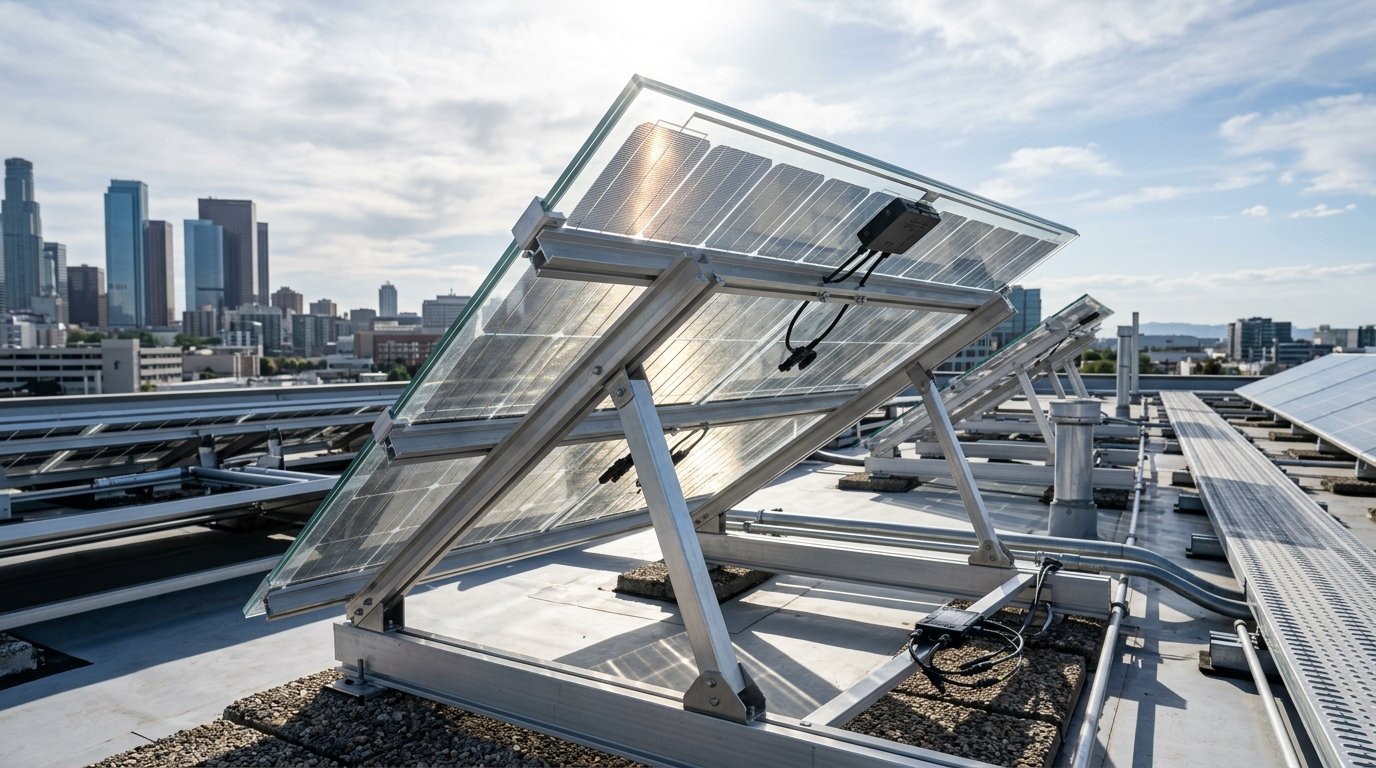
Why Bifacial Solar Requires Specialized Mounting Engineering
Bifacial solar photovoltaic modules have become the industry standard for high-performance rooftop and commercial installations. Unlike monofacial panels that feature an opaque white backsheet, bifacial panels utilize dual-glass encapsulation that allows the rear side of the silicon cells to capture reflected diffuse sunlight from the underlying ground or rooftop surface.
However, simply placing a bifacial panel on a low, standard monofacial mounting structure yields less than 3% rear-side gain. To unlock the full 15% to 25% bifacial energy bonus, mounting structure height, tilt, and rooftop albedo reflectivity must be engineered correctly.
30-Second Quick Takeaways
Key engineering principles for maximizing bifacial solar output
- Unlocking Bifacial Power: Bifacial solar modules generate electricity from both sides. While the front absorbs direct sunlight, the rear side captures diffuse reflected light from the rooftop surface (Albedo effect).
- Ground Clearance is King: Installing bifacial modules with at least 1.2m to 1.5m elevated ground clearance prevents rear-side shading from purlins and allows light to disperse evenly across all rear cells.
- Cool Roof Reflective Coatings: Applying high-albedo white elastomeric roof paint (Solar Reflectance Index SRI > 100) boosts rear generation by 18% to 25% compared to standard grey concrete roofs.
- Structure Shading Avoidance: Engineered torque tubes and low-profile mounting rails positioned along module edges eliminate rear rail shadow lines that cause cell mismatch losses.
Surface Albedo Coefficients & Energy Gain in India
| Rooftop / Ground Surface | Albedo Coefficient (α) | Rear-Side Gain (%) | Extra Annual Generation |
|---|---|---|---|
| Standard Grey Concrete Roof | 0.20 – 0.28 | 6% – 9% | +90 to +135 kWh/kW/yr |
| Terracotta / Red Clay Tiles | 0.25 – 0.32 | 8% – 11% | +120 to +165 kWh/kW/yr |
| White River Sand / Crushed Gravel | 0.40 – 0.50 | 12% – 16% | +180 to +240 kWh/kW/yr |
| High-SRI White Elastomeric Cool Roof Paint | 0.75 – 0.85 | 18% – 25% | +270 to +375 kWh/kW/yr |
Structure Design Rules: Clearance, Tilt & Rail Shading
Elevated Ground Clearance (1.2m to 1.5m)
Raising the lowest edge of the solar module to at least 1.2 meters above the roof floor allows scattered ground-reflected light rays to illuminate the entire rear surface uniformly, preventing dark shading spots at the bottom edge.
Edge-Clamped Mounting Rails
Never run standard cross-beams directly across the center backside of bifacial cells. Use specialized edge clamps or portrait-oriented purlins that sit flush with the aluminum perimeter frame.
Optimal Tilt Angle (+3° to +5° above latitude)
Slightly steeper tilt angles (e.g. 18°–22° across Central & South India) enhance self-cleaning during monsoons and expose a wider surface angle for rear-side ground reflection.
⚡ Calculate Your 2026 Solar Savings & Subsidy
Select your monthly electricity bill to calculate the ideal system capacity, PM Surya Ghar subsidy, and lifetime savings:
📲 Join 25,000+ Solar Homeowners in India
Get instant answers on PM Surya Ghar subsidies, net-metering status, and installer quotes.
Frequently Asked Questions (FAQs)