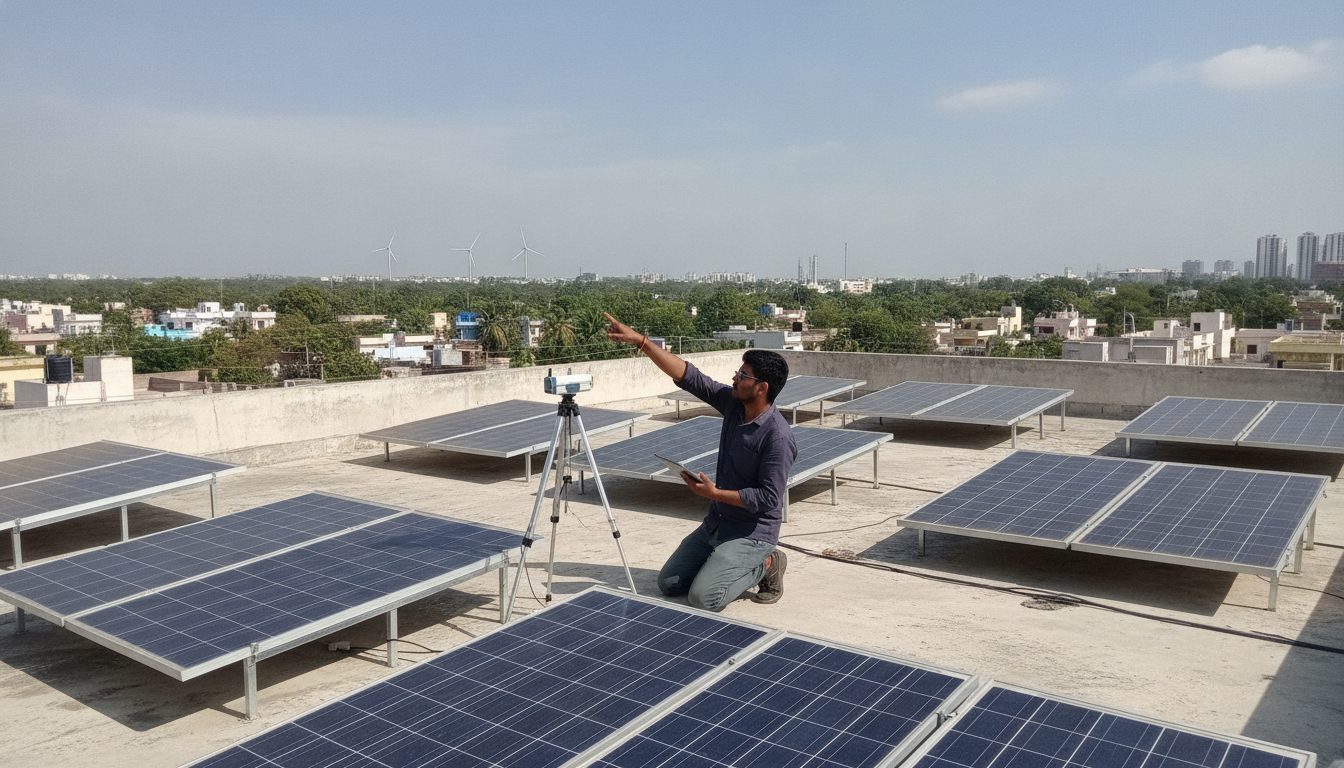
Determining Latitude and True South Orientation
Maximizing lifetime energy yield requires precise alignment based on geographic latitude. For installations across India, positioning panels to face true South ensures they intercept direct sunlight effectively throughout the day. Magnetic compass readings need correction for local magnetic declination to find true South accurately. Homeowners planning their layouts often start by checking available space with a solar roof area calculator to ensure proper panel placement.
The baseline solar panel tilt angle india corresponds closely to the local latitude of the installation site. Regions closer to the equator require a flatter mounting posture, while locations further north need steeper angles to capture low-angled winter sun.
Not sure what size you need? Our free solar calculator works out system size, cost after subsidy and payback from your monthly electricity bill.
Fixed Mounting Structures Versus Seasonal Adjustments
Fixed mounting structures offer structural simplicity and lower initial installation costs. They lock panels at a compromise angle that functions reasonably well across all twelve months. However, adjusting the tilt angle manually twice a year helps capture more energy as the sun shifts position between solstices.
Technicians usually recommend steeper angles during winter months and flatter positions during summer months. While manual seasonal adjustments require labor and physical access to the roof, they improve annual generation metrics compared to a static fixed mount.
Climatic Zones and Generation Metrics
India spans diverse climatic zones, ranging from arid western deserts to humid coastal belts and northern plains. Each region receives varying levels of global horizontal irradiation and diffuse radiation. Technicians must factor in local weather patterns when setting the tilt angle to prevent dust accumulation or wind load damage.
Higher tilt angles help self-cleaning mechanisms during rain showers by allowing water to wash away dust more efficiently. Dust accumulation reduces photovoltaic output over time, making correct inclination vital for maintaining projected generation metrics and long-term financial returns.
Impact on Annual Generation and Financial Returns
Energy yield directly influences the financial performance of a rooftop photovoltaic system. Optimal alignment ensures maximum kilowatt-hours produced per kilowatt installed, which shortens the payback period. Poor orientation reduces daily generation, lowering overall savings on utility bills.
Evaluating overall project feasibility involves looking at generation metrics alongside capital expenses. Homeowners can use a solar ROI and payback period calculator to understand how improved energy generation translates into monetary savings over the system lifespan.
🌟 Ready to Go Solar? Get 3 Free Quotes
Connect with verified, MNRE-empanelled solar installers near you — free, no obligation.
Get Free Solar Quotes →