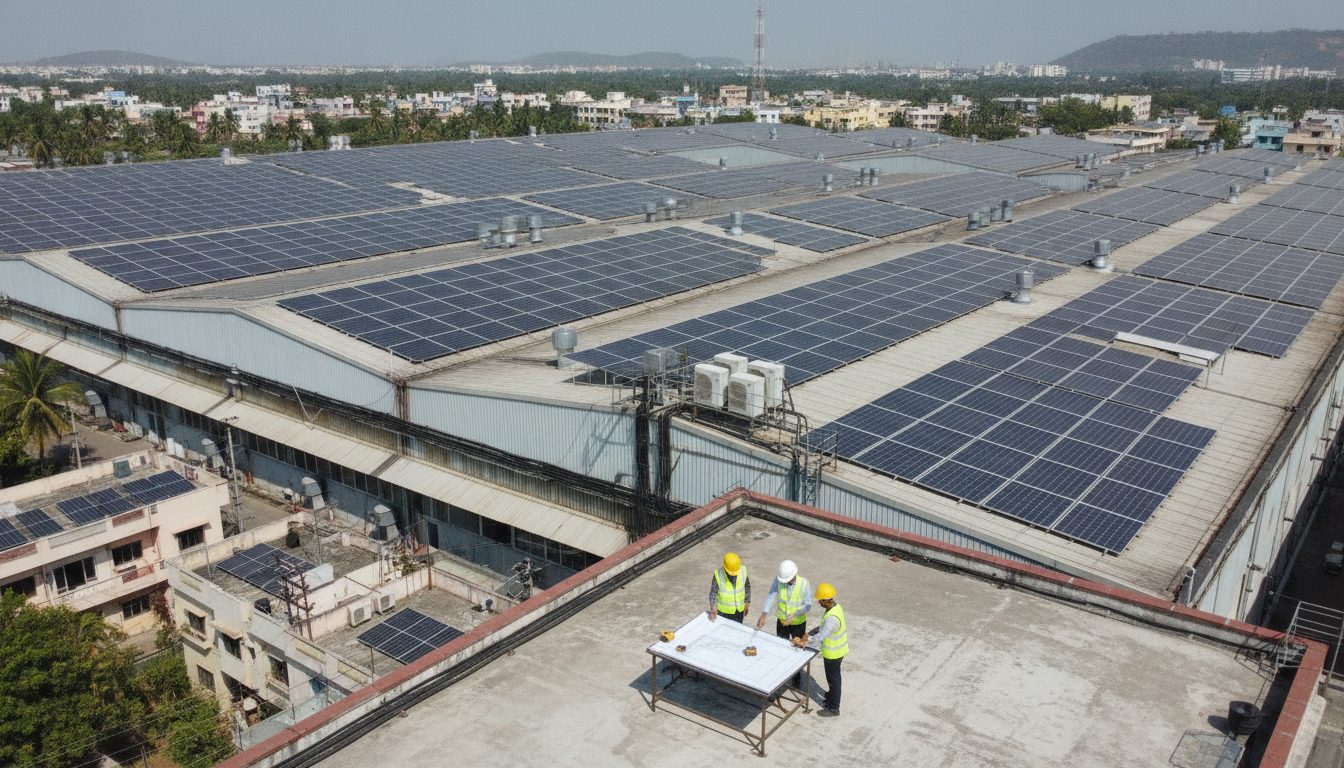
Sanctioned Load Versus Connected Load in Industrial Plants
A precise commercial solar load calculation factory assessment begins with understanding the gap between sanctioned load and connected load. Sanctioned load is the maximum power limit permitted by the electricity board under your contract. Connected load is the sum total of the wattage of all machinery, lighting, and auxiliary equipment installed in the facility.
Industrial and commercial buyers often miscalculate sanctioned load versus connected load, leading to penalties or oversized systems. If your connected load exceeds your sanctioned load without proper authorization, utilities levy heavy penalties. Conversely, sizing a solar plant based solely on a bloated connected load without checking the sanctioned limit will result in an oversized system that generates excess power you cannot feed back or utilize efficiently under local grid rules.
Not sure what size you need? Our free solar calculator works out system size, cost after subsidy and payback from your monthly electricity bill.
Analyzing Electricity Bills and Peak Demand Charges
Your monthly utility bills contain the raw data required for proper system sizing. Look closely at energy consumption measured in kilowatt-hours and peak demand recorded in kilovolt-amperes. Peak demand charges form a major portion of industrial electricity overheads because utilities charge heavily for the highest 15-minute or 30-minute demand spike during the billing cycle.
Industrial facilities can significantly lower these overheads by matching solar generation curves with peak operating hours. Reviewing historical billing data also helps determine whether you have enough physical space to host the array, which you can verify using a solar roof area calculator to check shadow-free square footage before ordering equipment.
Managing HT and LT Line Constraints
Factories receive power through either Low Tension or High Tension lines depending on their sanctioned capacity. LT supplies generally cater to smaller setups, while HT supplies handle larger industrial loads at higher voltages. Integrating a rooftop solar plant requires strict adherence to grid interconnection codes set by the local distribution company.
HT and LT line constraints dictate the maximum capacity you can interconnect at the transformer level without triggering mandatory network upgrades. Failing to account for these technical thresholds results in grid approval rejections. Consult your discom guidelines early in the planning phase to identify transformer capacity limits and protection relay requirements.
Step-by-Step Math for Sizing a 100kW Rooftop System
Designing a 100kW rooftop solar plant requires a systematic mathematical approach based on standard generation assumptions in Indian climatic conditions. A 100kW system typically generates an average of 400 to 450 units of electricity daily, assuming roughly four to four and a half productive generation hours per day.
| Parameter | Value |
|---|---|
| Target Capacity | 100 kW |
| Average Daily Generation | 400 - 450 kWh |
| Approximate Roof Area Required | 8,000 - 10,000 sq ft |
| Estimated Annual Output | 1,46,000 kWh |
To implement load shifting strategies effectively, match high-draw manufacturing processes to the peak solar generation window between late morning and mid-afternoon. Running heavy motors, compressors, or heating units during these hours directly displaces grid power, reduces peak demand charges, and maximizes financial returns on your capital expenditure.
🌟 Ready to Go Solar? Get 3 Free Quotes
Connect with verified, MNRE-empanelled solar installers near you — free, no obligation.
Get Free Solar Quotes →