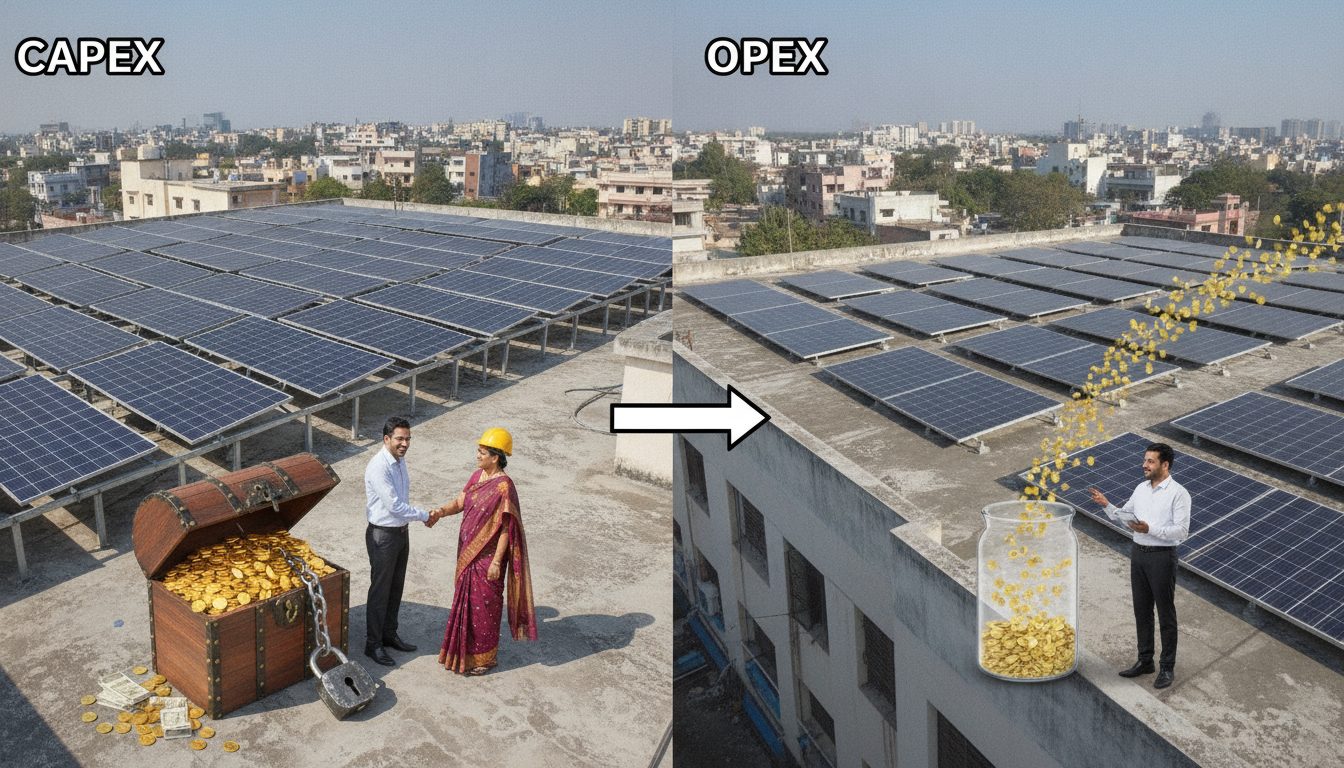
Understanding the Commercial Solar Financing Choice
C&I businesses across India are adopting solar to mitigate rising grid tariffs exceeding Rs. 9-12 per unit. Evaluating the commercial solar capex vs opex model india helps companies align their clean energy strategy with financial priorities. While CAPEX offers maximum long-term savings and accelerated depreciation benefits, OPEX requires zero upfront capital expenditure. Analyzing tax implications, cash flow impacts, and risk allocations helps commercial buyers choose the ideal structure.
You can evaluate your potential savings using our solar ROI and payback period calculator before committing funds.
Not sure what size you need? Our free solar calculator works out system size, cost after subsidy and payback from your monthly electricity bill.
The CAPEX Model: Maximum Ownership and Tax Benefits
Under the CAPEX model, the business purchases and owns the solar power plant entirely. This requires significant upfront capital expenditure from the company balance sheet or through commercial debt financing.
The primary advantage of this structure is long-term operational savings. Once the initial investment is recovered, the electricity generated is practically free aside from minimal maintenance costs. Businesses also benefit from accelerated depreciation provisions under Indian tax laws, which lower overall taxable income during the initial years of operation.
The OPEX Model: Zero Upfront Cost and Third-Party Ownership
The OPEX model, also known as the Third-Party or RESCO model, shifts ownership entirely to an external energy developer. The developer installs, operates, and maintains the solar installation on your roof at no initial cost to your business.
Instead of paying for the equipment, your company signs a power purchase agreement to buy the generated electricity at a predetermined tariff rate per unit. This tariff is typically lower than grid rates exceeding Rs. 9-12 per unit, providing immediate operational savings without draining working capital or requiring internal technical expertise for maintenance.
Comparing Tax Implications and Risk Allocation
Financial structures dictate who bears operational and regulatory risks. The table below outlines how responsibilities and benefits are divided between the two approaches.
| Parameter | CAPEX Model | OPEX Model |
|---|---|---|
| Upfront Cost | High (Internal funds or debt) | Zero (Funded by developer) |
| Equipment Ownership | Business owner | Third-party developer |
| Maintenance & Repairs | Managed internally or via AMC | Managed entirely by developer |
| Tax & Depreciation Benefits | Claimed by business owner | Claimed by developer |
Risk allocation is another deciding factor. In a CAPEX setup, equipment performance and generation drops are managed by your team. In an OPEX setup, the developer guarantees generation thresholds and assumes performance risks.
🌟 Ready to Go Solar? Get 3 Free Quotes
Connect with verified, MNRE-empanelled solar installers near you — free, no obligation.
Get Free Solar Quotes →