Understanding Group Captive Solar and Open Access
Commercial and industrial electricity consumers with high connected loads above 1MW can significantly reduce power purchase costs through open access and group captive models. By utilizing transmission lines owned by distribution companies or state transmission utilities, factories and large manufacturing units can source solar power directly from remote generation sites rather than relying solely on local grid tariffs.
Factory operators looking to evaluate their overall energy expenses before committing to open access can analyze baseline costs using the solar bill simulator and tariff calculator to compare current utility bills against projected solar procurement costs.
Navigating Regulatory Charges and Tariffs
Open access procurement involves distinct regulatory fees set by state electricity regulatory commissions. Buyers must account for state-wise wheeling charges for using transmission wires, cross-subsidy surcharges paid to discoms, and banking regulations that govern how excess solar generation is stored and adjusted against consumption.
These variable charges differ significantly across states. Buyers need to review applicable open access regulations carefully because additional fees can alter the financial viability of off-site solar procurement.
Financial Comparison Framework: Rooftop versus Off-Site Solar
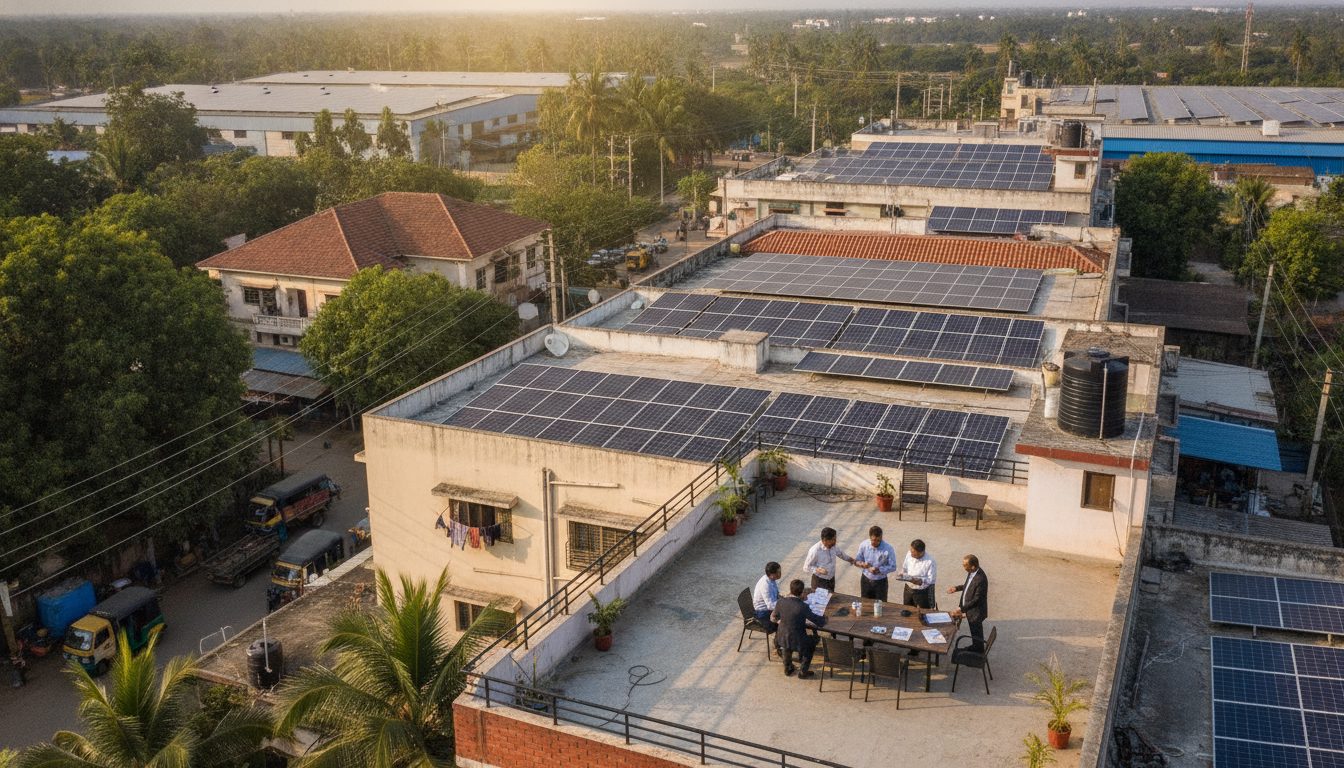
Factory owners face a distinct choice between installing on-site rooftop solar or purchasing shares in an off-site group captive solar farm. On-site rooftop systems typically avoid wheeling and transmission charges entirely, but they remain constrained by available roof space and structural load limits.
To determine whether available physical space is sufficient for an on-site system before exploring off-site open access, facility managers can use the roof area required for solar panels calculator to map out generation potential.
| Parameter | Rooftop Solar | Group Captive Open Access |
|---|---|---|
| Connected Load Requirement | Depends on roof size, no strict minimum | Generally requires above 1MW |
| Location | On-site factory roof or premises | Off-site utility-scale solar park |
| Regulatory Fees | Minimal wheeling charges in most states | Subject to wheeling charges, cross-subsidy surcharges, and banking fees |
| Capacity Scale | Limited by available shadow-free area | High capacity scaling based on equity share |
🌟 Ready to Go Solar? Get 3 Free Quotes
Connect with verified, MNRE-empanelled solar installers near you — free, no obligation.
Get Free Solar Quotes →