
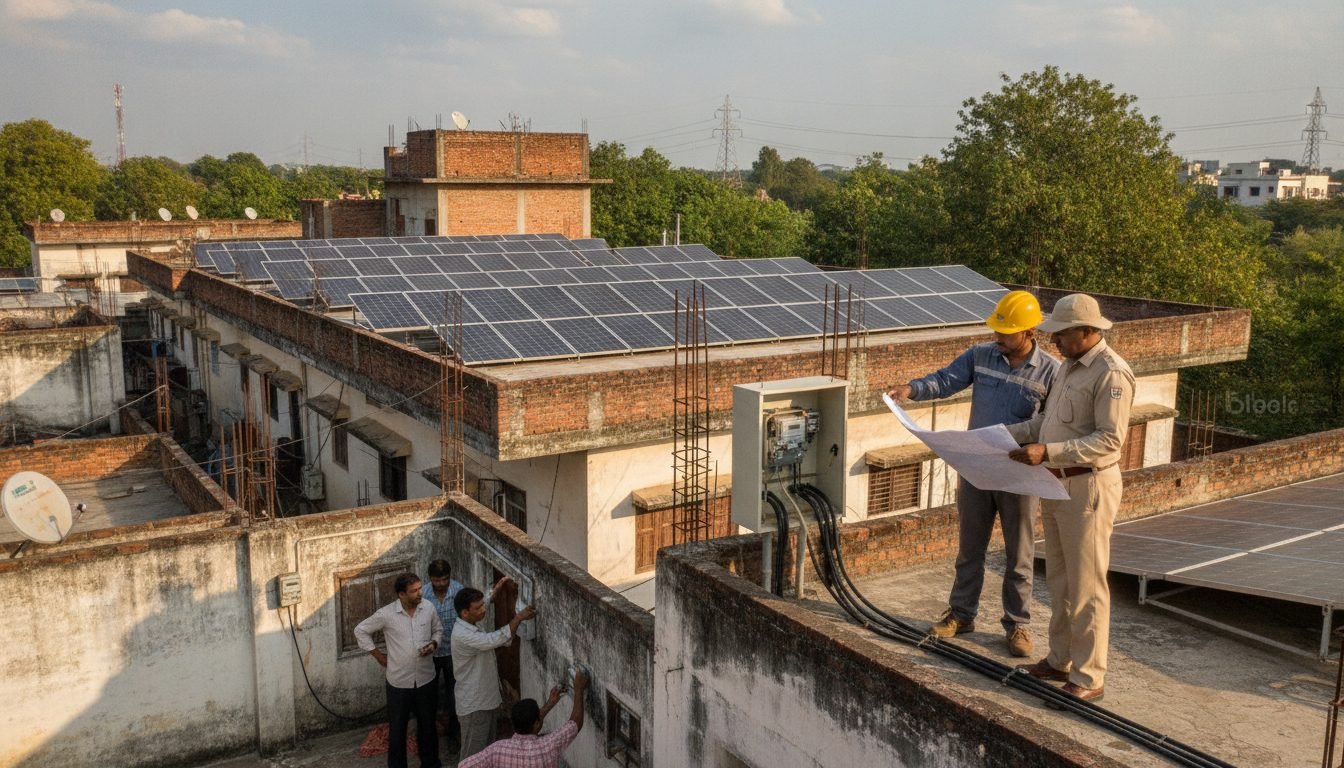
Navigating Commercial Solar Grid Interconnection in India
Installing a commercial rooftop solar plant on a factory, warehouse, office building, or commercial complex is only half the battle. To monetize surplus solar energy and legally connect your solar plant to the public power grid, commercial buyers must complete the official DISCOM Net Metering Approval Process.
In 2026, state electricity distribution companies (DISCOMs) across India have digitized net-metering approvals through unified online portals. Here is the complete step-by-step roadmap to securing grid connectivity without regulatory delays.
30-Second Quick Takeaways
Key milestone steps for commercial net metering approval
- Step 1: Grid Feasibility Clearance: Commercial buyers must file an online application on their state DISCOM portal (e.g. MSEDCL, UPPCL, BESCOM) to verify local 11kV/33kV transformer capacity (transformer loading limit <= 80%–100%).
- Step 2: Technical Sanction & Work Order: Upon grid feasibility approval, the DISCOM issues a Technical Feasibility Letter, allowing your empaneled EPC vendor to commence physical installation.
- Step 3: CEIG Approval (>10kW): Installations exceeding 10kW require Chief Electrical Inspector to Government (CEIG) site inspection and safety clearance for earthing, surge protection, and lightning arresters.
- Step 4: Meter Testing & Synchronization: The DISCOM tests and installs a Class 0.5s bi-directional smart meter, executes the Net Metering Agreement, and synchronizes your solar plant to the grid.
Step-by-Step DISCOM Net Metering Approval Workflow
Grid Feasibility Application Filing
Submit an online application on your DISCOM's renewable portal along with electricity bill copies, roof ownership documents, and proposed solar DC capacity (kWp). DISCOM engineers verify transformer loading limits.
Issuance of Technical Feasibility Letter (TFL)
Upon verifying that transformer capacity is under 80%–100% threshold, the DISCOM issues a formal TFL valid for 180 days, authorizing plant erection.
CEIG Electrical Safety Inspection (>10kW)
For systems >10kW or HT connections (11kV/33kV), the Chief Electrical Inspector to Government (CEIG) conducts a physical site audit inspecting earthing pits, lightning protection, and AC/DC isolation breakers.
Bi-Directional Smart Meter Testing & Installation
The Class 0.5s bi-directional smart meter is NABL-lab tested, programmed with TOD billing parameters, installed at the commercial boundary, and synchronized with DISCOM net-metering software.
Required Documents Checklist for Commercial Net Metering
| Document Name | Issued By | Purpose |
|---|---|---|
| Electricity Bill & Paid Receipt | State DISCOM | Verifies sanctioned load & tariff category |
| Single Line Diagram (SLD) | Certified Solar EPC / Electrical Engineer | Details solar DC array, inverter & AC protection |
| Inverter Type Test Certificate | NABL Accredited Lab / CEA Approved | Verifies anti-islanding & total harmonic distortion (THD < 3%) |
| CEIG Safety Approval Certificate | State Electrical Inspectorate | Mandatory safety clearance for >10kW plants |
| Bi-Directional Meter Test Report | DISCOM / NABL Meter Testing Lab | Calibrates active/reactive export-import accuracy |
⚡ Calculate Your 2026 Solar Savings & Subsidy
Select your monthly electricity bill to calculate the ideal system capacity, PM Surya Ghar subsidy, and lifetime savings:
📲 Join 25,000+ Solar Homeowners in India
Get instant answers on PM Surya Ghar subsidies, net-metering status, and installer quotes.
Frequently Asked Questions (FAQs)