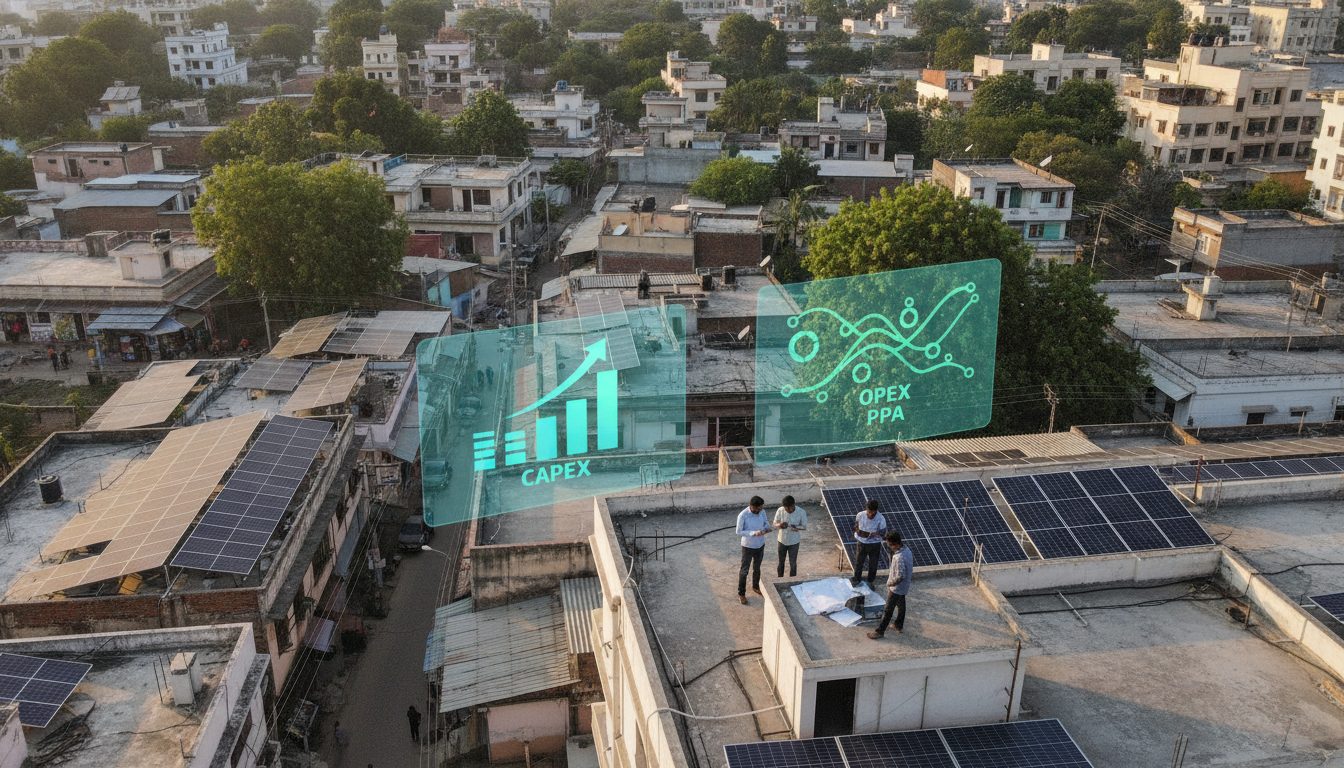
Understanding the Commercial Rooftop Solar Opex Model PPA
Adopting a commercial rooftop solar opex model ppa allows business and warehouse owners to install solar panels without paying any upfront capital costs. Under this Zero-Capex RESCO framework, a third-party developer installs, operates, and maintains the solar plant on your roof. You simply sign a Power Purchase Agreement agreeing to buy the generated electricity at a predetermined tariff per unit over a long-term contract span, which typically reaches up to 25 years. This approach removes the financial barrier of outright ownership while still providing immediate reductions in electricity expenses.
Property owners evaluating spatial requirements can utilize a solar roof area calculator to determine if their available square footage meets the threshold for commercial installations. The developer retains system ownership throughout the contract, meaning they absorb the equipment costs while you pay strictly for the power consumed on-site.
Want to see what this means for your roof? Use our free solar calculator for India to estimate system size, cost after the ₹78,000 subsidy and payback period.
Financial Comparison: Capex Versus Opex Models
Traditional outright ownership requires the property owner to fund the entire system purchase and installation upfront. While this route maximizes long-term electricity savings per unit after the system is fully paid off, it demands substantial capital allocation and places the burden of maintenance and repairs directly on the business. Depreciation benefits and tax savings remain with the buyer in a Capex setup.
Conversely, the Opex model shifts all financial and operational responsibility to the developer. You do not claim tax depreciation, but you also avoid capital expenditure entirely. Tariff savings per unit are locked in through the agreement, often featuring predetermined escalation clauses that increase the per-unit rate by a small, fixed percentage annually. This predictable structure helps businesses forecast operational expenditures accurately over the multi-decade lifespan of the project.
Contract Obligations and Performance Guarantees over 25 Years
Entering a long-term PPA or RESCO contract involves specific legal and operational commitments for commercial property owners. You must provide uninterrupted access to the roof for maintenance, ensure structural integrity, and commit to purchasing a minimum amount of solar energy or paying a deemed generation fee if your facility shuts down operations.
In return, developers back their installations with performance guarantees. These guarantees outline minimum energy generation thresholds per year, accounting for standard panel degradation over time. If the system underperforms due to equipment failure or poor maintenance by the developer, penalties or compensation terms typically apply as outlined in the initial contract. Reviewing these obligations carefully ensures that both parties maintain aligned expectations across the entire 25-year operational window.
🌟 Ready to Go Solar? Get 3 Free Quotes
Connect with verified, MNRE-empanelled solar installers near you — free, no obligation.
Get Free Solar Quotes →