
Choosing the Right Inverter Architecture for Commercial Solar
The solar inverter is the heart of any commercial photovoltaic power plant, converting direct current (DC) generated by solar modules into high-quality grid-synchronized alternating current (AC). For commercial and industrial (C&I) projects ranging from 100kW to 5MW, engineering teams face a crucial architectural choice: Multi-MPPT String Inverters vs Central Inverters.
30-Second Quick Takeaways
Technical comparison of string vs central inverters
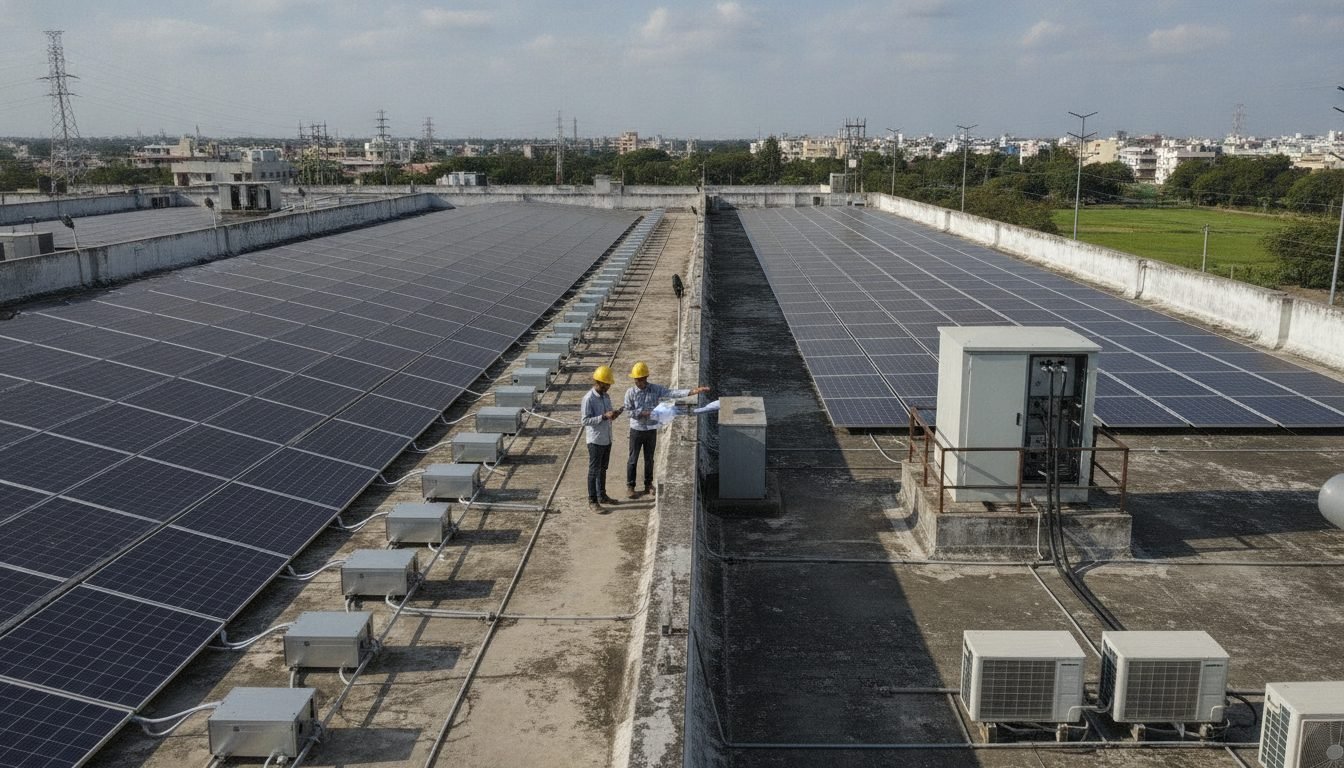
- String Inverters Dominating C&I: High-capacity 100kW–125kW multi-MPPT string inverters have become the dominant choice for rooftop commercial factories (50kW to 3MW) due to modular redundancy and granular MPPT tracking.
- Central Inverters for Ground-Mount: Central inverters (1MW to 3.125MW containerized stations) remain economical for large utility ground-mounted solar parks exceeding 5MW with uniform terrain.
- Granular Shading Management: String inverters featuring 6 to 12 independent MPPT trackers minimize generation losses caused by chimney shadows, rooftop HVAC units, or dust accumulation.
- O&M Redundancy: If a single string inverter fails, 90%+ of the factory solar plant keeps generating. Replacing a string inverter takes under 2 hours, whereas central inverter repairs require specialized factory engineers.
Technical Comparison: String Inverters vs Central Inverters
| Feature | Multi-MPPT String Inverters (50kW–125kW) | Central Inverters (1MW–3.125MW) |
|---|---|---|
| Ideal Project Application | Factory Rooftops, Commercial Buildings, Complex Roofs | Utility-Scale Ground-Mounted Solar Parks |
| MPPT Granular Trackers | High (6 to 12 independent MPPTs per inverter) | Low (1 to 2 MPPTs for the entire MW block) |
| Impact of Local Shading | Minimal (Only affects specific isolated string) | High (Shading on one array reduces entire block output) |
| Plant Downtime Risk | Near Zero (Failing 100kW string = 95% plant keeps running) | High (Inverter failure stops 100% of 1MW–3MW generation) |
| Replacement & Maintenance | Rapid modular replacement (< 2 hours by local team) | Requires specialized manufacturer engineer on-site |
| DC Cabling Losses | Lower (AC runs long distances, DC stays on roof) | Higher (Long heavy DC cable runs to central house) |
Thermal Derating Performance at 45°C Ambient Temperature
In hot Indian industrial belts (Rajasthan, Gujarat, Maharashtra, Delhi-NCR), summer ambient temperatures frequently touch 45°C. String inverters equipped with IP66 smart forced-air cooling maintain 100% active power output without thermal derating up to 45°C–50°C, ensuring maximum peak generation during summer noon hours.
⚡ Calculate Your 2026 Solar Savings & Subsidy
Select your monthly electricity bill to calculate the ideal system capacity, PM Surya Ghar subsidy, and lifetime savings:
📲 Join 25,000+ Solar Homeowners in India
Get instant answers on PM Surya Ghar subsidies, net-metering status, and installer quotes.
Frequently Asked Questions (FAQs)