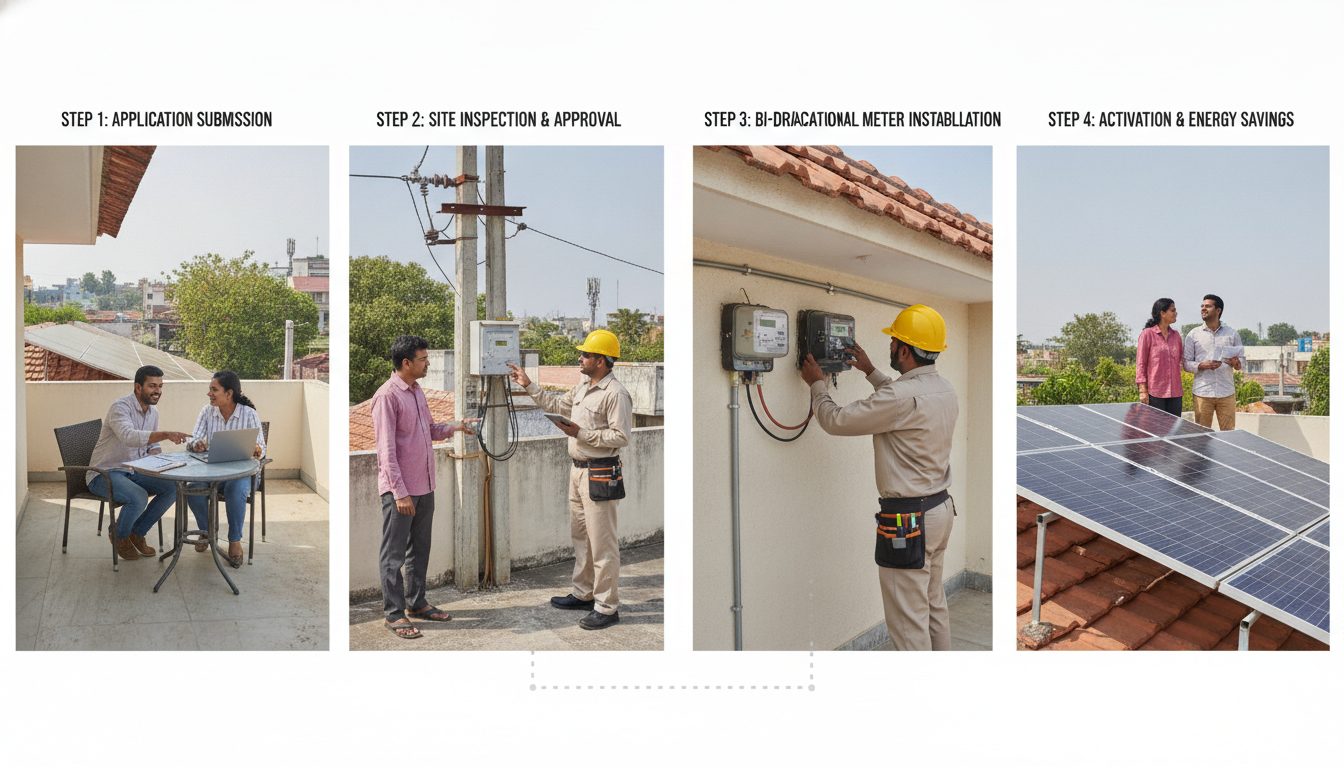
Understanding the DISCOM Net Metering Application Process
Transitioning a residential rooftop solar system to the grid requires strict adherence to state electricity board guidelines. The discom net metering application process is the formal procedure that allows homeowners to export surplus electricity back to the grid and receive credit on their monthly bills. Before submitting paperwork, you can check your estimated system generation and financial returns by using the solar system cost and savings calculator.
Every state electricity distribution company operates its own online portal for solar applications. Homeowners or their authorized solar vendors must register on the portal, fill out consumer details, and upload property ownership documents along with the latest electricity bill.
To check the numbers for your own home, try the solar calculator — enter your electricity bill and get system size, subsidy and payback in seconds.
Technical Documentation and Feasibility Approval
Once you submit the online form, the DISCOM reviews your proposed solar plant capacity against local distribution transformer limits. This stage results in the issuance of a Feasibility Certificate or Feasibility Approval. The primary documents required during this technical review include:
- A detailed single-line diagram (SLD) signed by a licensed electrical contractor
- Manufacturer test certificates and compliance reports for the solar inverter
- Equipment specifications for the bi-directional meter and solar panels
- Identity proof and property tax receipts or ownership proof
If your roof layout requires precise measurement before finalizing plant capacity, you can evaluate your available space with the solar roof area calculator to ensure proper alignment with DISCOM guidelines.
Safety Inspections and Bi-Directional Meter Installation
After receiving feasibility approval and completing the physical installation of your solar panels and inverter, the system undergoes a safety inspection. An authorized electrical inspector or DISCOM official checks earthing standards, wiring integrity, and anti-islanding protection on the inverter.
Following a successful inspection, the DISCOM replaces your existing single-direction energy meter with a certified bi-directional meter. This meter records both imported power consumed from the grid and exported solar units generated by your rooftop plant.
Timelines and Final Meter Commissioning
The entire procedure from initial application submission to final net meter commissioning typically takes between 15 to 45 days, depending on local DISCOM processing speeds and inspection schedules. Delays usually stem from incomplete single-line diagrams or documentation mismatches.
Once the bi-directional meter is activated and sealed by the utility official, your net metering arrangement goes live. Your monthly electricity bill will then reflect net consumption units, calculated by subtracting exported solar energy from grid power imported during the billing cycle.
🌟 Ready to Go Solar? Get 3 Free Quotes
Connect with verified, MNRE-empanelled solar installers near you — free, no obligation.
Get Free Solar Quotes →