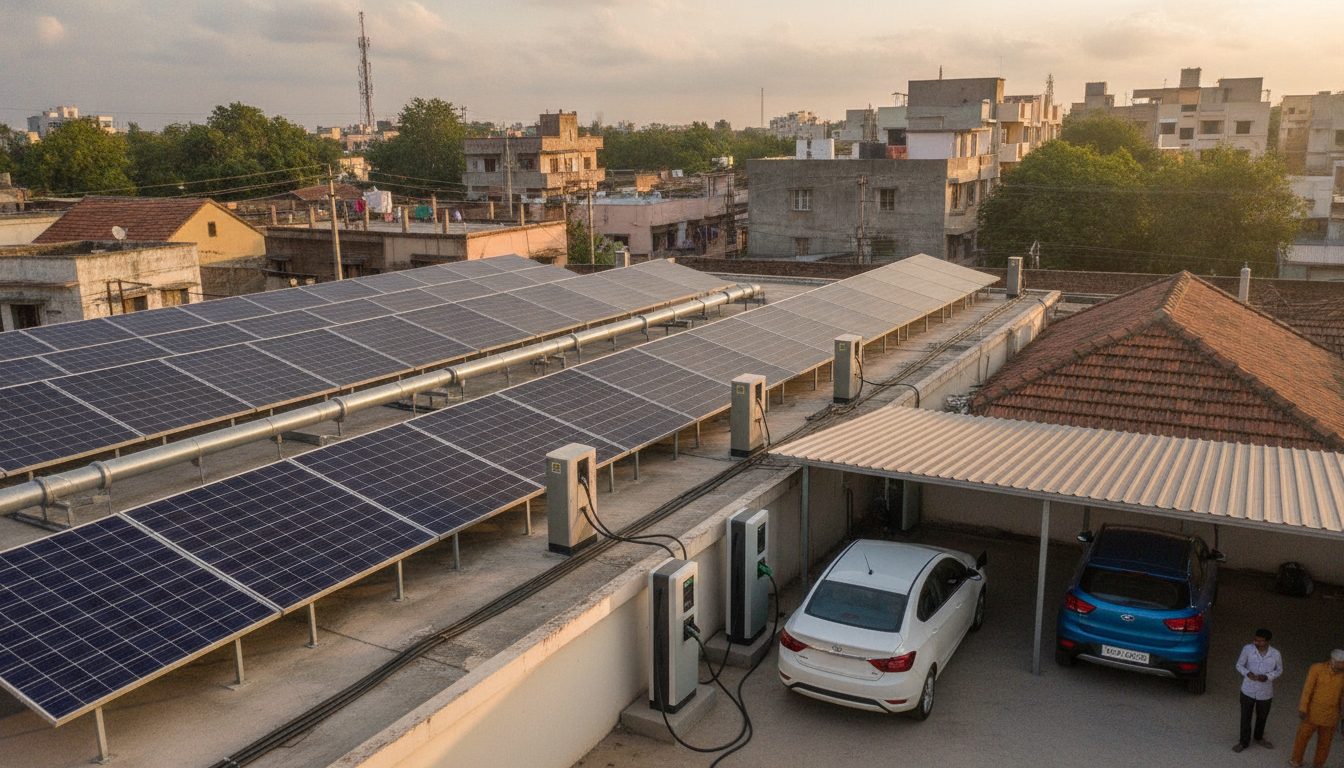
Understanding Solar EV Charging Station Integration in India
Executing a solar EV charging station integration India project requires a clear approach to matching your generation capacity with vehicle demand. Commercial and residential property owners looking to capitalize on the EV boom must address the unique electrical loads created by simultaneous vehicle charging and facility operations. Pairing photovoltaic arrays directly with charging infrastructure helps offset grid power consumption during peak sunlight hours. Before purchasing equipment, use the solar for EV charging calculator to estimate your setup requirements based on daily driving patterns and fleet sizes.
To check the numbers for your own home, try the solar calculator — enter your electricity bill and get system size, subsidy and payback in seconds.
Load Balancing and Time-of-Day Tariff Optimization
High-capacity vehicle chargers draw significant current, which can trigger heavy demand charges from local electricity boards if managed poorly. Commercial DISCOMs often enforce time-of-day (ToD) tariffs that penalize grid usage during evening peak hours. Solar generation naturally peaks during midday, creating a temporal mismatch with fleets that charge overnight or during early evening hours. Managing this profile requires strategic load shifting and monitoring tools to ensure facility consumption stays within sanctioned load limits.
Battery Storage Necessities for Peak Demand Management
Relying solely on direct solar generation leaves charging stations vulnerable to intermittency and high evening utility rates. Battery energy storage systems store excess midday solar generation for discharge during high-tariff periods or night hours when fleet vehicles return to base. This buffer prevents sudden spikes in grid demand and protects operators from costly DISCOM penalties. Property owners can evaluate overall financial viability by reviewing the solar ROI and payback period calculator to account for storage capital expenses.
Sizing Equations for Solar Generation and EV Fleets
Accurate sizing ensures your photovoltaic system can support daily vehicle energy consumption without overbuilding. The core sizing equation matches total daily kilowatt-hour demand from vehicles against daily solar yield, factoring in system losses and temperature derating. Fleet managers calculate daily vehicle energy needs by multiplying the average state-of-charge replenishment by battery capacity across all active vehicles. Solar yield is determined by multiplying system capacity in kilowatts by peak sun hours and performance ratio.
🌟 Ready to Go Solar? Get 3 Free Quotes
Connect with verified, MNRE-empanelled solar installers near you — free, no obligation.
Get Free Solar Quotes →