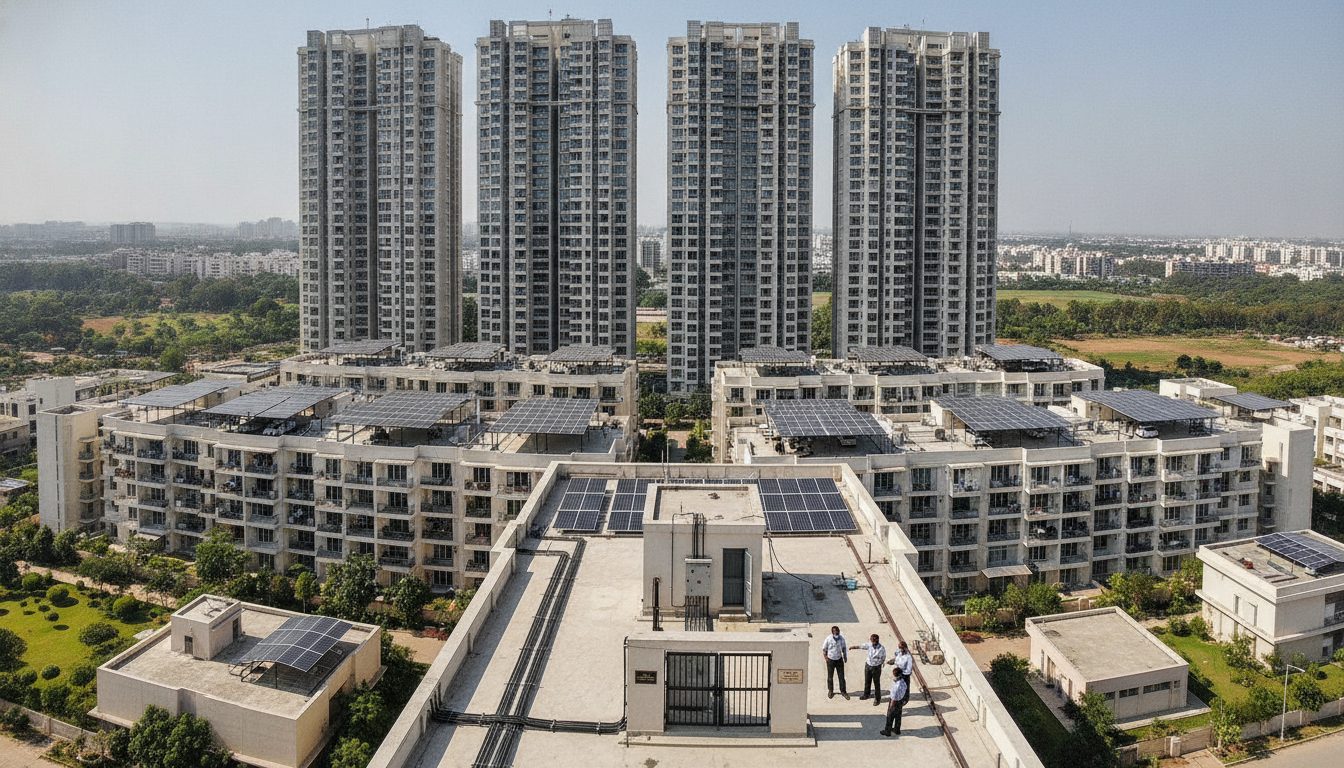
Understanding Group Housing Society Rooftop Solar Net Metering
Implementing group housing society rooftop solar net metering India requires Resident Welfare Associations to manage multi-apartment net metering frameworks and common-load energy sharing guidelines. The system offsets the high electricity consumption of shared amenities like water pumps, corridor lighting, and lifts. Before installation, RWAs must map out total common load requirements and check local discom regulations regarding group captive or society-level billing setups. You can estimate your space requirements beforehand using a solar roof area calculator to see how much usable flat roof space is available.
Structural Load Calculations and Fire Safety Clearances
High-rise flat roofs require careful engineering before solar panels are mounted. A certified structural engineer must assess whether the roof can bear the dead weight of the mounting structures, ballasts, and panels. Fire safety clearances are equally strict in multi-story residential complexes. Clearance pathways must be maintained between panel arrays for fire tender movement and emergency access. Local municipal bylaws dictate the exact distance required from parapet walls and lightning arresters to ensure full compliance.
Statutory Approvals and RWA Documentation
Passing an RWA resolution is the first administrative step for a society solar project. The managing committee must collect consent from flat owners as per the society bylaws before applying for discom feasibility approval. The discom reviews the existing transformer capacity and grid connection parameters to ensure the society feeder can handle the proposed solar injection. Following technical clearance, the installation proceeds under a registered vendor who handles discom inspections and final net meter commissioning.
Financial Breakdown and Common Area Bill Offsets
Common area electricity bills form a major recurring expense for apartment maintenance funds. Solar generation directly powers daytime loads such as water pumping and basement ventilation, which lowers grid draw during peak tariff hours. Excess generation feeds back into the grid under the net metering agreement, generating credits that reduce the net payable amount on the common utility bill. You can evaluate the financial returns and expected recovery timelines with a solar ROI and payback period calculator designed for shared properties.
🌟 Ready to Go Solar? Get 3 Free Quotes
Connect with verified, MNRE-empanelled solar installers near you — free, no obligation.
Get Free Solar Quotes →