Understanding Group Net Metering for Apartments
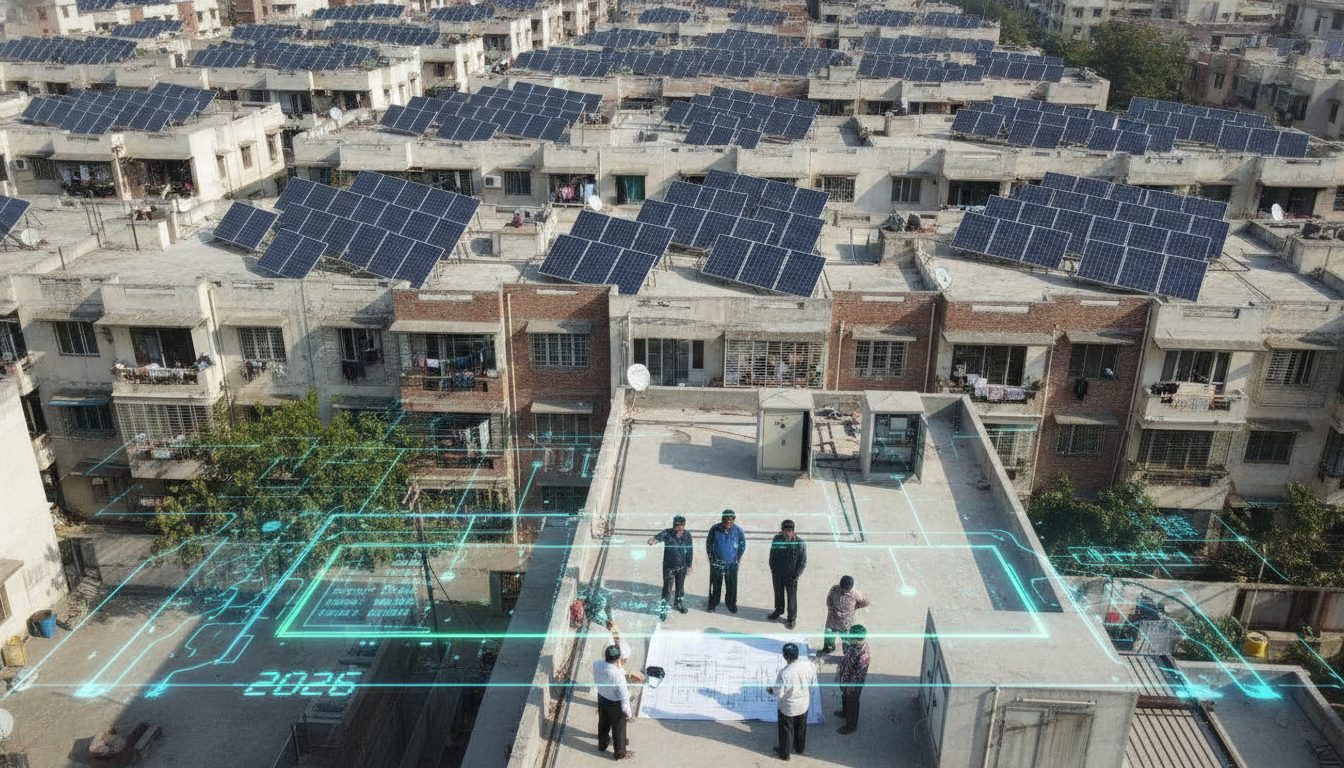
Group Net Metering (GNM) and Virtual Net Metering (VNM) policies are rolling out across multiple Indian states for Cooperative Housing Societies (CHSs). Adopting apartment group net metering solar India setups allows large residential complexes to offset energy consumption across both individual flats and shared amenities using a single rooftop solar array. Managing committees must first audit existing bills to understand how these policies apply to their specific distribution company guidelines.
Before planning installation capacities, committees need to determine the physical rooftop space available. Using a solar roof area calculator helps verify whether the society has adequate shade-free square footage to support the target generation capacity.
Want to see what this means for your roof? Use our free solar calculator for India to estimate system size, cost after the ₹78,000 subsidy and payback period.
Assessing Sanctioned Load and Consumption Profiles
The sanctioned load determines the maximum electrical capacity a housing society can draw from the grid at any given time. Managing committees must compile two distinct types of consumption data: common area usage and flat-wise usage. Common area loads include lifts, water pumps, corridor lighting, and security gates. Flat-wise consumption is captured via individual meters across all residential units.
DISCOMs require a detailed breakdown of these loads to sanction large-scale rooftop arrays under GNM frameworks. Committees should list every connected appliance load to match the official electricity bills issued by the utility provider.
Navigating DISCOM Approvals and Technical Feasibility
Submitting an application for group net metering requires formal technical feasibility studies conducted by the local electricity board. The DISCOM evaluates whether existing transformers and distribution lines can handle export from a large society rooftop. Managing committees coordinate this paperwork alongside registered installers who handle line diagrams and safety compliance documents.
Approval timelines vary by state utility, but maintaining accurate sanctioned load records prevents delays during the grid connectivity inspection phase.
🌟 Ready to Go Solar? Get 3 Free Quotes
Connect with verified, MNRE-empanelled solar installers near you — free, no obligation.
Get Free Solar Quotes →