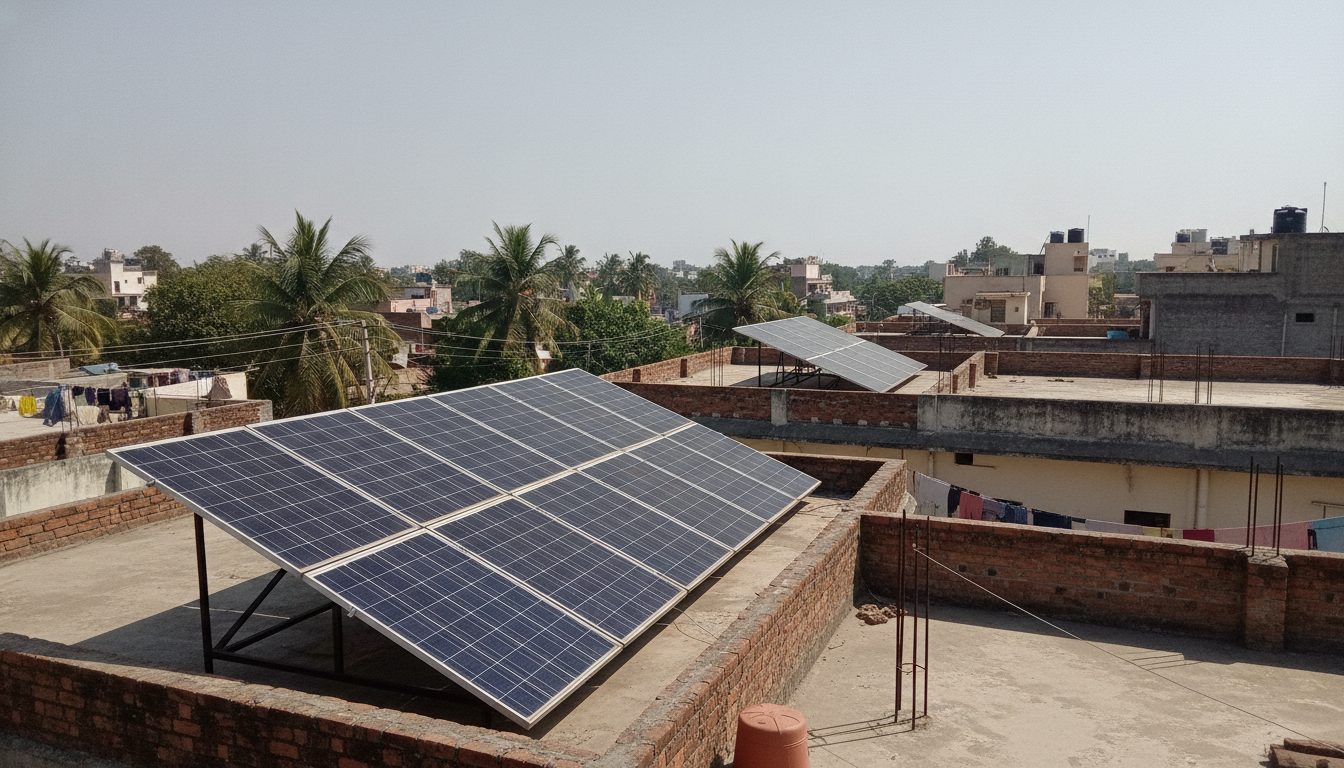
Why Latitude Dictates Your Solar Panel Tilt Angle
The tilt angle of your rooftop solar panels depends primarily on the latitude of your installation site. For most locations in India, panels should face South to maximize annual generation. The general rule sets the tilt angle equal to the local latitude. For instance, New Delhi requires about 28 degrees, Mumbai needs about 19 degrees, and Chennai requires about 13 degrees. Before final placement, homeowners can verify available space using a solar roof area calculator to ensure proper layout.
Fixed tilt installations remain the standard choice for residential roofs across the country. While homeowners can adjust panel angles seasonally to increase annual generation by 8-10 percent, fixed mounting provides a reliable, low-maintenance setup for daily energy needs.
Want to see what this means for your roof? Use our free solar calculator for India to estimate system size, cost after the ₹78,000 subsidy and payback period.
Expected Generation and Financial Returns
A typical 1kW rooftop solar system generates roughly 90 to 120 units of electricity per month in India. Larger setups scale accordingly, with a 3kW system producing roughly 270 to 360 units per month. Residential grid tariffs across Indian states typically range between ₹6 and ₹9 per unit.
Homeowners can offset setup costs through government support. The PM Surya Ghar Muft Bijli Yojana subsidy provides financial assistance of ₹30,000 for a 1kW system, ₹60,000 for a 2kW system, and ₹78,000 for a 3kW system and above as a maximum payout. You can estimate your net expenses and overall savings using our main solar system cost, savings, and subsidy calculator to plan your budget.
Hardware Warranties and Grid Connectivity
Solar panels come with standard industry protections. They carry a 25-year performance warranty that guarantees roughly 80 percent output at year 25, alongside a 10 to 12 year product warranty against manufacturing defects.
Grid-connected systems require net metering, which is available in all major states under MNRE guidelines established in 2022. Homeowners apply for net metering through their designated solar installer or local electricity DISCOM as part of the installation process.
🌟 Ready to Go Solar? Get 3 Free Quotes
Connect with verified, MNRE-empanelled solar installers near you — free, no obligation.
Get Free Solar Quotes →