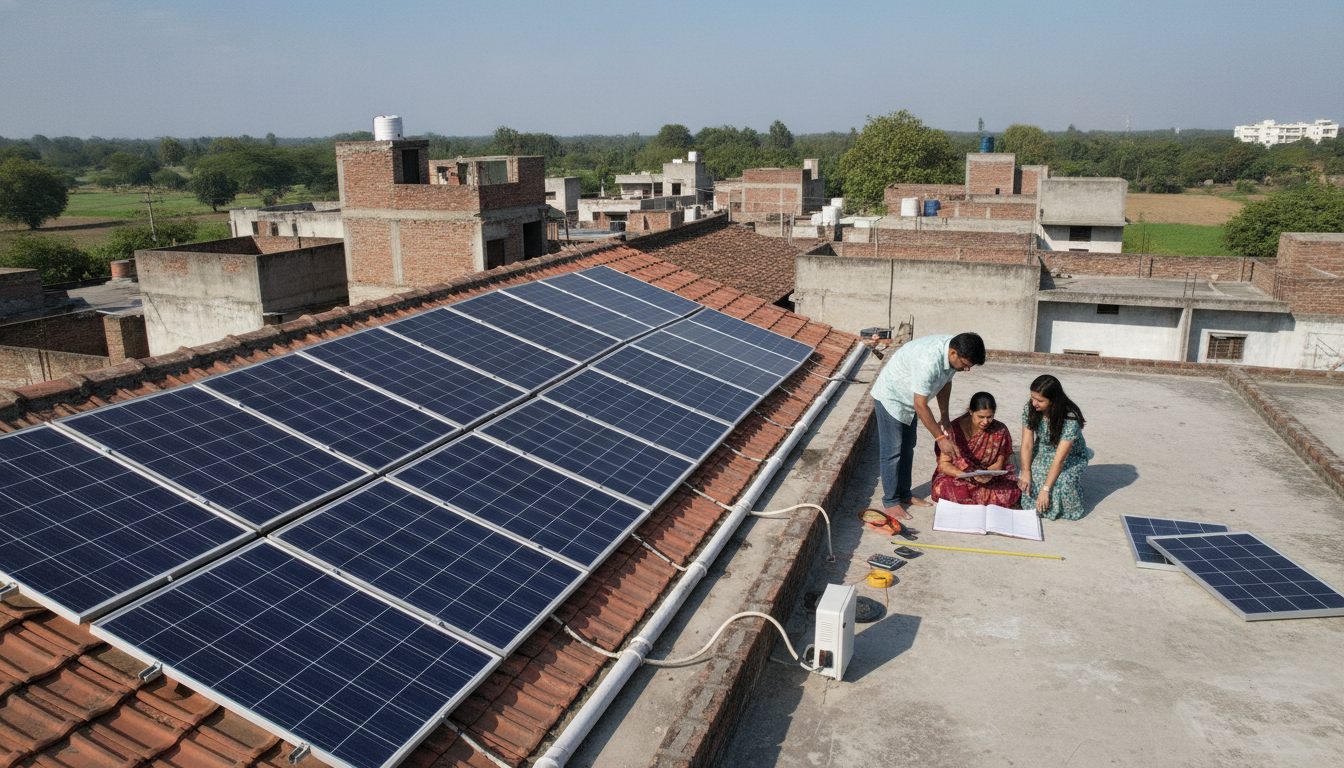
Calculating Your Required Number of Panels
Finding the exact solar setup for your home starts with your monthly electricity consumption. A helpful tool like an online how many solar panels do i need calculator simplifies this math. A 1kW rooftop solar system generates roughly 90 to 120 units per month in India, while a larger 3kW system produces about 270 to 360 units per month. Residential grid tariffs across Indian states typically range between ₹6 and ₹9 per unit.
Once you know your required system capacity in kilowatts, the calculation is straightforward. Divide the system size in kW by the individual panel wattage. For instance, using a standard 540W panel, you divide the total kW by 0.54 and round up to the next whole number. Because panels come in fixed physical sizes, rounding up ensures your system meets your actual power needs.
Panel Counts for Common System Sizes
Different household sizes require different generating capacities. The table below shows the exact number of 540W panels required for standard residential system sizes.
| System Size | Estimated Generation | Panel Count (540W) |
|---|---|---|
| 1 kW | 90 - 120 units/month | 2 panels |
| 2 kW | 180 - 240 units/month | 4 panels |
| 3 kW | 270 - 360 units/month | 6 panels |
| 5 kW | 450 - 600 units/month | 10 panels |
Selecting the right tier depends entirely on your average monthly electricity bill. Most grid-tied residential setups in India range from 1kW to 5kW depending on appliance usage and family size.
Financial Support and Subsidies
The PM Surya Ghar Muft Bijli Yojana provides direct financial assistance to reduce upfront capital costs for residential installations. The central subsidy is ₹30,000 for a 1kW system and ₹60,000 for a 2kW system. For systems sized at 3kW and above, the subsidy caps out at ₹78,000.
Homeowners can apply for net metering through their local installer or directly with the state DISCOM. Net metering is available in all major states under MNRE guidelines, allowing you to export surplus power back to the grid and adjust it against your consumption.
Hardware Warranties and Lifespan
Solar panels are long-term assets built to withstand harsh weather conditions across India. Standard industry equipment comes with a product warranty of 10 to 12 years covering manufacturing defects. Additionally, panels carry a 25-year performance warranty guaranteeing that output will not drop below roughly 80 percent by the end of the twenty-fifth year.
Routine maintenance involves basic cleaning to remove dust accumulation, ensuring your panel count continues to generate its expected monthly units without degradation caused by shading or surface grime.
🌟 Ready to Go Solar? Get 3 Free Quotes
Connect with verified, MNRE-empanelled solar installers near you — free, no obligation.
Get Free Solar Quotes →🧮 Interactive Calculator Tool
Calculate your exact solar panel requirement based on your electricity bill and roof space instantly.