 SolarCalculators
Net Metering vs Gross Metering in India (2026): Key Differences
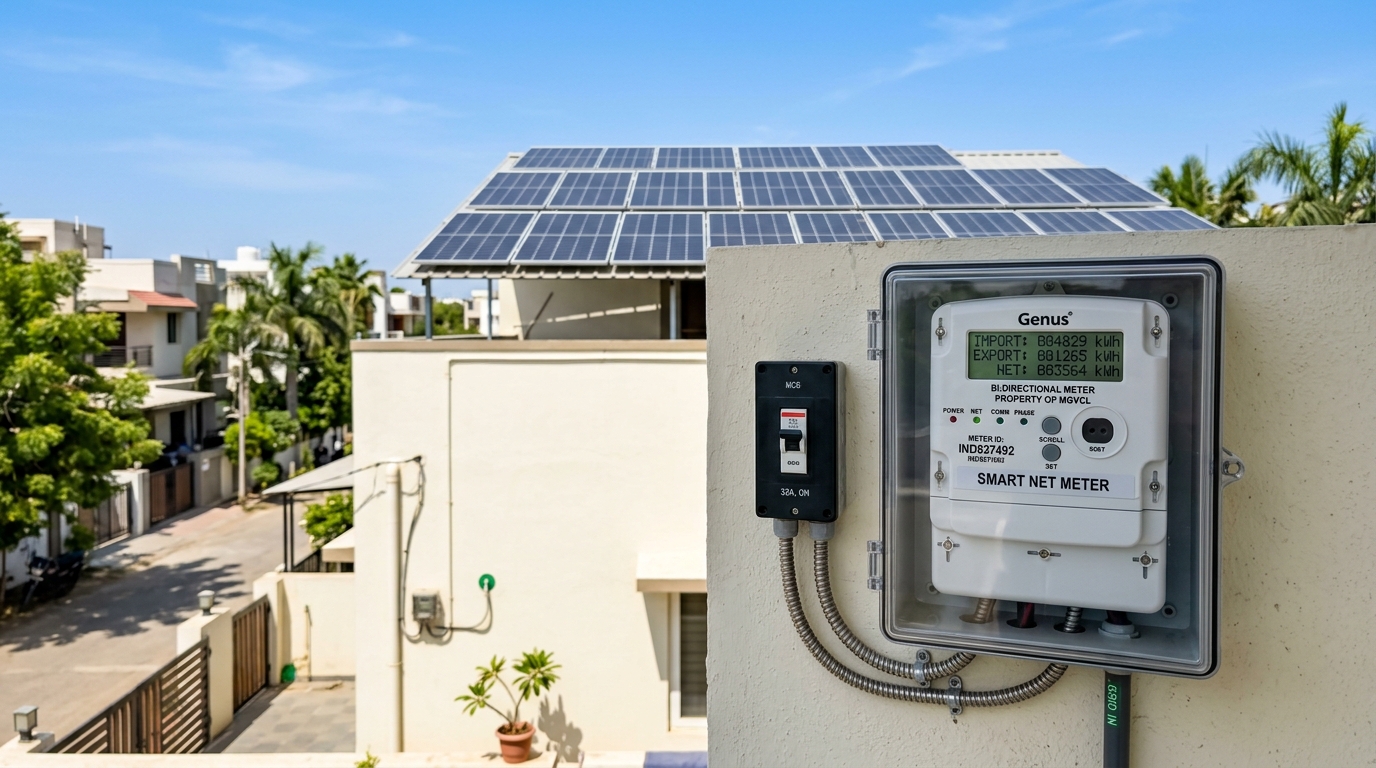
When installing a rooftop solar system in India, your choice of grid interconnection determines how much money you will actually save every month. Many prospective solar adopters believe that simply putting solar panels on the roof will cut their electricity bills to zero. However, the meter configuration assigned by your state electricity distribution company (DISCOM) is the real deciding factor.
In 2026, Indian state electricity regulatory commissions (SERCs) have refined the guidelines for Net Metering, Gross Metering, and Net Billing (Gross Feed-in). Understanding the fundamental mechanics of each billing model is critical before signing any contract with an installer.
What is Net Metering?
Net Metering uses a single bi-directional smart meter that tracks two power flows: electricity imported from the DISCOM grid and solar power exported into the grid.
- Self-Consumption: During daylight hours, your household appliances use solar electricity directly from the panels at zero transmission cost.
- Surplus Export: Any surplus power generated beyond your instantaneous load flows into the grid, turning the meter backwards or adding energy credits to your balance.
- Monthly Settlement: At billing time, your DISCOM deducts exported units from imported units. You only pay for the net energy consumed (plus fixed sanctioned load charges).
- Financial Value: Every exported kilowatt-hour (unit) offsets electricity otherwise bought at retail rates (typically ₹6.00 to ₹10.50/unit depending on your tariff slab).
Want to see what this means for your roof? Use our free solar calculator for India to estimate system size, cost after the ₹78,000 subsidy and payback period.
What is Gross Metering?
Under Gross Metering, there is no direct connection between your solar panels and your domestic load. Instead, two separate unidirectional meters are installed:
- Generation Meter: Records 100% of the electricity produced by your solar array and exports all of it into the grid.
- Consumer Meter: Records 100% of the electricity your home consumes from the grid.
The DISCOM buys all your solar power at a pre-determined, wholesale Feed-in Tariff (FiT)—which typically ranges between ₹2.25 and ₹3.50 per unit. Meanwhile, you continue buying every unit you consume from the grid at full retail prices (₹7.00 to ₹10.00+ per unit). The revenue from solar generation is simply credited as a deduction against your regular utility bill.
Head-to-Head Comparison: Net vs Gross Metering (2026)
| Parameter | Net Metering (Residential Preferred) | Gross Metering (Commercial / Utility) |
|---|---|---|
| Meter Setup | Single Bi-directional Smart Meter | Two Separate Meters (Export & Import) |
| Self Consumption | Yes, power consumed on-site first | No, 100% solar power exported to grid |
| Energy Valuation | Valued at Retail Tariff (₹6 - ₹10/kWh) | Valued at Feed-in Tariff (₹2.50 - ₹3.50/kWh) |
| Annual Payback Period | 3.0 to 4.5 Years | 6.5 to 9.0 Years |
| PM Surya Ghar Subsidy | Fully Eligible (up to ₹78,000) | Not applicable for standard rooftop subsidies |
| Capacity Limit | Typically up to 10 kW (up to 500 kW in some states) | Often mandated above 10 kW to 100 kW+ for C&I |
The Financial Impact: A Real 3 kW System Example
Consider an average 3 kW residential rooftop solar system in Maharashtra or Delhi generating approximately 360 units per month, where the homeowner consumes 400 units monthly at an average retail tariff of ₹8.00/unit.
Total consumption: 400 units. Total solar generation: 360 units.
Net billed units = 400 - 360 = 40 units.
Net electricity bill = 40 × ₹8.00 = ₹320 (+ fixed charges).
Monthly Savings: ₹2,880.
Electricity consumption charge: 400 × ₹8.00 = ₹3,200.
Solar export revenue credit: 360 × ₹2.75 = ₹990.
Final bill payable: ₹3,200 - ₹990 = ₹2,210 (+ fixed charges).
Monthly Savings: only ₹990.
In this realistic scenario, Net Metering saves nearly 3 times more money each month compared to Gross Metering, explaining why homeowners should always push for net metering approval.
State-Wise Regulations in 2026
Following the Ministry of Power's landmark Electricity (Rights of Consumers) Amendment Rules, here is where major states stand today:
- Maharashtra (MSEDCL): Net metering permitted up to 10 kW for residential; net billing / gross metering for higher industrial loads.
- Gujarat (UGVCL, PGVCL, MGVCL): Net metering standard for PM Surya Ghar consumers; high banking flexibility.
- Uttar Pradesh (UPPCL): Net metering for residential consumers up to sanctioned load; strict guidelines on annual energy settlement.
- Karnataka (BESCOM): Transitioned residential consumers up to 10 kW back to net metering to stimulate PM Surya Ghar adoption.
Conclusion: What Should You Choose?
For any residential consumer, Net Metering is without question the superior option. It drastically accelerates your return on investment and pairs seamlessly with rooftop solar subsidies.
Before applying, always confirm your sanctioned load and ensure your solar installer applies for the correct bi-directional net meter category on the national portal.