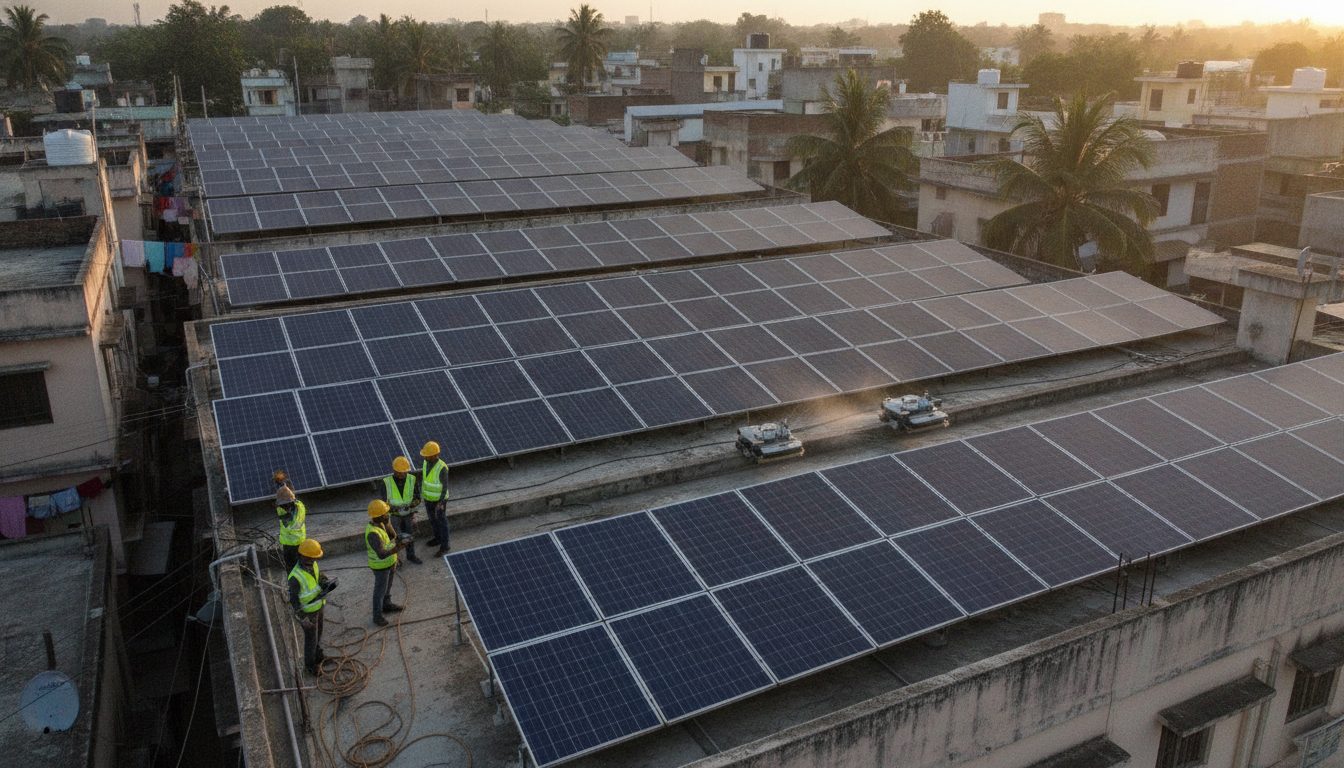
Understanding Dust Generation Losses in Indian Solar Plants
Dust accumulation in arid and industrial zones of India can cause daily generation losses exceeding 15%, directly threatening project economics. Panels operating in high-soiling regions require structured intervention beyond manual washing cycles, which often consume excessive water and create inconsistent results. Asset owners managing large commercial solar plant maintenance cleaning India must track real-time yield drops against soiling ratios to schedule interventions before revenue leakage accumulates.
Before scaling up operations, owners often evaluate preliminary layouts using a solar roof area calculator to understand spatial constraints and panel placement efficiency.
Want to see what this means for your roof? Use our free solar calculator for India to estimate system size, cost after the ₹78,000 subsidy and payback period.
Financial ROI of Robotic Dry-Cleaning Systems
Robotic dry-cleaning systems eliminate water dependencies while maintaining high panel cleanliness in water-scarce regions. These systems operate autonomously on pre-set schedules, sweeping particulate matter across strings without abrasive friction. The financial return on investment stems from eliminated manual labour costs, reduced water consumption, and consistent daily energy yields. For large commercial setups, automated dry cleaning prevents the cumulative generation decay that occurs between traditional cleaning cycles.
To evaluate how improved generation efficiency impacts overall project economics, asset managers frequently check figures using a solar ROI and payback period calculator.
Thermographic Drone Inspections for Rapid Hotspot Detection
Manual identification of micro-cracks, string failures, and module hotspots across extensive commercial roofs or ground mounts remains slow and error-prone. Thermographic drone inspections capture thermal anomalies across megawatt-scale arrays in hours instead of weeks. Detecting reverse currents, shading faults, and internal cell damage early prevents catastrophic module failures and fire risks. Maintenance teams use these thermal maps to isolate faulty panels for immediate warranty claims or replacements.
Standardizing Preventive Maintenance Schedules
Ad-hoc repairs lead to unexpected downtime and unpredictable plant performance. Standardizing preventive maintenance schedules ensures mechanical trackers, inverter stations, and DC combiners receive structured quarterly and annual checks. A documented maintenance log preserves equipment warranties and satisfies technical due diligence for lenders or insurance underwriters. Asset owners who institutionalize these schedules reduce long-term operating expenditures and secure stable energy output over the project lifetime.
🌟 Ready to Go Solar? Get 3 Free Quotes
Connect with verified, MNRE-empanelled solar installers near you — free, no obligation.
Get Free Solar Quotes →