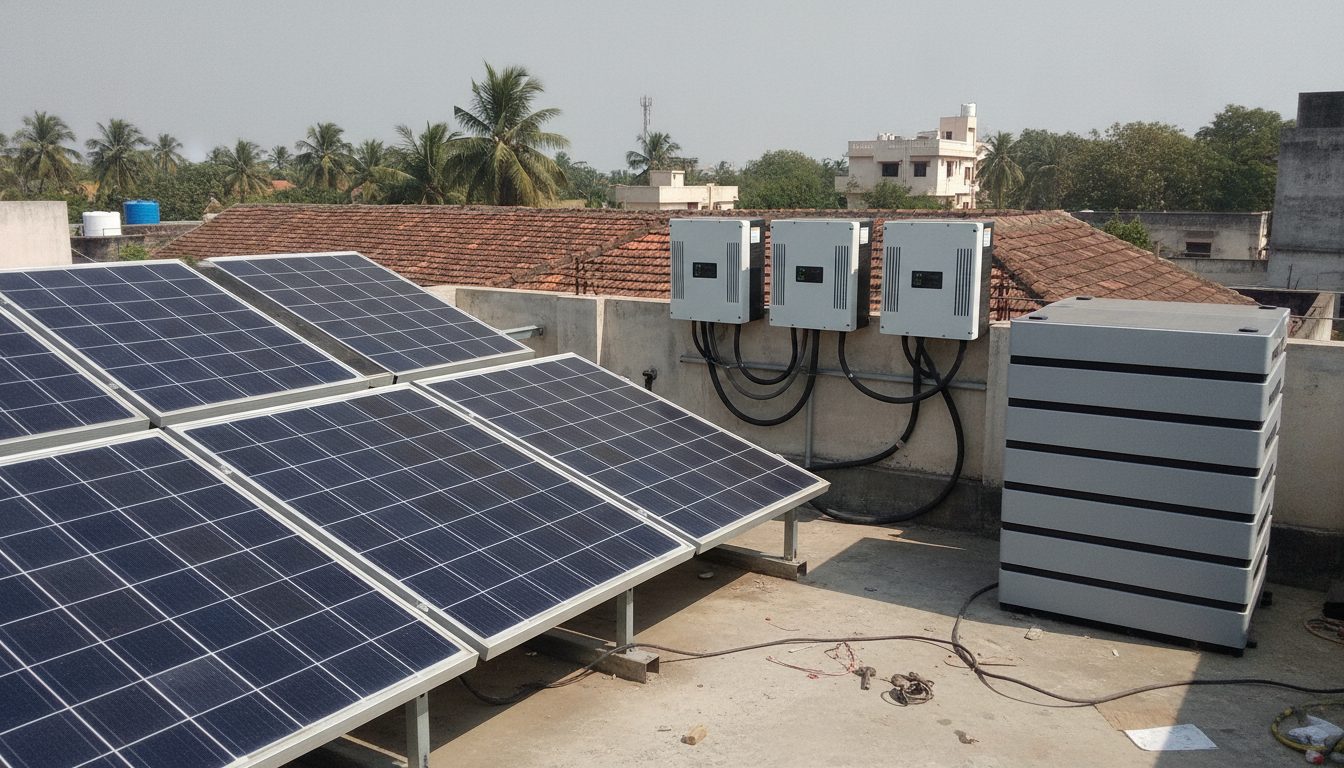
Understanding Essential Loads Versus Full-Home Backup
Residential solar battery storage sizing starts by dividing your household appliances into two distinct categories: essential loads needed during grid outages and non-essential loads reserved for normal grid availability. Essential loads typically include refrigerators, Wi-Fi routers, ceiling fans, and a select number of lights. High-draw appliances such as air conditioners, water heaters, and water pumps require careful evaluation because running them simultaneously during a power cut demands a much larger inverter capacity.
As grid reliability fluctuates and time-of-use tariffs rise across urban India, homeowners increasingly demand hybrid setups that manage both backup power and daily grid shifts. A standard residential hybrid inverter must handle the continuous surge power of inductive loads while maintaining stable voltage output. Before purchasing equipment, you can test your exact power requirements using our home inverter and battery backup size calculator to prevent under-sizing your system.
Want to see what this means for your roof? Use our free solar calculator for India to estimate system size, cost after the ₹78,000 subsidy and payback period.
Calculating Battery Capacity in Kilowatt-Hours
Battery capacity is measured in kilowatt-hours (kWh), representing the total volume of electrical energy the storage bank can hold. To compute your daily requirement, multiply the wattage of each running essential appliance by the expected hours of use during a grid outage. Sum these values to find your total daily watt-hours, and divide by one thousand to get the required usable kWh.
When evaluating storage options, the chemistry of the battery dictates how much of that total capacity you can actually use. Lithium Iron Phosphate (LFP) chemistry stands out for its high thermal stability, safety profile, and tolerance for daily cycling. Unlike older lead-acid alternatives, LFP batteries support a much deeper Depth of Discharge (DoD) without shortening their operational lifespan. A typical LFP battery allows a high DoD, meaning you can safely utilize the vast majority of its rated capacity before needing a recharge from solar panels or the grid.
Sizing Hybrid Inverters for Peak Shaving
Peak shaving involves using stored battery energy during times of day when electricity tariffs from the local distribution company reach their highest rates. To size your hybrid inverter for this function, look at the maximum continuous load you draw during peak tariff windows. The continuous power rating of the inverter, measured in kilowatts, must equal or exceed this peak demand to avoid tripping the system or switching back to expensive grid power.
Integrating solar panels with a properly sized hybrid inverter also helps offset high daytime consumption rates. To determine how many panels and how much roof space you need to keep your battery bank fully charged, check your available layout using our roof area required for solar panels calculator. Proper alignment between your generation source and storage capacity prevents energy bottlenecks.
🌟 Ready to Go Solar? Get 3 Free Quotes
Connect with verified, MNRE-empanelled solar installers near you — free, no obligation.
Get Free Solar Quotes →