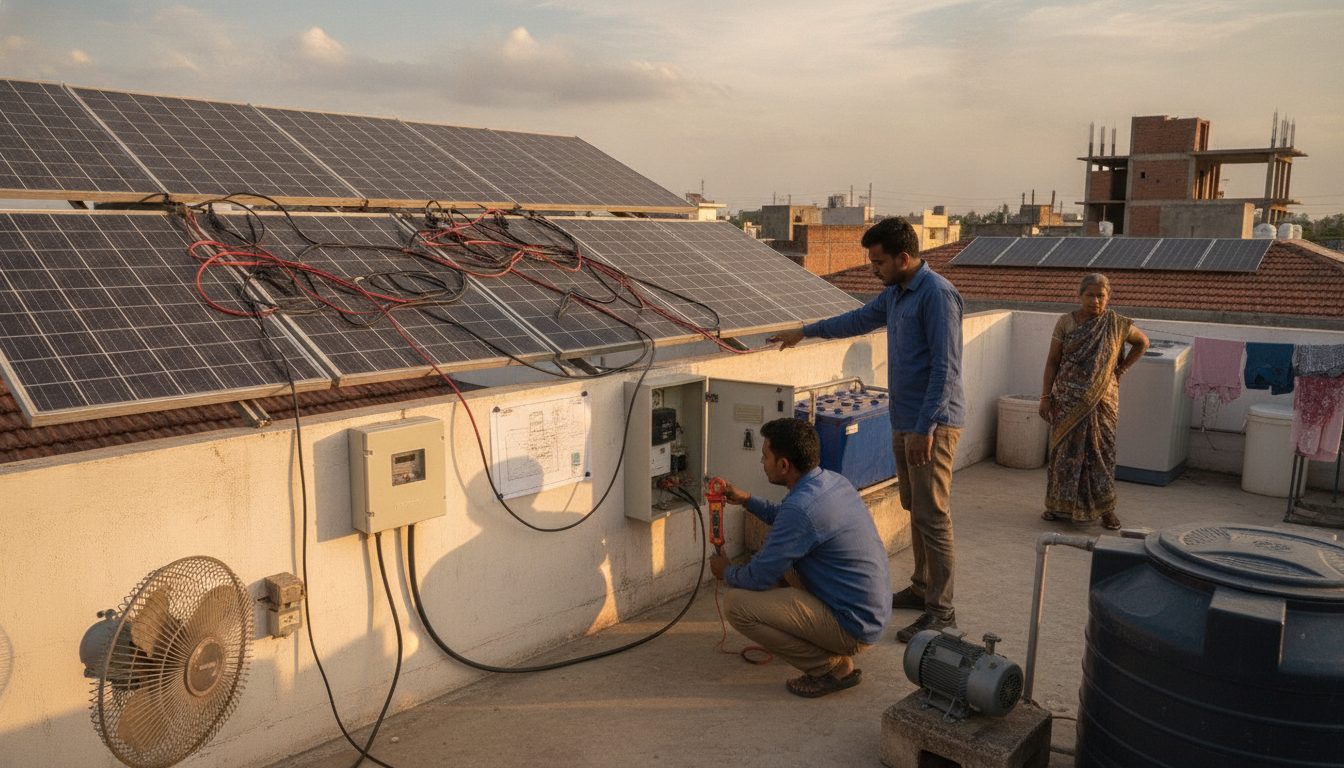
Understanding Sanctioned Load Versus Connected Load
Performing an accurate solar load calculation for home use starts with understanding the difference between your sanctioned load and your connected load. Your sanctioned load is the maximum electricity limit approved by your local DISCOM, listed directly on your monthly electricity bill. Your connected load is the actual total wattage of every electrical appliance installed in your house.
DISCOMs in India monitor these figures strictly. If your solar setup or daily power draw frequently exceeds your sanctioned limit, you may face penalties or demands to upgrade your official meter capacity. Before sizing your system, check your electricity bill to confirm your sanctioned load and review our main solar system cost, savings, and subsidy calculator to align your budget with utility rules.
Not sure what size you need? Our free solar calculator works out system size, cost after subsidy and payback from your monthly electricity bill.
Mapping Indian Household Appliance Wattage Ratings
Every appliance in your home contributes to your total energy demand. Standard Indian household appliances carry distinct wattage ratings that determine your baseline consumption. Air conditioners typically draw between 1,500 to 2,500 watts depending on their tonnage and star rating. Water pumps often require 750 to 1,500 watts, while induction cooktops demand 1,200 to 2,000 watts during operation.
List all active appliances in your household, noting their running wattage and expected daily usage hours. Refrigerators, lights, ceiling fans, and televisions add steady baseline loads throughout the day. Summing these values gives you the peak running wattage required to keep your home functioning smoothly without tripping your inverter.
Factoring EV Charging Loads into Residential Sizing
Modern residential sizing must account for future electricity consumption, particularly electric vehicle charging. Home EV chargers typically add a continuous load of 3kW to 7kW during charging cycles. If you plan to charge an electric vehicle at home, a standard 1kW or 2kW solar setup will fall short of your actual household demand.
Residential solar systems generally range from 3kW to 10kW depending on these heavy appliance and vehicle charging requirements. Sizing your inverter and panel array to handle this additional capacity prevents grid dependency and avoids DISCOM tariff penalties associated with sudden peak load spikes.
🌟 Ready to Go Solar? Get 3 Free Quotes
Connect with verified, MNRE-empanelled solar installers near you — free, no obligation.
Get Free Solar Quotes →