Understanding Urban Rooftop Shading Challenges in India
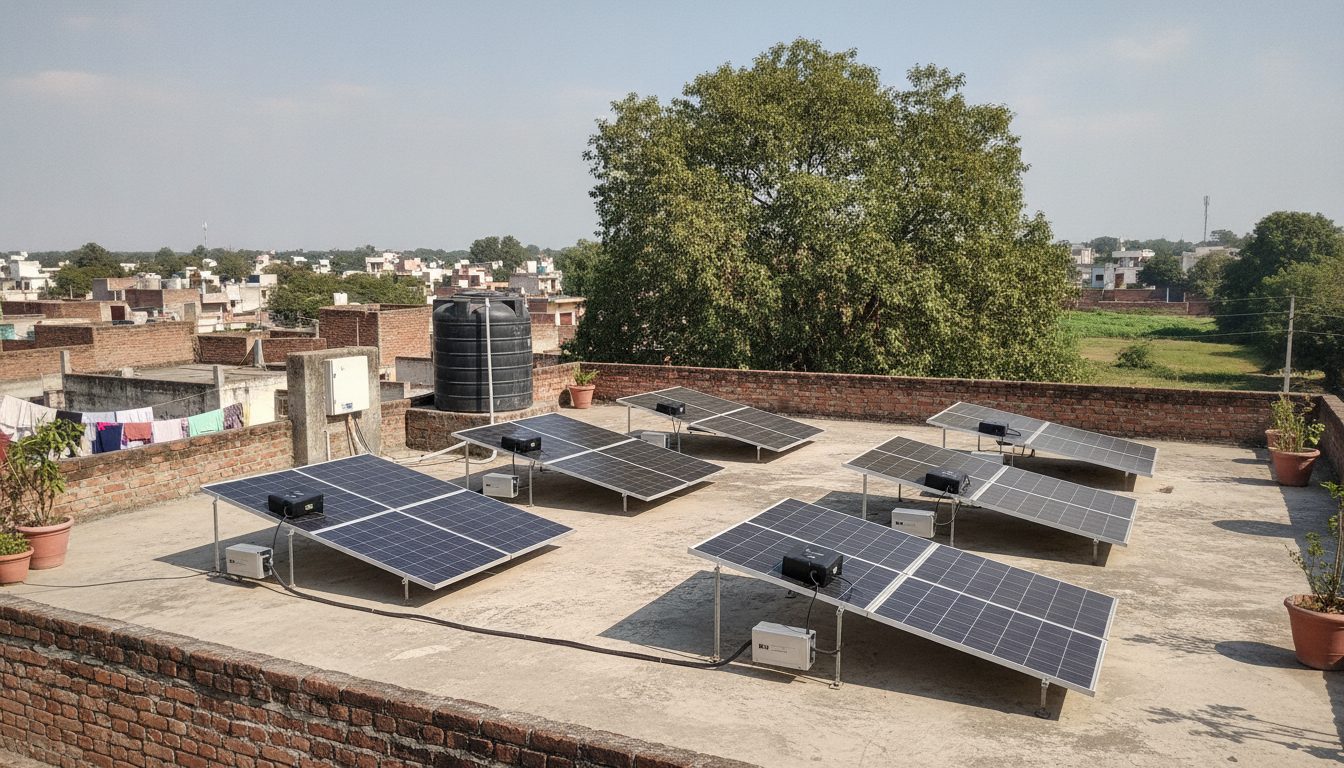
Urban Indian residential roofs face unique structural hurdles that frequently obstruct direct sunlight. Surrounding multi-story buildings, overhead water tanks, mumty structures, and high parapet walls cast moving shadows across rooftop solar arrays throughout the day. When evaluating solar microinverters vs string inverters shading India, homeowners must understand how traditional setups handle these obstructions.
In a standard string inverter configuration, all solar panels are wired together in series. This electrical design means the entire string of panels operates at the current level of the weakest, most shaded panel. Performance data shows that partial shading on just a single panel can drag down an entire string output by up to 30 percent in traditional setups. This vulnerability makes standard string inverters less efficient for urban rooftops with complex geometries.
Want to see what this means for your roof? Use our free solar calculator for India to estimate system size, cost after the ₹78,000 subsidy and payback period.
Comparing String Inverters with Module-Level Power Electronics
To counter the severe generation losses caused by shadows, the solar industry adopted module-level power electronics, commonly known as MLPE. This category includes both microinverters and DC optimizers, which operate at the individual panel level rather than the entire array level.
Microinverters convert direct current to alternating current right beneath each individual panel. If one panel falls into shadow, the remaining panels continue producing at their maximum capacity without interference. DC optimizers function similarly by conditioning the DC power at the panel level before sending it to a central string inverter. Both technologies prevent the bottleneck effect seen in traditional configurations, making them well-suited for Indian homes affected by water tanks and adjacent structures. Homeowners planning their layout can estimate their physical constraints using a solar roof area calculator to see how many panels fit away from shaded zones.
Efficiency Metrics and Payback Periods for Indian Roofs
Choosing between string inverters and MLPE involves balancing initial equipment costs against long-term energy yield. While microinverters and DC optimizers carry a higher upfront purchase price than standard string inverters, their ability to recover lost generation often alters the financial timeline.
On partially shaded residential roofs, MLPE systems capture more kilowatt-hours annually than traditional strings. This increased generation shortens the payback period, helping owners recover their capital expenditure faster despite the higher initial outlay. Calculating the exact financial return requires factoring in local electricity tariffs and consumption patterns.
🌟 Ready to Go Solar? Get 3 Free Quotes
Connect with verified, MNRE-empanelled solar installers near you — free, no obligation.
Get Free Solar Quotes →