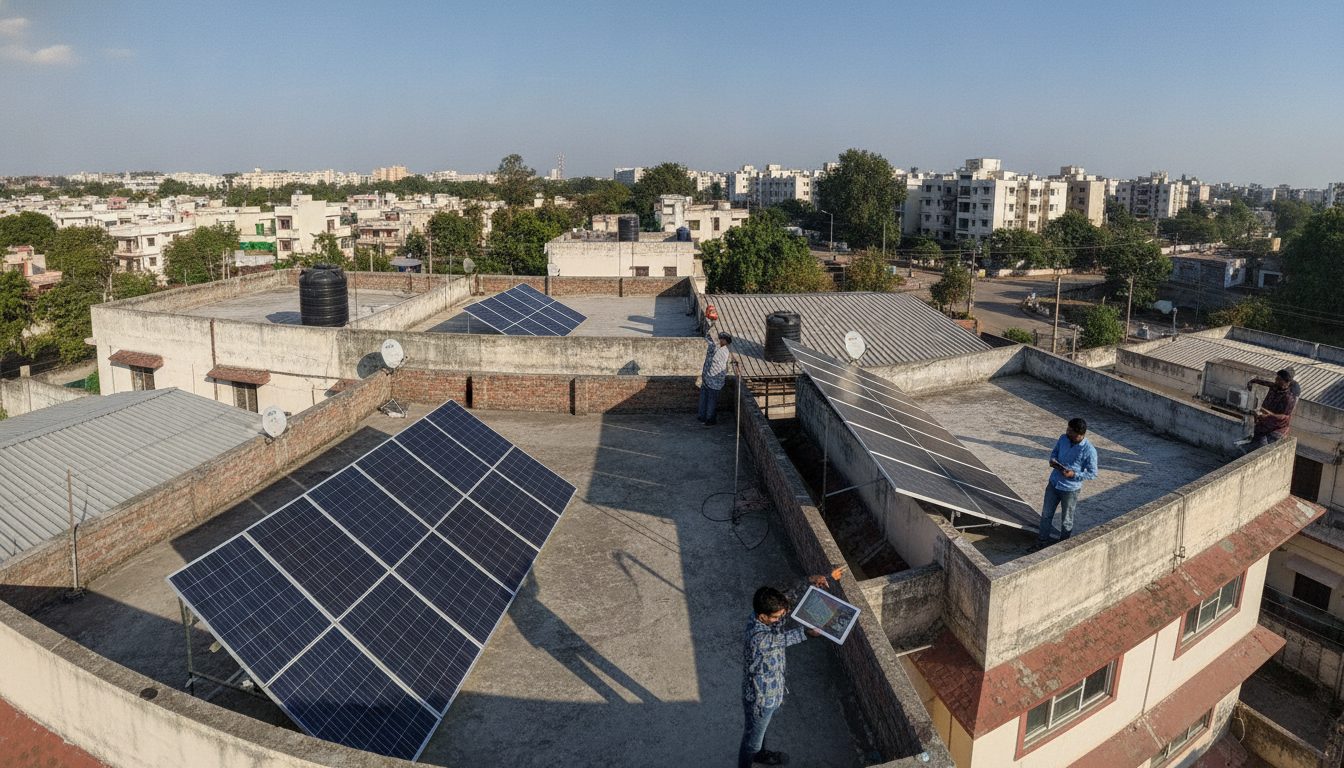
Conducting a Thorough Solar Roof Shadow Analysis
Performing an accurate solar roof shadow analysis and tilt angle india check determines the long-term output of your rooftop panels. Shading from neighboring buildings, overhead water tanks, mumty structures, and mature trees reduces power generation significantly because solar panels are wired in series. If a single panel falls under a shadow, the output of the entire string drops. Walk your roof at different hours of the day to map out moving shadows across seasons. Keep in mind that the sun sits lower in the southern sky during winter, casting longer shadows from objects located to your south and east-west than it does in summer.
Before finalizing your panel layout, check your available space by using a solar roof area calculator to ensure your unshaded zone matches your target system size.
Not sure what size you need? Our free solar calculator works out system size, cost after subsidy and payback from your monthly electricity bill.
Optimizing Tilt Angle and Orientation Across Indian Latitudes
Panel tilt and orientation dictate how much sunlight your installation captures over the course of a year. In India, panels must always face true South to capture maximum daily radiation. The ideal tilt angle generally equals the latitude of your location. For example, cities in southern India near the equator require a flatter tilt, while northern locations need a steeper angle to catch the lower winter sun.
| Region / Latitude Zone | Optimal Tilt Angle | Orientation |
|---|---|---|
| Northern India (Delhi, Jaipur ~28°N) | 28 to 30 degrees | True South |
| Central India (Bhopal, Nagpur ~23°N) | 22 to 24 degrees | True South |
| Southern India (Bengaluru, Chennai ~12°N) | 12 to 15 degrees | True South |
Mitigating Partial Shading with Microinverters and String Optimizers
Unavoidable obstacles like overhead power lines, service pipes, or adjacent stairwells often create partial shade on residential roofs. Traditional string inverters treat all connected panels as a single unit, meaning a shadow on one panel drags down the performance of the entire array. Microinverters and string optimizers solve this problem by operating at the individual panel level. If debris or a shadow blocks one panel, the remaining panels continue to operate at their maximum capacity without performance loss.
For homeowners planning a complete setup with energy storage, balancing panel placement with proper inverter sizing is essential. You can estimate your overall financial returns using our main solar system calculator to see how shading mitigation affects your payback timeline.
🌟 Ready to Go Solar? Get 3 Free Quotes
Connect with verified, MNRE-empanelled solar installers near you — free, no obligation.
Get Free Solar Quotes →