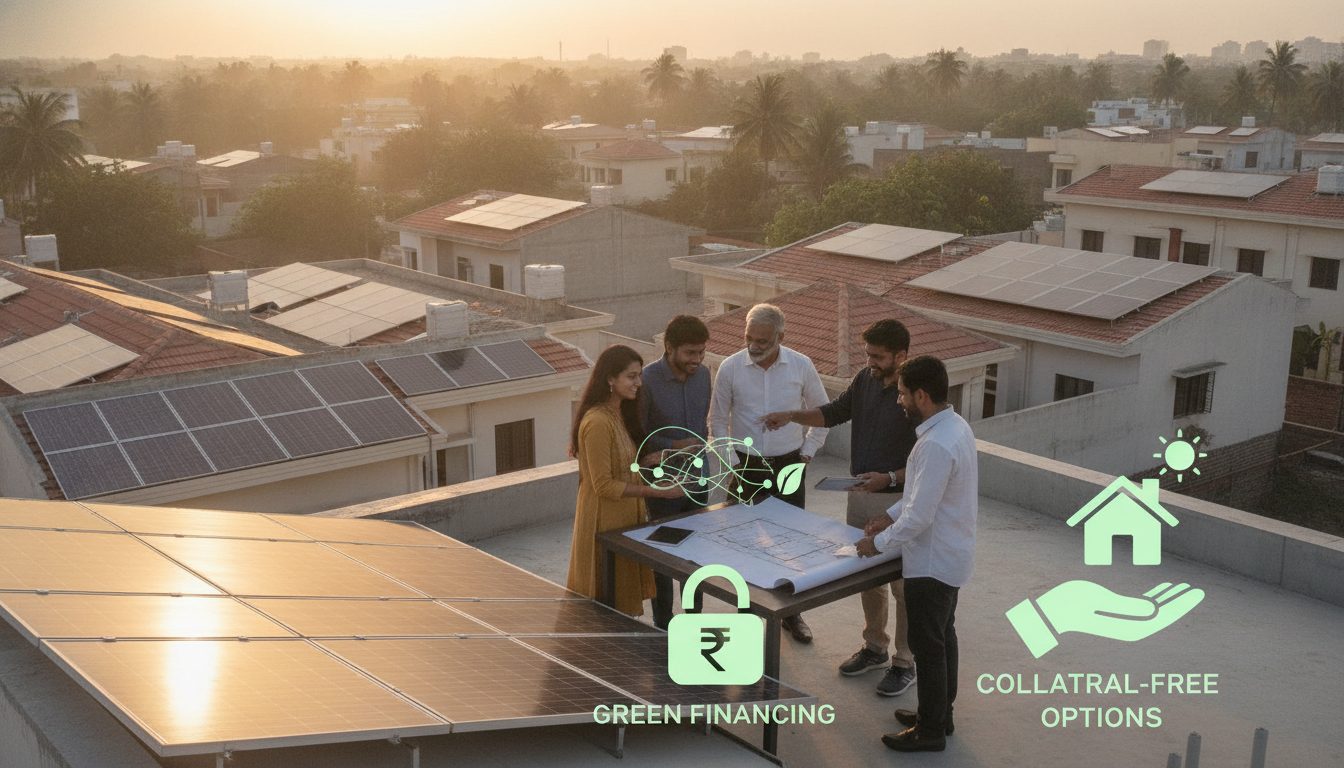
Understanding Green Financing Schemes in India
Adopting rooftop solar systems often requires capital expenditure that can be managed through structured green financing. Major public sector lenders, including the State Bank of India (SBI) and Punjab National Bank (PNB), offer dedicated credit lines for renewable energy adoption. These offerings fall under priority sector lending guidelines, which aim to encourage sustainable infrastructure development across residential and commercial properties.
Borrowers evaluating these facilities should assess how their financing plans align with overall system expenses. You can check expected expenditures and long-term savings through our solar system cost and subsidy calculator before applying for credit.
Not sure what size you need? Our free solar calculator works out system size, cost after subsidy and payback from your monthly electricity bill.
Comparing Bank Loans and NBFC Alternatives
Public sector banks typically provide secured loans backed by property collateral or the solar asset itself, featuring lower annual percentage rates aligned with Reserve Bank of India directives. Non-Banking Financial Companies (NBFCs) function differently by offering collateral-free options and faster approvals, though their processing fees and borrowing costs might run higher than traditional commercial banks.
Evaluating exact monthly outlays requires running numbers based on tenure and loan amounts. You can plan your monthly budgets by testing different interest scenarios using the solar financing and loan EMI calculator to see how repayments fit your cash flow.
Documentation and Processing Requirements
Securing a renewable energy loan demands standard financial paperwork alongside technical clearances from local power distribution companies (DISCOMs). Applicants must submit identity proofs, property ownership documents, income tax returns or business balance sheets, and the formal quotation provided by an empanelled solar vendor.
Lenders also verify technical feasibility approvals issued by the DISCOM before disbursing funds. Processing timelines generally range from a few days with private NBFCs to a few weeks for public bank green channels that require strict asset verification.
Integrating Loans with Central and State Subsidies
Financing a system through debt does not disqualify buyers from receiving government financial assistance. Central rooftop solar schemes provide direct bank transfer subsidies based on approved generation capacity, which reduces the total principal amount that needs financing.
Borrowers should apply for government subsidies prior to final loan disbursement or use the subsidy amount to prepay a portion of the principal. This strategy lowers the total interest burden over the repayment tenure and shortens the overall payback period.
🌟 Ready to Go Solar? Get 3 Free Quotes
Connect with verified, MNRE-empanelled solar installers near you — free, no obligation.
Get Free Solar Quotes →