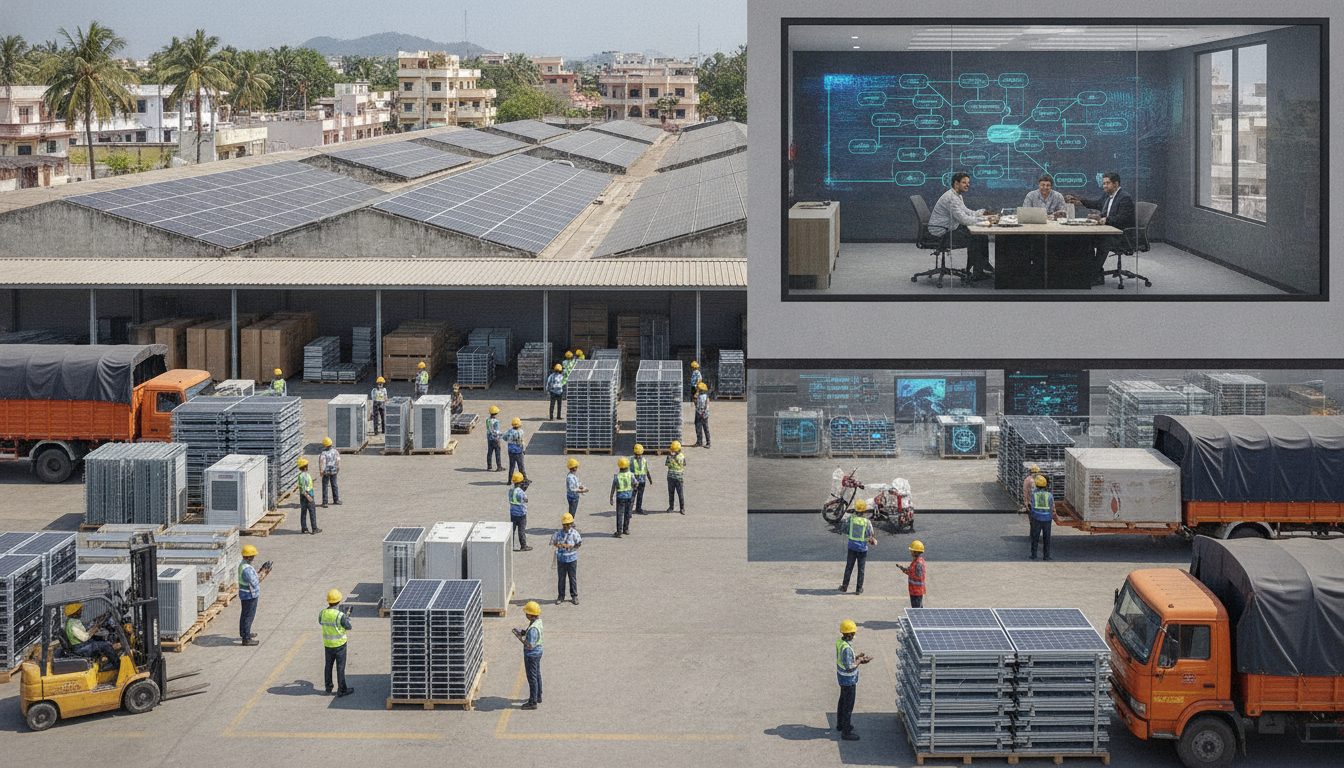
The Challenge of Balance-of-System Components in Scaling EPC Businesses
Rapid scaling in solar EPC businesses often leads to cash flow blockages due to mismanaged balance-of-system (BOS) components. When mounting structures, cables, junction boxes, and protection devices are stored without centralized tracking, capital gets trapped in excess stock while active project sites face shortages.
Deploying dedicated solar inventory management software India gives project managers real-time visibility across multiple warehouse locations. This operational control ensures that BOS components arrive at project sites exactly when needed, preventing costly installation delays without requiring excessive storage buffers.
Want to see what this means for your roof? Use our free solar calculator for India to estimate system size, cost after the ₹78,000 subsidy and payback period.
Working Capital Control Amid Module Price Volatility
PV module prices fluctuate frequently based on global supply chains, tariff revisions, and raw material availability. Module price volatility requires tight working capital control to protect profit margins on fixed-price EPC contracts.
An enterprise resource planning platform connects procurement schedules directly with active pipeline orders. Companies can evaluate their financial projections using tools like the solar ROI and payback period calculator to align material purchases with actual cash inflows, reducing the risk of holding expensive stock during market downturns.
Serial Number Tracking for Warranty Validation
Tier-1 manufacturers require exact serial number records for PV modules and string inverters to honor performance and product warranties. Manual record-keeping on spreadsheets frequently leads to missing data and disputed claims during equipment failures.
Integrated supply chain software captures barcode or QR code scans at the warehouse gate during inward movement and logs them against specific project dispatch notes. This creates an audit-ready database that simplifies warranty claims and speeds up handover documentation for commercial and residential clients.
Optimizing Module-to-Inverter Ratio Allocations
Mismatching DC module capacity with AC inverter ratings reduces plant generation efficiency and strains hardware over time. Proper design specifications require precise stock allocation during the kitting phase before dispatching materials to a site.
An ERP system enforces predefined engineering ratios during the picking process so warehouse staff cannot ship incorrect component combinations. By maintaining strict oversight on these allocations, EPC firms reduce replacement callouts and ensure installed systems deliver the expected generation metrics.
🌟 Ready to Go Solar? Get 3 Free Quotes
Connect with verified, MNRE-empanelled solar installers near you — free, no obligation.
Get Free Solar Quotes →