 SolarCalculators
Solar Inverter DC/AC Overloading Ratio (1.25 to 1.35): Maximize Generation in India
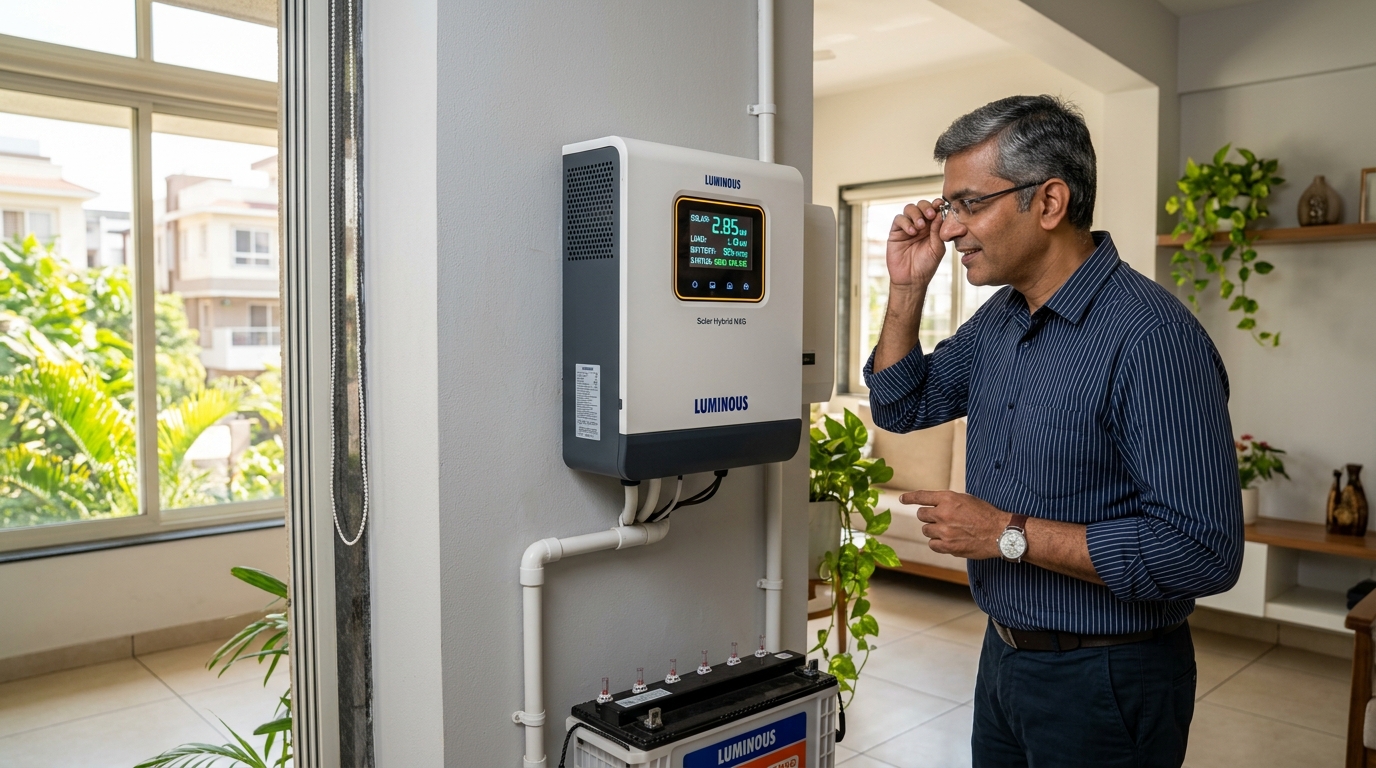
When you design a rooftop solar plant in India, your solar panels face continuous real-world derating factors: module surface temperatures exceeding 60°C (-12% power loss), dust accumulation (-5% loss), and DC cable resistance (-2% loss). As a result, a "3 kW panel array" usually delivers only 2.3 kW to 2.5 kW of actual DC power to the inverter during most hours of the day.
By "overclocking" or oversizing your DC panel array relative to your inverter's AC nameplate rating, the inverter wakes up earlier at sunrise, operates at its peak 98% efficiency plateau all day, and shuts down later at sunset.
Understanding Inverter Clipping vs Generation Gains
| DC/AC Ratio | DC Panel Capacity on 3kW Inverter | Morning & Evening Gain | Monsoon & Winter Gain | Peak Noon Clipping Loss | Net Annual Energy Gain |
|---|---|---|---|---|---|
| 1.00 (Standard) | 3.00 kWp (6 × 500W) | Baseline (0%) | Baseline (0%) | 0.0% | Baseline (~4,200 Units/yr) |
| 1.15 (Mild) | 3.45 kWp (6 × 575W) | +8.5% | +7.2% | < 0.2% | +7.8% (~4,525 Units/yr) |
| 1.28 (Sweet Spot) | 3.85 kWp (7 × 550W) | +16.4% | +15.1% | ~ 1.1% | +14.8% (~4,820 Units/yr) |
| 1.40 (Aggressive) | 4.20 kWp (7 × 600W) | +24.0% | +22.0% | ~ 3.6% | +18.2% (~4,965 Units/yr) |
Want to see what this means for your roof? Use our free solar calculator for India to estimate system size, cost after the ₹78,000 subsidy and payback period.
Why Clipping Losses Are Inconsequential in India
Inverter Clipping occurs during bright cloudless summer noon hours (11:30 AM to 1:30 PM) when the solar array produces 3.4 kW DC, but the 3 kW inverter caps AC output to 3.0 kW.
While the top 400W is trimmed for ~90 minutes on peak summer days (a loss of roughly 0.6 kWh), the oversized array delivers an extra 2.8 kWh of power across the remaining 7 hours of the day (morning 7 AM–11 AM and afternoon 2 PM–6 PM) when light intensity is sub-optimal.
The Math: You sacrifice 0.6 kWh of clipped peak power to gain 2.8 kWh of shoulder power — delivering a net profit of +2.2 kWh every single sunny day!
Manufacturer DC Overloading Limits (2026 Tier-1 Inverters)
Leading solar inverter brands officially design and certify their hardware for heavy DC oversizing without voiding warranty:
| Inverter Brand & Model | Rated AC Output | Max Allowable DC Input | Max Safe DC/AC Ratio | MPPT Voltage Range |
|---|---|---|---|---|
| Growatt MIN 3000-6000TL-X | 3.0 kW – 6.0 kW | 140% of AC Rating | 1.40 : 1 | 80V – 550V |
| Sungrow SG3.0–SG6.0RS | 3.0 kW – 6.0 kW | 150% of AC Rating | 1.50 : 1 (Industry Lead) | 90V – 560V |
| Solis S6-GR1P (3K to 6K) | 3.0 kW – 6.0 kW | 135% of AC Rating | 1.35 : 1 | 90V – 520V |
| Havells Enviro GTi | 3.3 kW – 5.5 kW | 130% of AC Rating | 1.30 : 1 | 120V – 500V |
| Deye Hybrid (SUN-3.6/5/6K-SG) | 3.6 kW – 6.0 kW | 140% of AC Rating | 1.40 : 1 | 125V – 500V |
The 2 Golden Safety Rules Before Overloading
Calculate the coldest winter morning string voltage (at 0°C to 5°C in North India). The string's combined Voc must never exceed the inverter's maximum input voltage (typically 550V or 600V DC). Over-voltage damages internal MOSFETs and instantly voids warranty.
Modern high-power TOPCon modules (550W–600W) have an Imp of 13.5A to 14.5A and an Isc of 14.5A to 15.5A. Ensure your inverter's MPPT maximum input current rating is at least 16A per string.
🔗 Technical Engineering Calculators
Inverter Sizing Calculator String Sizing & Voc Calculator DC Cable Sizing & Loss Tool Complete Rooftop Solar SizerFrequently Asked Questions
Calculate Exact Inverter String Sizing
Use our automated tool to match your module wattage, string Voc, and inverter MPPT voltage limits with zero errors.
Run String Sizing Calculator →