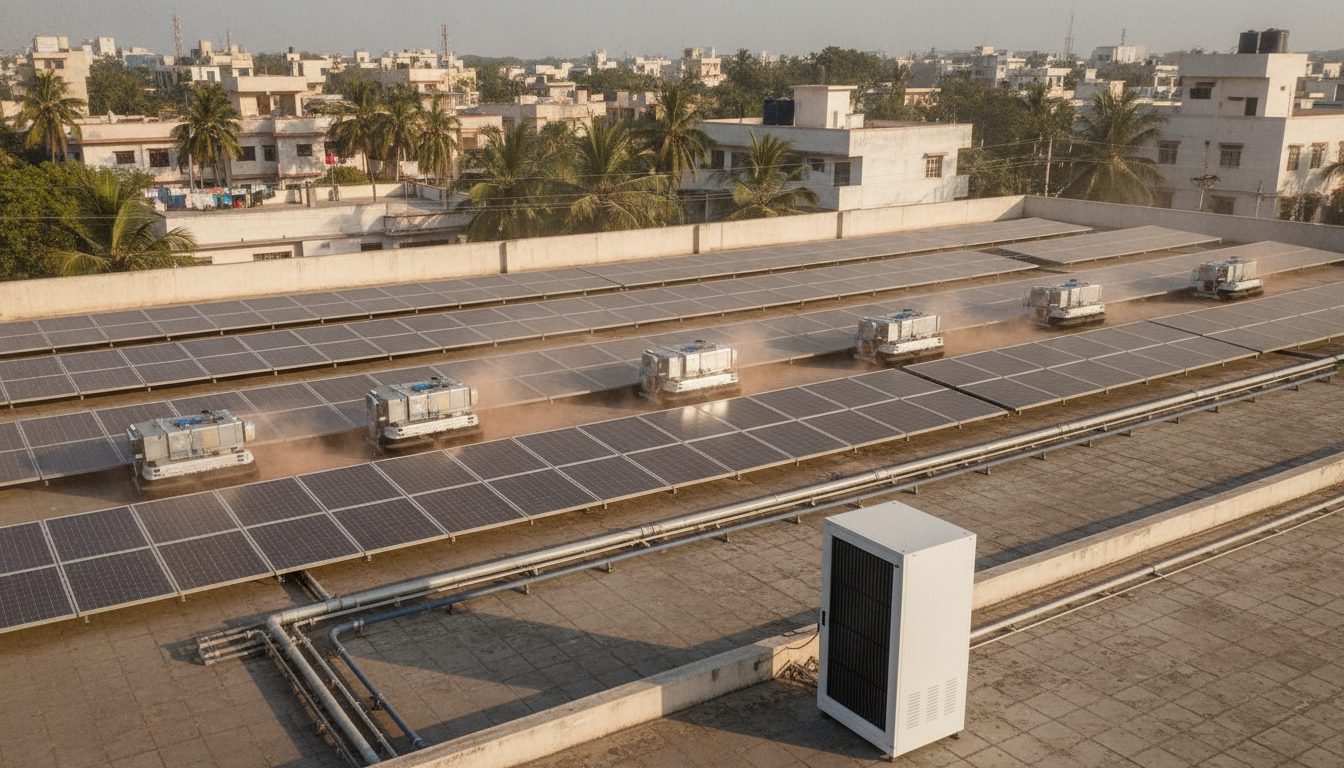
Understanding Dust Accumulation and Energy Loss in Indian Solar Plants
Dust accumulation on photovoltaic modules causes up to 25 percent energy generation loss in arid and dusty Indian regions. Soiling blocks sunlight from reaching the solar cells, reducing the overall output of commercial and industrial installations. Manual cleaning methods often fail to clear fine dust uniformly, and water scarcity makes traditional washing impractical for large installations. Automated systems help maintain optimal generation levels without wasting water resources.
Property owners evaluating large arrays can estimate space constraints using a solar roof area calculator to plan maintenance access for robotic tracks.
Want to see what this means for your roof? Use our free solar calculator for India to estimate system size, cost after the ₹78,000 subsidy and payback period.
Manual Labor Versus Automated Dry-Brushing Systems
Manual cleaning requires continuous human labor, water tankers, and supervision, leading to rising operational expenses over time. Automated robotic dry-brushing systems operate without water, utilizing programmed schedules to sweep panels clean of loose dust and grit. These units reduce the risk of micro-cracks caused by improper manual handling and abrasive washing tools. Commercial facilities benefit from consistent cleaning cycles that maintain peak module performance.
Financial Payback and Commercial ROI Calculations
Investing in autonomous cleaning technology involves upfront capital expenditure, but ongoing savings on manual labor and restored energy yields offset these costs. Commercial and industrial rooftop plants recover their investment through recovered electricity generation that would otherwise be lost to soiling. Assessing the financial returns of plant maintenance requires balancing equipment costs against monthly generation gains.
Plant managers can use a solar ROI and payback period calculator to model long-term financial returns and operational savings.
🌟 Ready to Go Solar? Get 3 Free Quotes
Connect with verified, MNRE-empanelled solar installers near you — free, no obligation.
Get Free Solar Quotes →