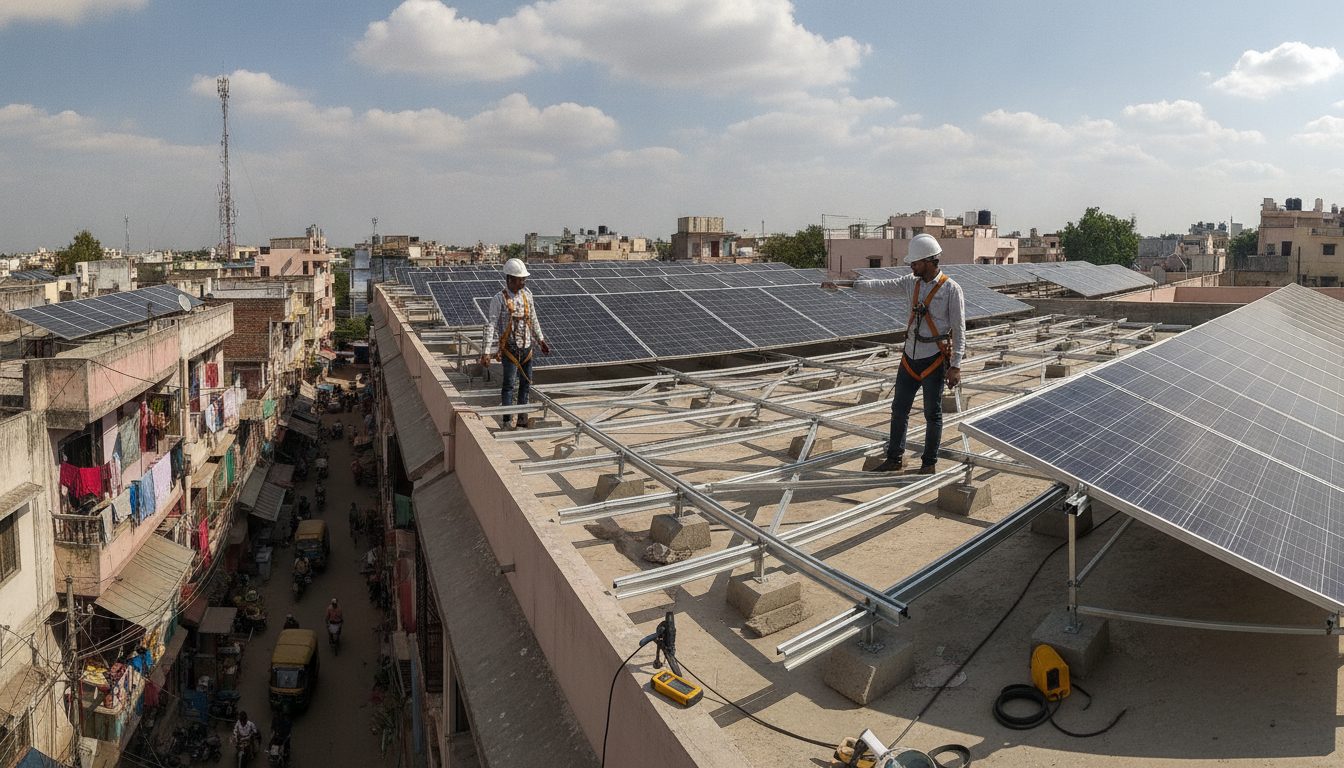
Understanding Wind Load Safety Standards for Rooftop Solar
High-velocity wind gusts can easily detach poorly anchored solar arrays, causing catastrophic roof damage and structural liabilities. When planning an installation, verifying the structural integrity of your roof space starts with understanding basic spatial limits, which you can check using a solar roof area calculator before finalizing your layout.
Indian standards require mounting systems to withstand local wind speeds dictated by regional zoning maps. Structural engineers evaluate the angle of the panels, building height, and terrain category to calculate the exact uplift pressure exerted on the hardware.
BIS and IS 875 Compliance Requirements
Compliance with Bureau of Indian Standards and the IS 875 code is mandatory for safe rooftop solar installations. IS 875 provides the mathematical framework for calculating design wind speeds based on historical meteorological data across different zones in India.
Manufacturers must test their components against these standards to ensure the frame does not buckle or shear under peak pressure. Ignoring these guidelines creates severe legal and financial liabilities if a system collapses during a storm.
Ballast Versus Chemical Anchor Calculations
Different roof types demand different anchoring methodologies to resist lateral wind shear. The choice between weighted ballast blocks and drilled chemical anchors depends entirely on the dead load capacity of the building.
| Roof Type | Primary Anchorage Method | Load Consideration |
|---|---|---|
| RCC Flat Roof | Chemical Anchors or Ballast | Must verify safe dead load limits |
| Metal Shed Roof | Clamp-to-Purlin Fasteners | Requires direct structural rib attachment |
| Sloped Tiled Roof | Rafter-Mounted Hook Systems | Penetrates tiles to anchor into timber or concrete beams |
Chemical anchors provide high pull-out resistance for concrete slabs by bonding threaded rods directly into the masonry. Ballast systems rely on concrete pavers to hold the array down through gravity without piercing the waterproofing membrane, though they add significant dead weight to the structure.
Hot-Dip Galvanized Steel Versus Aluminum Rails
The choice of metal for the mounting rails dictates the long-term durability of the entire installation against corrosion and mechanical fatigue. Hot-dip galvanized steel offers superior tensile strength and rigidity for large spans, resisting bending under heavy wind loads.
Aluminum rails provide a lighter alternative with natural corrosion resistance due to an oxide layer, but they require thicker profiles or closer support points in high-wind zones. Combining high-grade steel brackets with properly rated fasteners prevents galvanic corrosion where dissimilar metals touch.
🌟 Ready to Go Solar? Get 3 Free Quotes
Connect with verified, MNRE-empanelled solar installers near you — free, no obligation.
Get Free Solar Quotes →