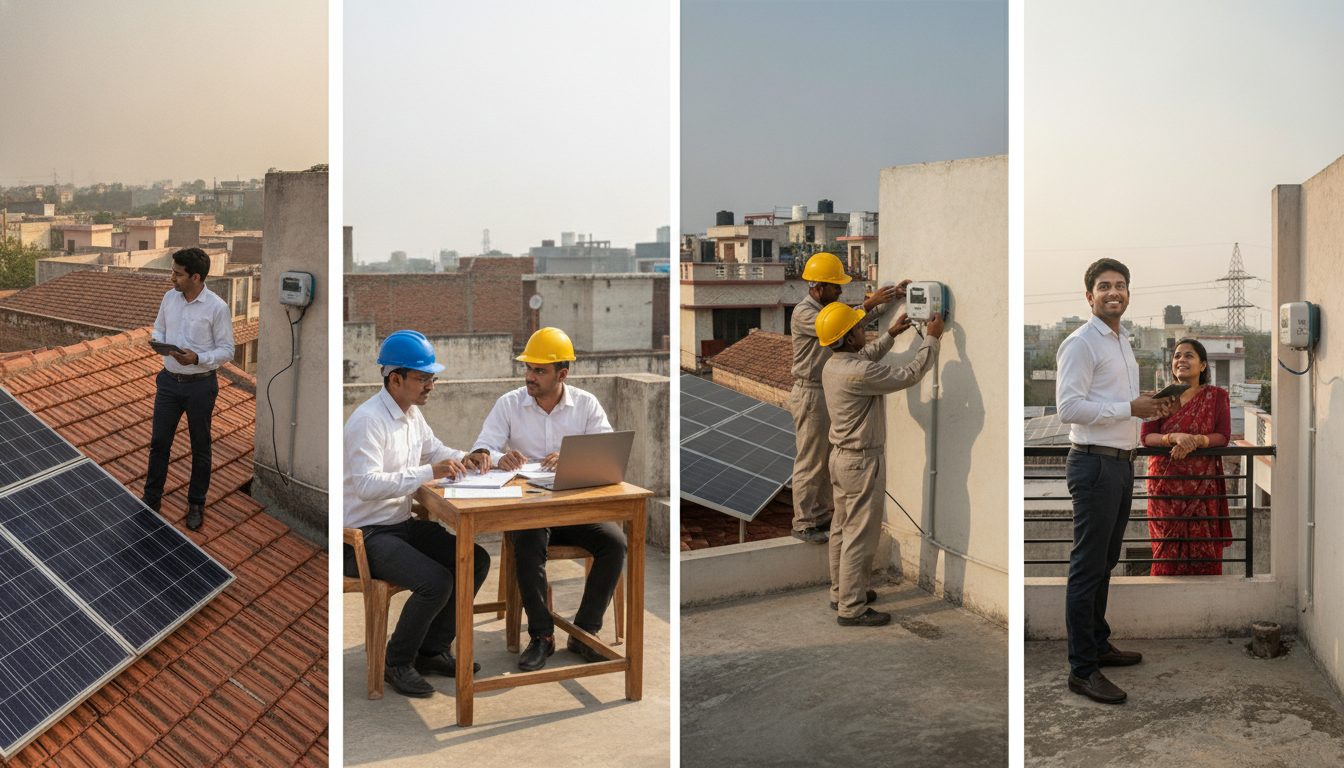
Understanding Net Metering and the Application Workflow
Net metering allows residential consumers to export excess rooftop solar generation to the local electrical grid, adjusting those units against imported electricity on the monthly utility bill. The standard solar net metering application process follows clear guidelines issued by the Ministry of New and Renewable Energy (MNRE). Residential grid tariffs across Indian states typically range from ₹6 to ₹9 per unit, making bill offsets through net metering highly practical for cutting monthly expenses.
You can check your estimated monthly offset by using our solar bill simulator and tariff calculator before submitting paperwork. Net metering is legally mandated across all major states under MNRE guidelines, provided your system meets technical and safety standards set by the Central Electricity Authority.
Want to see what this means for your roof? Use our free solar calculator for India to estimate system size, cost after the ₹78,000 subsidy and payback period.
Step-by-Step Application Process Through Your DISCOM
The entire workflow runs through your local electricity distribution company (DISCOM), usually handled alongside your system vendor. Here are the core steps to complete the paperwork:
- Step 1: System Installation by Empanelled Vendor: Hire an authorized installer to set up your rooftop system. Panels carry a standard 25-year performance warranty with roughly 80 percent output retained at year 25, alongside a 10 to 12 year product warranty.
- Step 2: Submit Application to DISCOM: File the net metering application online or offline through your DISCOM portal, attaching documents like identity proof, property tax receipts, and technical specifications of the inverter and panels.
- Step 3: Feasibility Study: The DISCOM evaluates local grid capacity and transformer limits within a prescribed timeframe, usually issuing a technical feasibility approval if the grid can absorb your proposed capacity.
- Step 4: Installation and Inspection: Once feasibility is granted, your installer completes the physical wiring. A DISCOM official visits your premises to inspect the installation for safety and compliance.
- Step 5: Meter Replacement and Agreement: The utility replaces your existing meter with a bidirectional solar meter and executes a formal net metering agreement between you and the DISCOM.
Financial Support and Generation Expectations
Understanding your system output helps justify the transition to solar energy. A 1kW rooftop solar system generates roughly 90 to 120 units per month in India, while a 3kW system generates roughly 270 to 360 units per month. Actual generation varies depending on shadow-free roof area, tilt angle, and regional sunlight patterns.
To evaluate your available space before applying, use the roof area required for solar panels calculator. Central financial assistance is available under the PM Surya Ghar Muft Bijli Yojana subsidy scheme, providing direct transfers of ₹30,000 for a 1kW system, ₹60,000 for a 2kW system, and ₹78,000 for a 3kW system and above, which acts as the maximum cap for residential installations.
🌟 Ready to Go Solar? Get 3 Free Quotes
Connect with verified, MNRE-empanelled solar installers near you — free, no obligation.
Get Free Solar Quotes →