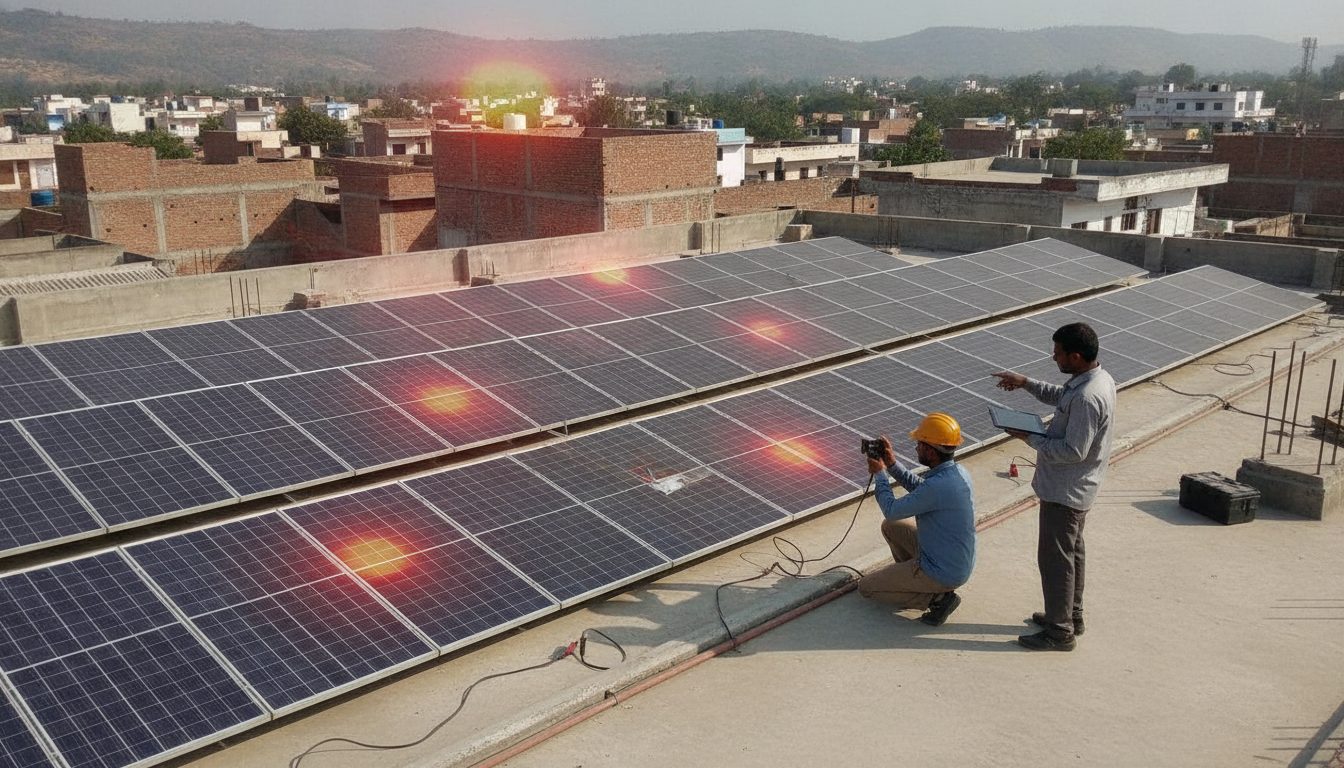
Detecting Thermal Anomalies Under Peak Irradiance
Routine solar panel hotspot thermal imaging maintenance India relies heavily on peak irradiance conditions exceeding 800 W/m² to produce reliable temperature differentials. When sunlight intensity crosses this threshold, failing cells or damaged internal pathways reveal themselves as distinct heat signatures on infrared detectors. Technicians use handheld infrared cameras or aerial thermography to scan large rooftop arrays quickly.
Thermal anomalies rarely appear uniformly across a system. Instead, localized heat spots point to specific physical defects inside the silicon wafers or electrical connections. Catching these shifts early prevents localized melting, glass cracking, and complete module failure during high-temperature summer months. Before planning an inspection schedule, homeowners often map their physical layout using a solar roof area calculator to ensure clear access paths for maintenance crews.
Want to see what this means for your roof? Use our free solar calculator for India to estimate system size, cost after the ₹78,000 subsidy and payback period.
Common Root Causes of Thermal Stress
Hotspots manifest due to several distinct mechanical and electrical failures within photovoltaic installations. Micro-cracks caused by mishandling or severe weather restrict current flow, creating high-resistance zones that dissipate energy as heat rather than electricity. Potential Induced Degradation, commonly known as PID, creates voltage leakage paths between the semiconductor material and the grounded aluminum frame, resulting in broad heating patterns across multiple cells.
Junction box failures and string mismatch also contribute significantly to thermal stress. When bypass diodes malfunction or internal solder joints degrade, reverse current forces shaded or damaged cells to absorb power from active cells in the same string. This reverse-bias condition drives temperatures sharply upward, which infrared equipment captures immediately during an operational audit.
Corrective Protocols and Preventive Drone Schedules
Addressing identified hotspots requires strict adherence to safety and technical repair protocols. Technicians must isolate affected strings before performing physical inspections or corrective bypass diode replacement. Replacing a faulty diode restores safe current pathways and prevents adjacent cells from overheating. For megawatt-scale commercial and industrial rooftops, manual point-and-shoot camera checks take excessive time and labor.
Implementing regular preventive drone inspection schedules ensures entire multi-megawatt arrays are scanned efficiently within a single solar noon window. Routine aerial thermography tracks the long-term health of modules, protecting financial yields and extending the operational lifespan of the installation.
🌟 Ready to Go Solar? Get 3 Free Quotes
Connect with verified, MNRE-empanelled solar installers near you — free, no obligation.
Get Free Solar Quotes →