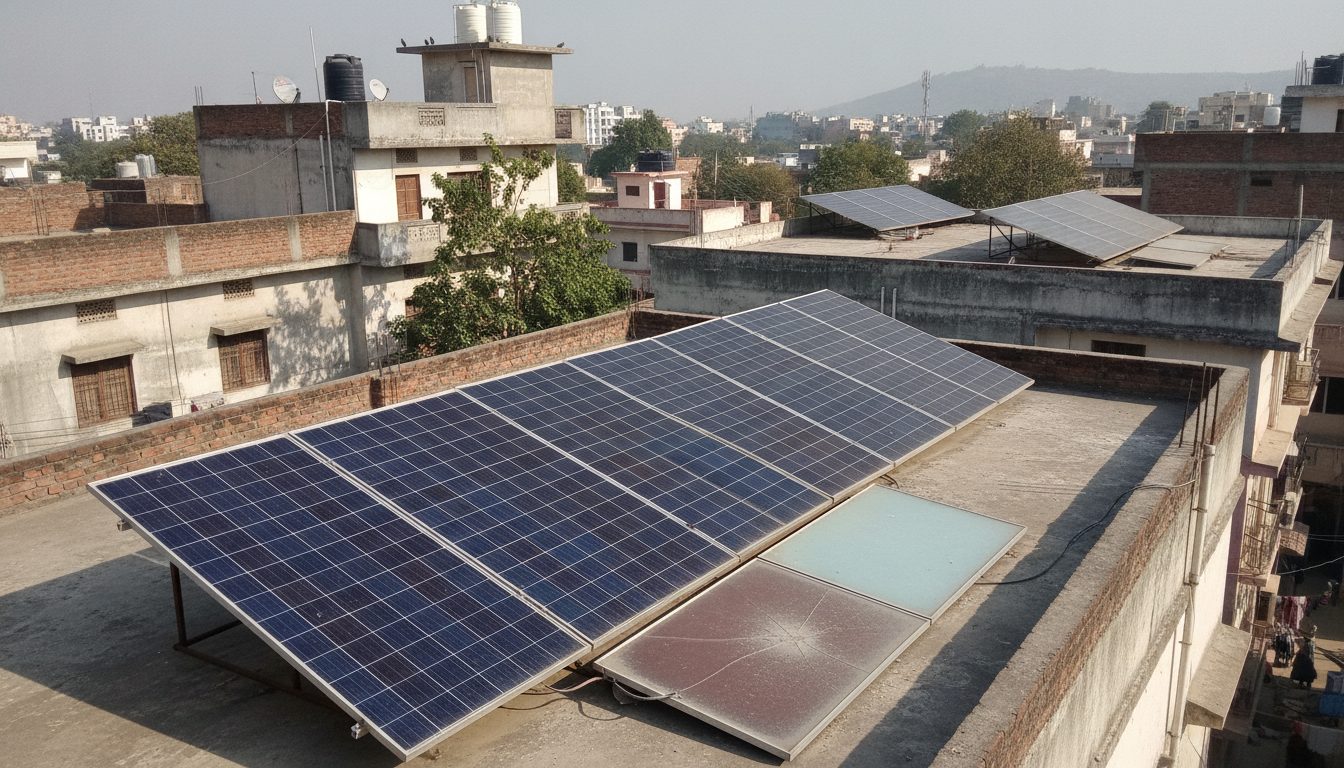
Understanding Partial Shading in Urban Indian Rooftops
Urban Indian homes face unique architectural hurdles for rooftop solar setups. Multi-story buildings next door, overhead water tanks, and parapet walls cast moving shadows across panels throughout the day. When even a small section of a panel goes dark, current production drops. This is why a proper solar panel shading analysis mismatch losses assessment matters before installation. Before finalizing your setup, you can evaluate your space availability using our solar roof area calculator to plan a layout that minimizes structural shadows.
Want to see what this means for your roof? Use our free solar calculator for India to estimate system size, cost after the ₹78,000 subsidy and payback period.
How Bypass Diodes and String Mismatch Interact
Traditional string setups wire multiple panels in series. The total current of the string drops to match the lowest-performing shaded cell. To prevent severe damage from reverse biasing, modern panels contain bypass diodes. These diodes route the current around the shaded cells, keeping the circuit safe. However, this action reduces the voltage of that specific module, creating an imbalance in the string that pulls down overall energy yield.
Mitigation Tech: String Inverters, Microinverters, and Optimizers
Different inverter architectures handle shade in distinct ways. Standard string inverter optimization works well for unshaded roofs, but suffers when shadows hit individual modules. Microinverters attach to each panel independently, ensuring that a shadow on one unit does not affect the others. Power optimizers work similarly at the module level, conditioning the DC power before sending it to a central string inverter. Homeowners dealing with persistent shadows often choose these module-level electronics to recover lost generation.
🌟 Ready to Go Solar? Get 3 Free Quotes
Connect with verified, MNRE-empanelled solar installers near you — free, no obligation.
Get Free Solar Quotes →