Preventing Yield Loss on Complex Rooftops
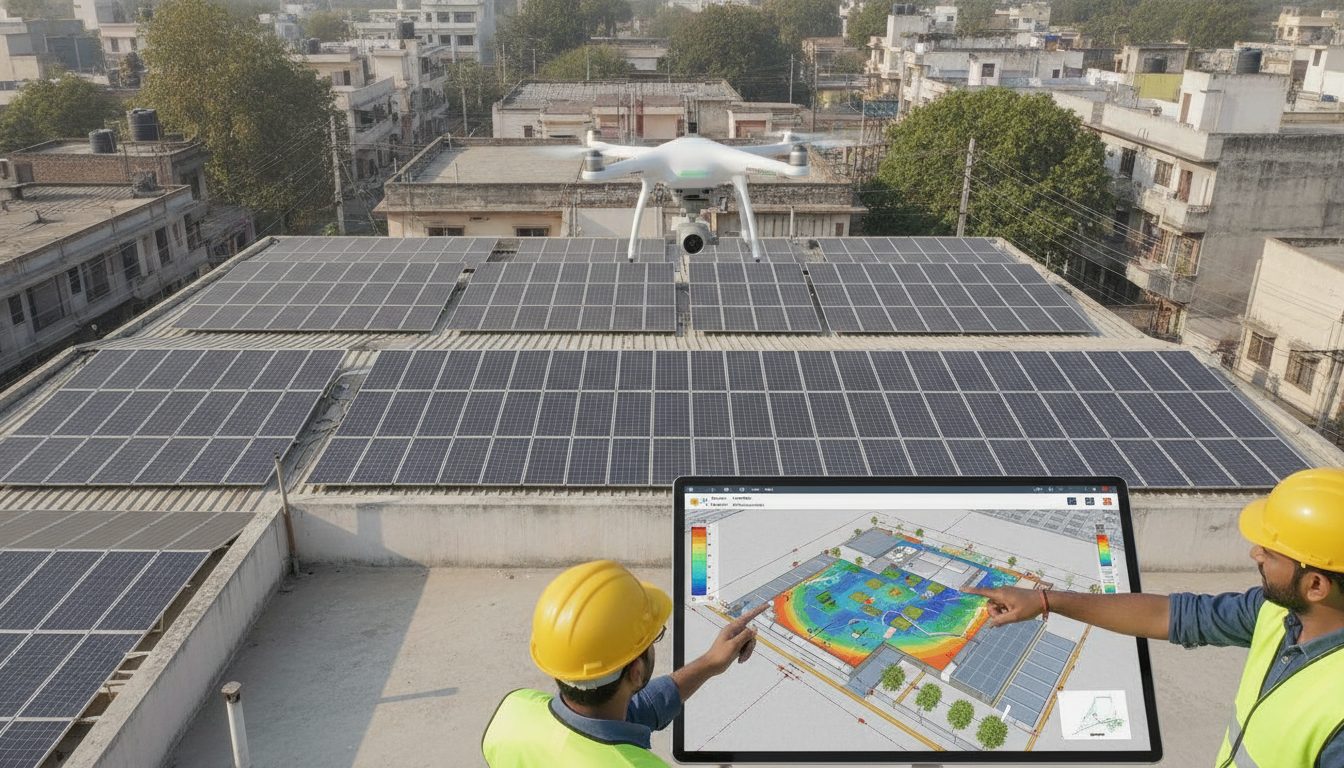
Accurate shading analysis prevents up to 15 percent energy yield loss in complex commercial and industrial rooftops. Traditional manual string sizing often misses HVAC ducts, parapet walls, and upcoming high-rises nearby. Executing a proper commercial solar drone shadow analysis bridges the gap between estimated output and actual generation figures by mapping every surface irregularity accurately.
Commercial buildings rarely feature flat, unobstructed expanses. Water tanks, ventilation shafts, and structural columns cast moving shadows across different hours of the day. Without precise spatial data, string layouts end up placing modules in sub-optimal zones. Integrating accurate rooftop dimensions with a solar roof area calculator helps teams map usable surface limits before finalizing string designs.
Not sure what size you need? Our free solar calculator works out system size, cost after subsidy and payback from your monthly electricity bill.
Integrating Photogrammetry with Simulation Software
Engineering, procurement, and construction firms rely on aerial data collected by unmanned aerial vehicles to build exact digital twins of client properties. Photogrammetry software processes these overlapping aerial images into high-resolution orthomosaics and 3D point clouds. EPCs can import these spatial models directly into planning platforms.
Industry-standard tools allow designers to apply 3D horizon shading data over the generated point cloud. This workflow maps distant obstructions alongside immediate rooftop fixtures. Simulating realistic irradiance values across every hour of the year clarifies module placement constraints and string configurations long before installation crews reach the site.
Winning C&I Tenders with Professional Reports
Commercial property owners evaluate multiple proposals before awarding large rooftop contracts. Detailed simulation reports generated from drone mapping provide the technical credibility needed to stand out in competitive tenders. Clients appreciate seeing precise irradiance heatmaps rather than generalized production estimates.
Presenting visual proof of shade mitigation builds trust during client negotiations. When financial stakeholders review clear production forecasts backed by rigorous spatial analysis, approval timelines for capital expenditure tend to move faster.
🌟 Ready to Go Solar? Get 3 Free Quotes
Connect with verified, MNRE-empanelled solar installers near you — free, no obligation.
Get Free Solar Quotes →