Identifying Common Roof Obstacles on Indian Homes
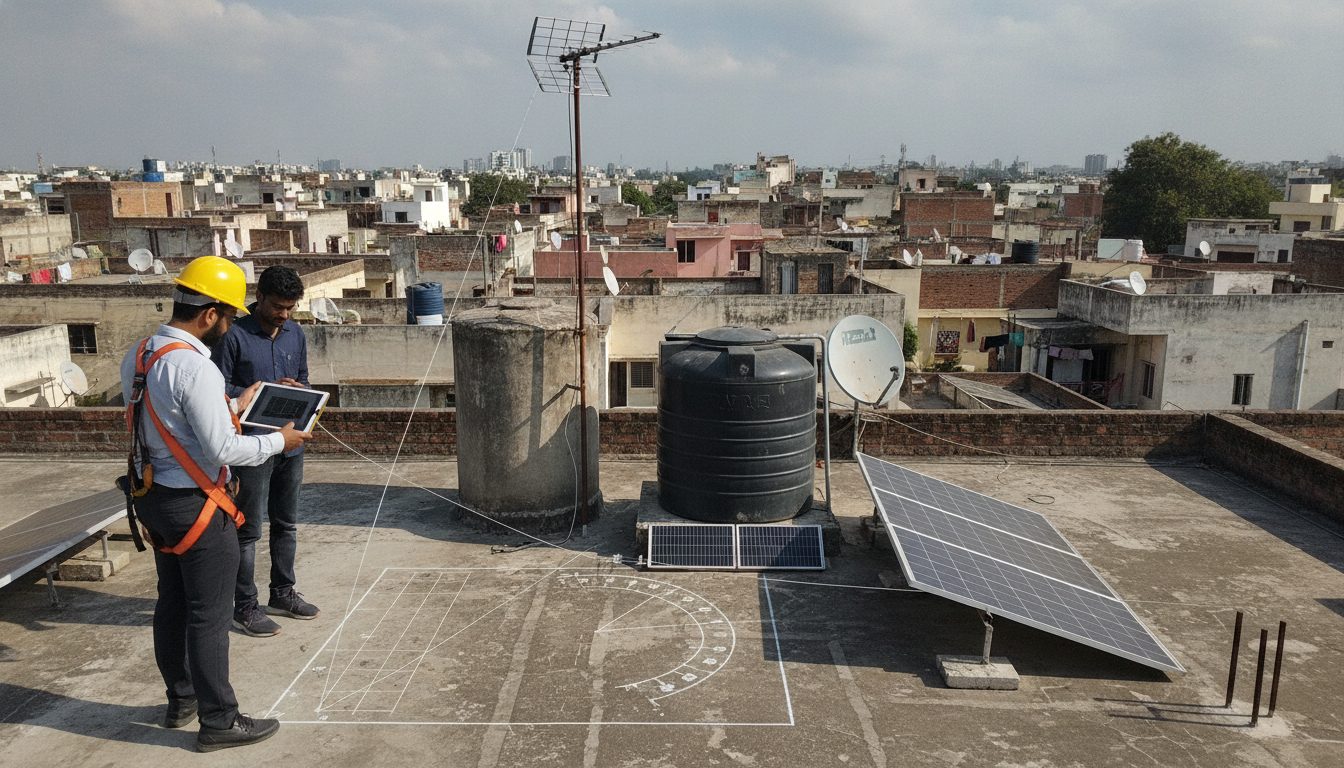
Performing a proper solar shadow analysis roof obstacles india starts with a physical site visit to map every obstruction that casts shadows on the rooftop. Typical Indian residential roofs feature raised stairwell enclosures known as mumtys, overhead water storage tanks, parapet walls, and television antennas. Adjacent multi-story buildings and tall boundary trees also block direct sunlight during specific hours of the day.
These obstructions shift their shadow angles drastically between the summer and winter solstices due to the changing path of the sun. Ignoring these obstacles during the planning phase leads to miscalculated generation estimates. Before finalizing your layout, you can check your available space using a solar roof area calculator to ensure panels are placed away from persistent shadow zones.
To check the numbers for your own home, try the solar calculator — enter your electricity bill and get system size, subsidy and payback in seconds.
Professional Tools for Shadow and Site Mapping
Site engineers and experienced homeowners rely on specialized instruments and digital software to measure shadow impact accurately. A physical solar pathfinder uses a hemispherical mirror to reflect the horizon and record sun paths throughout the year for a specific rooftop location. Modern drone surveys capture high-resolution aerial imagery that translates physical roof geometry into topographical models.
Advanced 3D shading simulation programs like PVsyst and Helioscope process this site data to generate precise annual yield reports. These software platforms simulate minute-by-minute solar irradiance, accounting for horizon shading and nearby architectural structures. Accurate modeling prevents costly mistakes and ensures the array placement captures maximum daylight.
Mitigating Partial Shading with Modern Inverter Technology
Partial shading severely impacts string inverter yields because traditional string setups operate panels in a series circuit. When shade covers even a small portion of one panel in a string, the entire string drops to the output level of the weakest module. This bottleneck causes significant generation losses on complex Indian rooftops dotted with mumtys and water tanks.
Using microinverters or power optimizers solves this issue by managing each solar panel independently. If shade covers one panel, the remaining modules continue operating at full capacity without dragging down the rest of the array. This module-level electronics approach is essential for urban rooftops with irregular layouts and unavoidable shading factors.
🌟 Ready to Go Solar? Get 3 Free Quotes
Connect with verified, MNRE-empanelled solar installers near you — free, no obligation.
Get Free Solar Quotes →