 SolarCalculators
Agri-PV (Agrivoltaics) in India: Crop Yields, Structure Clearance & PM-KUSUM ROI 2026
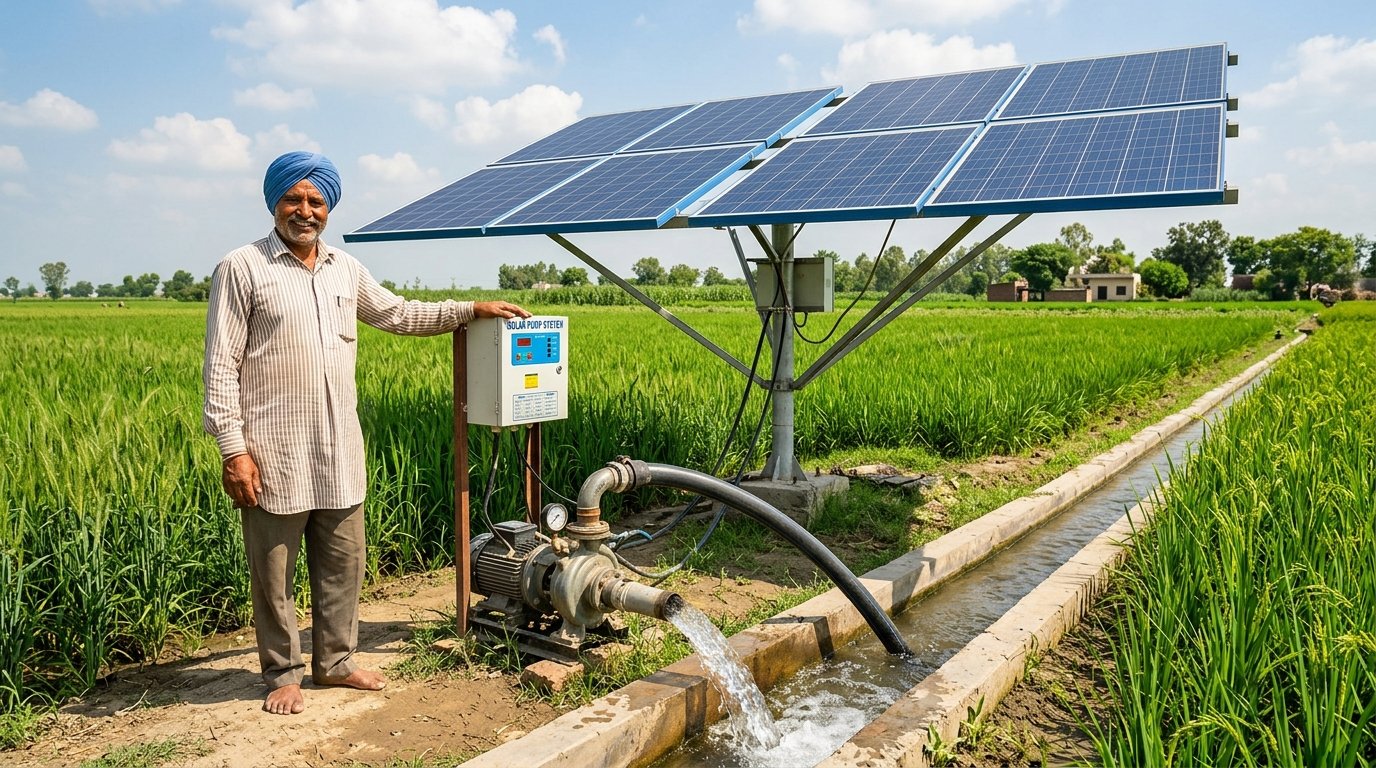
⚡ The Dual-Income Revolution in Indian Agriculture: Agri-Photovoltaics (Agri-PV) solves India's classic dilemma of food security versus green energy by utilizing the exact same parcel of agricultural land for both food cultivation and solar power generation. By elevating solar arrays 2.8m to 3.5m above ground, farmers maintain full mechanized tractor access beneath the panels. Crucially, the microclimate created under solar shade reduces soil moisture evaporation by 25% to 35%, allowing shade-resilient crops to achieve 10% to 20% higher yields while earning fixed power revenue under PM-KUSUM.
1. Photosynthetically Active Radiation (PAR) & Crop Physiology
Plants do not utilize 100% of the intense sunlight available during hot Indian summers. Solar radiation beyond the plant's light saturation point causes photoinhibition (heat stress), prompting stomata closure, reducing photosynthetic carbon assimilation, and driving excessive transpiration water loss.
By spacing solar modules to transmit 60% to 75% of Photosynthetically Active Radiation (PAR, 400–700 nm) to the ground floor, Agri-PV creates an optimal sub-canopy microclimate with reduced peak soil temperatures (lowered by 3°C to 7°C).
| Crop Category | Recommended Crops | Shade Tolerance | Observed Yield Impact Under Agri-PV |
|---|---|---|---|
| High-Value Spices & Roots | Turmeric, Ginger, Garlic, Aloe Vera | Very High (Partial Shade Preferred) | +15% to +28% Increase in root biomass and curcumin content |
| Horticultural Vegetables | Tomatoes, Bell Peppers (Capsicum), Chilli, Eggplant | Moderate to High | +8% to +18% Yield; reduced blossom-end rot and sunscald |
| Leafy Greens & Pulses | Spinach, Fenugreek (Methi), Coriander, Chickpeas | High | +12% to +20% Yield; delayed bolting and sweeter foliage |
| Cereals & Grains | Wheat, Mustard, Soybean | Moderate | Neutral (0% to +5% depending on row pitch and azimuth) |
2. Mechanical & Civil Engineering: Clearance & Foundation
Designing an Agri-PV mounting structure involves strict aerodynamic and mechanical constraints:
- Minimum Vertical Clearance: A minimum of 2.8 meters to 3.2 meters under the lowest module edge to permit tractors with rotary tillers and small combine harvesters to navigate unhindered.
- Inter-Row Spacing (Pitch): Minimum row pitch of 5.5 to 7.0 meters between parallel module tables to prevent cast shadows over crop zones and allow direct sunlight rotation during morning and late afternoon hours.
- High-Tensile Galvanized Steel Framing: Because elevated structures experience higher overturning moments from monsoonal winds (IS 875 Part 3 wind speeds up to 44 m/s), foundations require reinforced concrete auger piles (minimum 1.5m to 2.2m depth) and POSMAC / HDG coating (\(\ge 80\,\mu ext{m}\)) to resist soil agro-chemical corrosion.
3. Single-Axis Tracking vs Vertical Bifacial Agri-PV Fencing
Two primary Agri-PV structural topologies are dominating installations across Maharashtra, Gujarat, and Rajasthan:
- Elevated Single-Axis Trackers (East-West Tracking): Modules rotate from East to West throughout the day. Trackers can be programmed with smart "agricultural tracking modes" that tilt vertically during extreme hail or high midday heat, intentionally directing maximum light to the crops underneath.
- Vertical Bifacial East-West Fencing: Panels are mounted vertically like cattle fences (tilt 90°) facing East and West with 8m to 12m clear agricultural alleys between rows. This delivers a unique bimodal power generation profile—generating peak electricity during morning and late afternoon when grid spot market tariffs are highest—with virtually 100% normal tractor farming in the wide lanes.
4. 1 MW Agri-PV PM-KUSUM Component-A Financial Economics
| Financial Parameter | Standard Ground-Mount (1 MW) | Agri-PV Installation (1 MW) |
|---|---|---|
| Required Land Area | 3.5 to 4.0 Acres | 4.5 to 5.2 Acres (due to wider row pitch) |
| Turnkey EPC CAPEX | ₹2.80 Crores | ₹3.45 Crores (+23% for high-clearance structure) |
| Annual Electricity Revenue (@ ₹3.15/kWh PPA) | ₹47.25 Lakhs / yr (15 Lakh units) | ₹49.14 Lakhs / yr (+4% cooler module yield) |
| Annual Agricultural Crop Revenue | ₹0.00 (Land lost to solar) | ₹8.50 to ₹14.00 Lakhs / yr (Turmeric/Tomato) |
| Combined Annual Gross Earnings | ₹47.25 Lakhs | ₹57.64 to ₹63.14 Lakhs |
| Simple Payback Period | 5.9 Years | 5.4 to 5.8 Years |