Maximizing Bifacial Solar Panel Generation: Albedo Coating, Height & Pitch Angle (2026)

Solar Technology & Energy Specialist
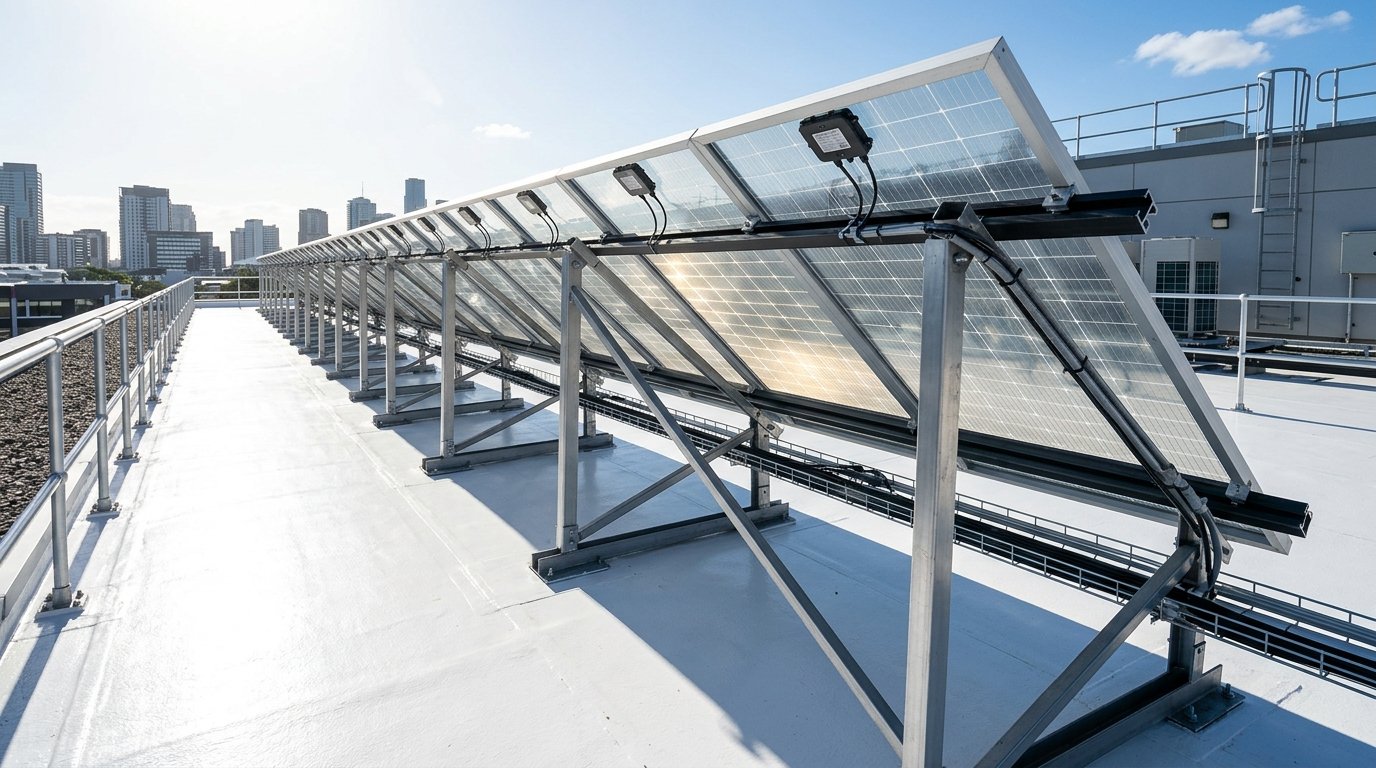
⚡ The Bifacial Reality (2026 Insights): Installing bifacial solar panels flat on a grey concrete roof without adequate ground clearance yields less than 3% to 5% rear generation gain. However, elevating the structure by 1.0 meter to 1.2 meters and applying a high-reflectivity White Cool-Roof Albedo Coating (SRI > 100) delivers a massive 18% to 26% extra energy yield from the exact same panels!
1. The Physics of Bifacial Solar Panels: Front vs Rear Energy Capture
Modern N-Type TOPCon and Heterojunction (HJT) bifacial solar panels have dual-glass encapsulation and active photovoltaic cells on both the front and rear faces. While the front absorbs direct and diffuse atmospheric sunlight, the rear side absorbs reflected ground irradiance (Albedo).
The total system power output formula is:
Total Power (P_total) = P_front + (P_rear × Bifaciality_Factor × Albedo_Coefficient)
2. Surface Albedo Reflectivity Comparison
| Ground / Rooftop Surface | Albedo Reflectivity (%) | Expected Rear-Side Bifacial Yield Gain |
|---|---|---|
| High-Albedo White Cool-Roof Paint / TPO Membrane | 75% – 85% | +18% to +25% Extra Generation |
| White Marble Chips / Light River Gravel | 50% – 65% | +12% to +17% Extra Generation |
| Light Sand / Dry Desert Soil (Rajasthan/Gujarat) | 35% – 45% | +8% to +12% Extra Generation |
| Standard Grey Concrete Terrace | 20% – 28% | +4% to +7% Extra Generation |
| Green Grass / Lawn | 15% – 22% | +3% to +5% Extra Generation |
| Black Bitumen / Dark Asphalt | 5% – 10% | < 2% (Negligible) |
3. The Critical Role of Ground Clearance Height (Elevation)
Ground clearance is the vertical distance between the lower edge of the tilted solar panel and the terrace/ground floor. If a panel is installed close to the ground (e.g. 0.3 meters):
- The panel's own shadow directly blocks the reflected ground light from reaching its rear face.
- Light distribution across the rear cells becomes highly non-uniform, triggering internal mismatch losses and localized hot-spots.
| Ground Clearance Height (Lower Edge) | Rear Irradiance Uniformity | Bifacial Performance Efficiency |
|---|---|---|
| 0.2m – 0.4m (Standard low flush mount) | Very Poor (Heavy self-shading) | 20% – 30% of potential bifacial gain |
| 0.6m – 0.8m (Moderate height) | Moderate (Partial shadow dispersion) | 65% – 75% of potential bifacial gain |
| 1.0m – 1.4m (Optimal Engineering Standard) | Excellent (Full diffuse light scattering) | 95% – 100% Maximum Bifacial Yield |
4. Structure Design: Avoiding Purlin Rear Shading
In traditional solar mounting structures, horizontal steel C-channels run directly behind the middle of solar panels. On bifacial panels, a 40mm steel rail directly shadowing the rear silicon cells causes a 15% to 25% drop in rear current.
🛠️ Best Practice for 2026: Use specialized Bifacial-Optimized Clamping Rails where purlins align exclusively with module outer aluminium frames, leaving the entire rear glass area 100% unobstructed.
5. 10 kW Residential Rooftop Case Study: Concrete vs White Albedo
| Metric | Standard Concrete Roof | Elevated Structure + White Cool-Roof Paint |
|---|---|---|
| System Capacity | 10 kW (18x 560W TOPCon Bifacial) | 10 kW (18x 560W TOPCon Bifacial) |
| Ground Clearance | 0.4 meters | 1.2 meters |
| Albedo Reflectivity | 22% | 80% (High SRI Solar Reflective Coating) |
| Annual Energy Yield | 14,800 Units (kWh) | 17,600 Units (kWh) (+2,800 Units!) |
| Extra Annual Electricity Value (@ ₹9.50/unit) | — | ₹26,600 / year |
| Cool-Roof Paint & High Mast Capex | — | ₹18,000 one-time cost |
| Albedo Optimization Payback Period | — | Just 8 Months! |
Written by Shraddha
Solar Technology & Energy Specialist at SolarCalculators.in, researching MNRE PM Surya Ghar subsidy regulations, industrial C&I solar models, and renewable engineering across India.