 SolarCalculators
DCR vs Non-DCR Solar Panels
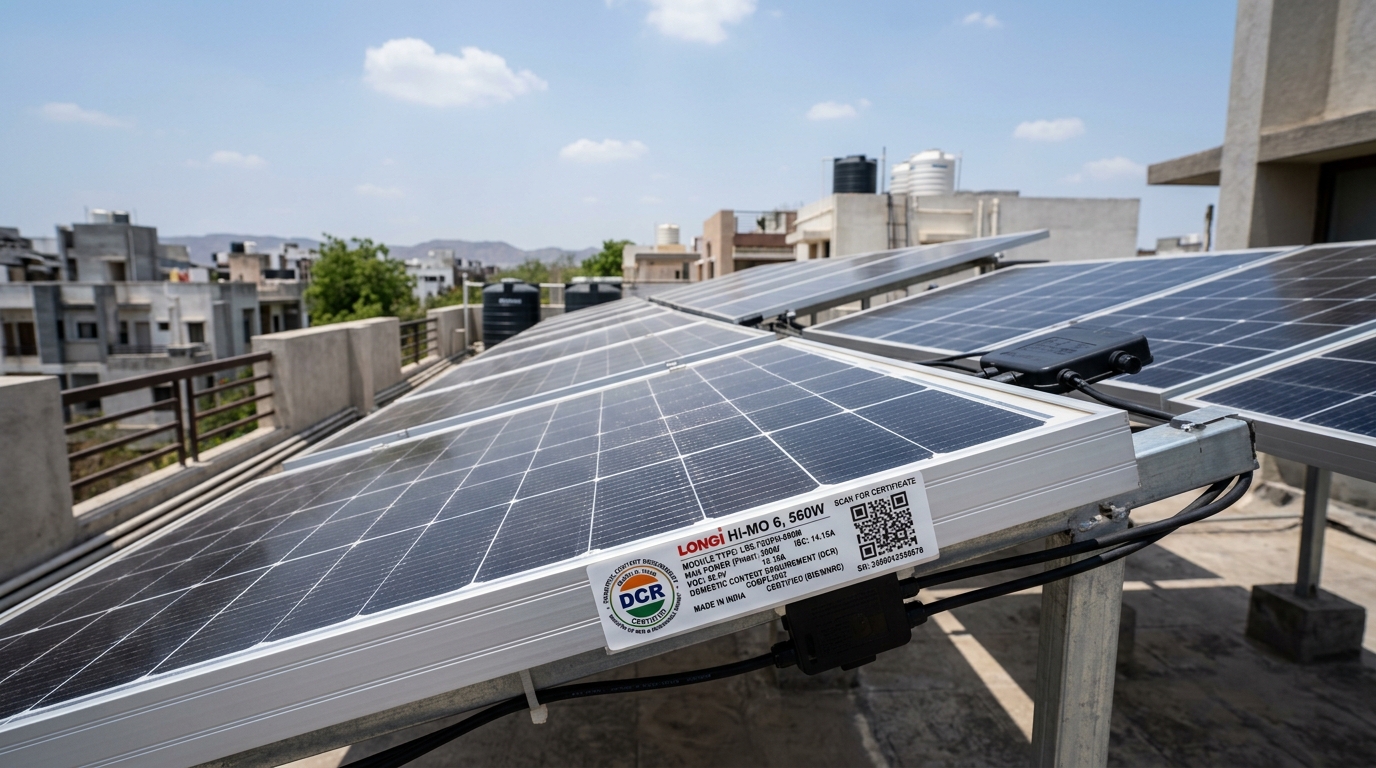
If you have recently asked for a quote to install rooftop solar in India under the PM Surya Ghar: Muft Bijli Yojana, you may have noticed installers offering two distinct panel quotes: one labeled "DCR" and another labeled "Non-DCR".
The Non-DCR quote is often ₹10,000 to ₹25,000 cheaper. But beware: choosing Non-DCR panels for a residential rooftop in 2026 will instantly void your ₹78,000 Central Government subsidy. Here is everything you need to know about Domestic Content Requirement (DCR), how it impacts your wallet, and how to verify that your panels are 100% genuine before DISCOM arrives for inspection.
1. What Exactly Is the Difference Between DCR and Non-DCR?
To understand the difference, you must understand how a solar panel is made. A solar module consists of silicon wafers processed into solar cells, which are then wired and laminated between glass and backsheet into a finished solar panel.
- DCR (Domestic Content Requirement) Modules: Both the silicon solar cells and the final solar module packaging are manufactured inside India. Companies like Waaree, Tata Power Solar, Adani Solar, Premier Energies, and Vikram Solar manufacture DCR modules with domestic cell lines.
- Non-DCR Modules: The finished panel is assembled in India (or imported whole), but the underlying silicon photovoltaic cells were imported from abroad (primarily China, Vietnam, or Malaysia). While mechanically reliable, they do not fulfill MNRE's domestic content mandate.
| Feature | DCR Solar Panels | Non-DCR Solar Panels |
|---|---|---|
| Solar Cell Origin | 100% Made in India | Imported (China / SE Asia) |
| PM Surya Ghar Subsidy | ✅ 100% Eligible (Up to ₹78,000) | ❌ Ineligible (₹0 Subsidy) |
| Average Module Cost (2026) | ₹22 – ₹26 per Watt-peak | ₹18 – ₹21 per Watt-peak |
| ALMM Listing | Mandatory List-I Listed | May be listed in ALMM without DCR status |
| Best For | Homes, housing societies, subsidized projects | Commercial factories, warehouses, off-grid |
Want to see what this means for your roof? Use our free solar calculator for India to estimate system size, cost after the ₹78,000 subsidy and payback period.
2. Cost Breakdown: Why the Extra ₹12,000 for DCR Actually Saves You ₹66,000
A common mistake homeowners make is looking only at the initial invoice before factoring in government support. Let us look at a typical 3 kW on-grid solar system in 2026:
Gross system cost: ~₹1,85,000
PM Surya Ghar Central Subsidy: -₹78,000
Net Out-of-Pocket Cost: ₹1,07,000
Gross system cost: ~₹1,72,000 (Module saving of ~₹13,000)
PM Surya Ghar Central Subsidy: ₹0 (Disqualified during DISCOM inspection)
Net Out-of-Pocket Cost: ₹1,72,000
By attempting to save ₹13,000 upfront with Non-DCR modules, you lose ₹78,000 in free government grants. The effective penalty is ₹65,000 out of your own pocket!
3. How to Check if Your Installed Panels are Truly DCR (Verification Checklist)
Unscrupulous local contractors have occasionally misled consumers by installing cheaper Non-DCR panels while claiming they are DCR. During the mandatory DISCOM joint inspection, the utility engineer will test the panels. If fake certificates are caught, the installation is blacklisted.
1. Scan the Embedded RFID Tag Inside the Glass
Every genuine DCR module has a micro RFID tag laminated inside the solar glass (it cannot be removed without shattering the panel). The RFID tag contains:
- Name of the manufacturer of solar cells and solar modules
- Country of origin of solar cells and solar modules (Must state INDIA for both)
- Date and year of manufacturing of cells and module
- Unique serial number tied to the National Solar Portal registry
2. Match the Serial Number on the National Portal
When your vendor submits the work completion report on pmsuryaghar.gov.in, they must upload the manufacturer's flash test report and DCR undertaking. Check that the physical serial numbers on your panels match the portal documents letter-for-letter.
3. Check the ALMM Enlistment Certificate
The Ministry of New and Renewable Energy maintains the Approved List of Models and Manufacturers (ALMM). Request the manufacturer's ALMM certificate from your installer. The module model code on your panel label must correspond to an active ALMM entry.
Explore Related Solar Sizing & Pricing Tools
Check Surya Ghar Subsidy → System Cost Calculator → DISCOM Connection Fees → Panel Lifespan Calculator → Compare Free Installer Quotes →4. When Is It Acceptable to Choose Non-DCR Panels?
Non-DCR panels are not bad panels — in fact, top global tier-1 brands (like Canadian Solar, JinkoSolar, Trina, and LONGi) produce some of the highest-efficiency N-Type TOPCon panels in the world with imported cells. Non-DCR is the ideal choice for:
- Commercial & Industrial (C&I) Projects: Factories, warehouses, and office parks do not receive residential capital subsidies anyway. They benefit more from the lower ₹/watt capex of Non-DCR modules and can claim 40% accelerated depreciation under Section 32 of the Income Tax Act.
- Off-Grid Remote Systems: If you are installing an off-grid battery solar system for an agricultural farmhouse or telecom tower where no net meter or government portal is involved.
- Utility-Scale Open Access: Businesses purchasing solar power under open access or group captive models.