Hospital & Healthcare Solar Power Systems: Critical Load Backup, DG Fuel Savings & ROI (2026)

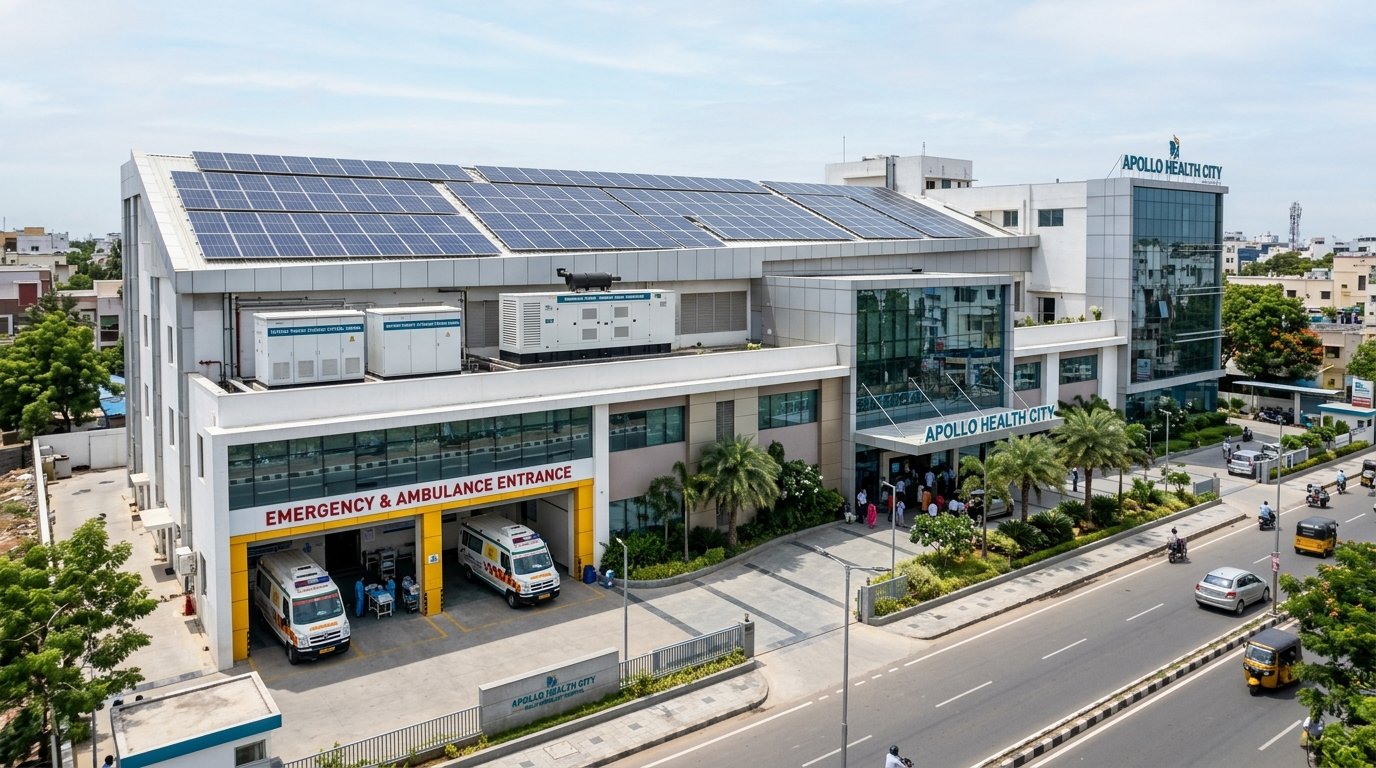
1. The Energy Dilemma in Indian Healthcare Facilities
Unlike commercial offices that operate on 9-to-6 schedules Monday through Friday, hospitals have round-the-clock power requirements. Power failure in critical care zones (Intensive Care Units - ICUs, Neonatal ICUs - NICUs, Operation Theatres - OTs, and life-support ventilators) is non-negotiable and life-threatening.
Historically, hospitals relied heavily on automated Diesel Generator (DG) synchronization panels. However, with diesel prices hovering around ₹90/liter in India, running a 250 kVA or 500 kVA DG set burns ₹3,500 to ₹7,000 per hour in fuel alone.
2. 3-Way Energy Architecture: Solar + Battery BESS + DG Synchronization
| Operational Mode | Primary Power Source | Secondary / Backup Source | Cost per kWh (Unit) |
|---|---|---|---|
| Normal Daytime (Sunny) | Rooftop Solar (100% Direct Supply) | Grid Net Metering (Surplus Export) | ₹2.50 – ₹3.20 / unit (Levelized Cost of Solar) |
| Daytime Grid Outage | Solar PV + Hybrid Inverter + BESS | DG Set on minimum 25% base load (Zero-Export) | ₹4.80 / unit (Blended) |
| Night Peak Hours | Battery Storage (BESS Peak Shaving) | Grid Off-Peak Tariff | ₹6.50 / unit vs ₹13.00 Grid Peak |
| Unmanaged Diesel Run (Legacy) | 100% Diesel Generator (DG) | None | ₹28.00 – ₹34.00 / unit (Extremely Costly) |
3. Zero-Export DG Protection: Preventing Reverse Power Flow
When a hospital runs on Diesel Generators during a grid outage, solar generation may exceed current hospital load. If surplus solar power reverse-feeds into the diesel alternator, it causes diesel engine reverse-power tripping, frequency hunting, and catastrophic mechanical damage.
To prevent this, certified hospital solar designs install a Smart Zero-Export DG Controller (e.g. DEIF, ComAp, Schneider). The controller continuously samples DG output via Current Transformers (CTs) and throttles the solar inverter within 100 milliseconds to ensure the DG set always maintains a healthy 25% minimum base load.
4. Financial ROI & 40% Tax Depreciation for a 150 kW Hospital System
| Financial Parameter | 150 kW Turnkey Rooftop Solar Plant |
|---|---|
| Total Project Capex (Dual-Glass TOPCon + Structure) | ₹67,50,000 (~₹45,000/kW) |
| Annual Solar Energy Generation (4.2 units/kW/day) | 2,30,000 kWh (Units) |
| Annual Grid Electricity Bill Savings (@ ₹11.50/unit) | ₹26,45,000 / year |
| Avoided Diesel Fuel Costs (150 hrs DG runtime saved) | ₹4,50,000 / year |
| Total Annual Operational Cost Savings | ₹30,95,000 / year |
| Year 1 Tax Shield (40% Accelerated Depreciation @ 25% Tax) | ₹6,75,000 Direct Cash Tax Saved |
| Net Simple Payback Period | Just 2.1 Years! |
| 25-Year Cumulative Net Profit | ₹6.8+ Crores |
5. Hospital Rooftop Hygiene & Structural Safety (NABH Standards)
- Elevated Superstructures (8 to 10 feet clearance): Allows hospital staff 100% unrestricted terrace access for biomedical waste handling, HVAC chiller maintenance, and laundry drying.
- Fire Retardant Class-A Dual Glass Modules: Eliminates flammable polymer backsheets, fulfilling NABH / Fire Department hospital safety norms.
- Medical Equipment Harmonic Compliance: Ultra-low Total Harmonic Distortion (THD < 3%) inverters prevent sensitive radiological equipment interference (CT, MRI, X-Ray).