Microinverter vs String Inverter vs Hybrid Inverter: Which Is Best for Indian Homes (2026)?
 Rajesh Sharma · September 22, 2026 · 9 min read
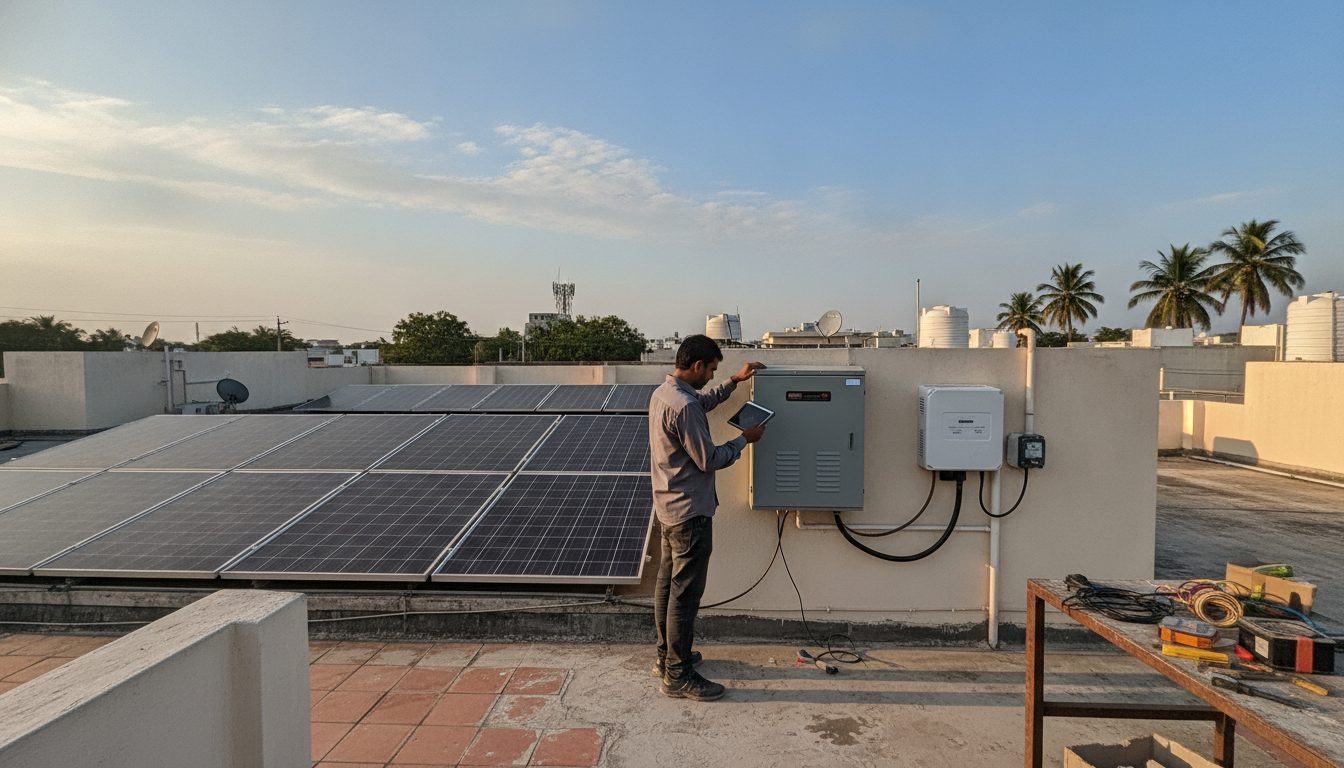
⚡ Key Takeaway: The inverter is the brain of your rooftop solar plant. In 2026, Indian homeowners have 3 main choices: String Inverters (most cost-effective for shadow-free roofs), Microinverters (maximum efficiency on complex or partially shaded roofs), and Hybrid Inverters (seamless battery backup during power outages). Here is how to choose the right one for your home.
1. Quick Technology Overview
- String Inverter (Centralized): All solar panels are connected in series ("string") to a single wall-mounted inverter. If one panel gets shaded, the output of the entire string drops.
- Microinverter (Distributed): A miniature inverter is mounted directly behind each panel (or pair of panels). Each panel operates independently with its own MPPT tracker.
- Hybrid Inverter (Solar + Battery + Grid): Combines the functions of an on-grid grid-tie inverter and an off-grid battery inverter in one smart unit. It exports excess solar to the grid while keeping a lithium battery charged for power cuts.
2. In-Depth Comparison Matrix
| Feature | String Inverter | Microinverter | Hybrid Inverter |
|---|---|---|---|
| Cost per Watt (Inverter only) | ₹5 – ₹8 / Watt (Lowest) | ₹14 – ₹22 / Watt (Highest) | ₹10 – ₹16 / Watt (Moderate) |
| Shadow Tolerance | Poor (Whole string affected) | Excellent (Panel-level isolation) | Moderate (Multi-MPPT strings) |
| Battery Storage Support | No (Grid-tied only) | Requires AC-Coupled Battery | Direct DC Lithium Battery Ready |
| Warranty Period | 5 to 10 Years | 15 to 25 Years | 5 to 10 Years |
| Rooftop Safety (DC Voltage) | High DC Voltage (up to 600V–1000V) | Low DC Voltage (<60V Rapid Shutdown) | High DC Voltage |
| PM Surya Ghar Subsidy | ✅ 100% Eligible | ✅ 100% Eligible | ✅ Eligible (Subsidy on solar portion) |
3. When Should You Choose Which Inverter?
A. Choose a String Inverter if:
- Your roof is open, flat, and has zero shade from trees, neighboring buildings, or water tanks from 9 AM to 5 PM.
- You want the fastest return on investment (payback period under 3 to 3.5 years).
- Your area has reliable 24/7 grid electricity with rare power cuts.
B. Choose a Microinverter if:
- Your roof has partial shade, chimneys, dormers, or faces multiple directions (East-West mix).
- You want panel-level monitoring on your phone to see exactly how each individual panel is performing.
- Fire safety is a top priority (zero high-voltage DC on the roof).
C. Choose a Hybrid Inverter if:
- You experience 1 to 4 hours of daily power outages and want solar power to run your AC, fridge, and fans during grid failure.
- You want to future-proof your system for Time-of-Day (ToD) tariffs and battery storage.
💡 Buying Tip: Under PM Surya Ghar Muft Bijli Yojana, make sure your inverter is listed on the ALMM/MNRE approved vendor list and includes an integrated WiFi data logger for DISCOM generation reporting.