 SolarCalculators
Rice Mill & Flour Mill Rooftop Solar: Husk Dust Soiling & Captive ROI 2026
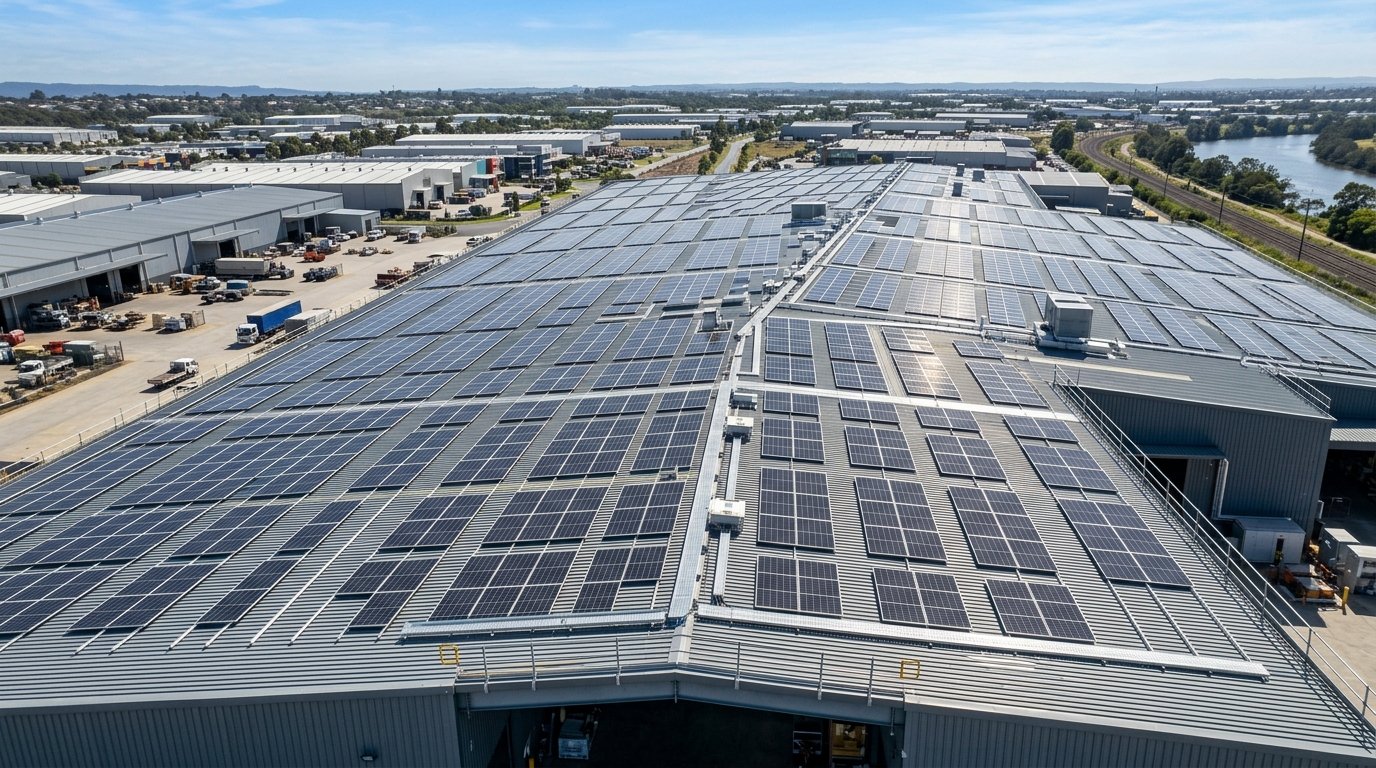
⚡ Agro-Industrial Power Realities: Grain agro-processing plants—including modern paddy rice mills, flour mills (atta chakki), and dal mills across Punjab, Haryana, Uttar Pradesh, Bihar, Andhra Pradesh, and West Bengal—run heavy industrial induction motors for 12 to 20 hours daily during milling seasons. Electricity constitutes 18% to 25% of total milling operating costs. While expansive warehouse sheds (25,000 to 1,00,000 sq.ft.) offer ideal solar installation space, the airborne dispersion of abrasive, silica-rich rice husk ash and flour dust presents severe soiling and electrical risks. Here is how modern EPCs engineer around these hazards to deliver a complete capital payback in under 2.3 years.
1. The Agricultural Dust Hazard: Rice Husk vs Standard Dust
Unlike ordinary desert dust composed primarily of calcium and clay, rice husk and grain processing dust has unique chemical and physical properties that aggressively attack solar modules:
| Dust / Environmental Factor | Chemical / Physical Characteristic | Impact on Solar PV Arrays | Engineering Solution |
|---|---|---|---|
| Rice Husk Dust (Paddy Fluff) | Over 85% to 92% amorphous silica (\(\text{SiO}_2\)) with sharp, microscopic needle-like shards | Highly abrasive; dry-scrubbing with standard brooms scratches anti-reflective glass coatings, reducing light transmission permanently | Mandatory water-based contactless wash or high-density soft microfiber automated rollers with zero-drag rotation |
| Morning Dew Cementation | Silica particles bond with ambient moisture and grain starch residues | Forms a rock-hard, cement-like crust on module glass that cannot be rinsed off by light rainfall | Hydrophobic / oleophobic anti-soiling chemical nano-coating + steep tilt angle (\(\ge 18^\circ - 20^\circ\)) |
| Airborne Flour Dust (Combustible) | Starch organic particles classified as Class St-1 explosive dust | Dust accumulation inside inverter fans and heatsinks creates thermal insulation, causing derating and fire risks | IP66 sealed inverters mounted in positive-pressure electrical rooms with exterior heat exchangers |
| Vibration from Grain Machinery | Heavy vibratory destoners, paddy separators, and bucket elevators | Induces structural harmonic vibrations into PEB shed roofs, loosening traditional clamp fasteners | EPDM rubber dampening pads under mounting clamps + serrated Nord-Lock vibration-proof washers |
2. Managing Heavy Motor Inrush & Reactive Power Surges
Rice and flour mills operate massive 3-phase squirrel cage induction motors (ranging from 30 HP to 150 HP each) to power roller mills, blowers, and hammer mills. Induction motors draw 5 to 7 times their full-load current (FLA) during across-the-line Direct-On-Line (DOL) starting:
- Grid Voltage Dips: When a 75 kW blower starts, instantaneous current draw surges from 135A to 800A, causing a momentary voltage sag on the 415V LT bus.
- Inverter Tripping Prevention: If the solar inverter is poorly coordinated, its internal grid monitoring software mistakes this temporary voltage sag for a grid failure, tripping on "Grid Under-Voltage Error (AC UVP)". Modern inverters must be configured with Low Voltage Ride-Through (LVRT) enabled to ride through 300ms motor starting dips without disconnecting.
- Variable Frequency Drives (VFD) & Soft Starters: Retrofitting older mill motors with VFDs eliminates inrush current spikes, matching power demand smoothly with real-time solar generation.
3. Turnkey 300 kWp Agro-Mill CAPEX & Cash Flow (2026)
Evaluating economics for a modern 4-ton/hour paddy rice mill in Punjab or Andhra Pradesh installing a 300 kWp rooftop solar plant:
| Financial Dimension | 300 kWp Rice Mill Solar Installation |
|---|---|
| Turnkey EPC Investment (Including Anti-Soiling Coating & Water Line) | ₹1,14,00,000 (₹1.14 Crores) |
| Annual Solar Energy Generation | 440,000 units (kWh) / year |
| Industrial HT Electricity Tariff | ₹8.90 / kWh (State C&I blended rate) |
| Annual Grid Electricity Cost Displaced | ₹39,16,000 (₹39.16 Lakhs / year) |
| Year 1 Tax Shield (40% Accelerated Depreciation @ 25% Tax) | ₹11,40,000 (Direct cash income-tax reduction) |
| Annual O&M, Frequent Washing & Filter Servicing | ₹2,80,000 / year |
| Net Year 1 Economic Cash Benefit | ₹39.16L savings + ₹11.40L tax - ₹2.80L O&M = ₹47.76 Lakhs |
| Effective Post-Tax Payback Period | 2.38 Years (~28 Months!) |