 SolarCalculators
Solar Bi-Directional Net-Meter & ABT Tri-Vector Meter Testing (IS 14697): 0.2s Accuracy & DISCOM Seals 2026
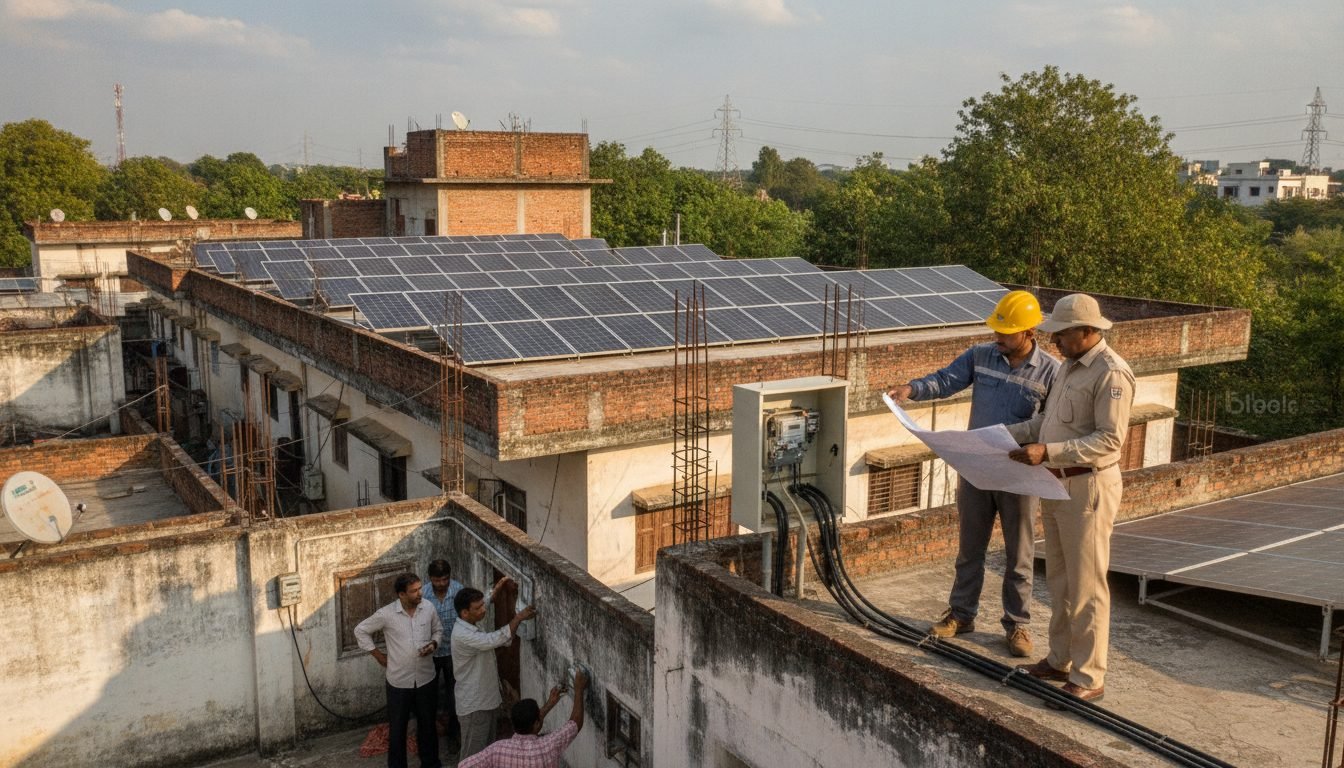
1. Whole-Current Meters vs HT ABT Tri-Vector Meters
Depending on the plant capacity and interconnection voltage level, Indian state electricity regulatory commissions (SERCs) mandate distinct metering architectures:
| System Category | Interconnection Voltage | Applicable Indian Standard | Metering Configuration | Typical Accuracy Class |
|---|---|---|---|---|
| Residential Rooftop (1 kW to 10 kW) | 230V Single-Phase / 415V Three-Phase LT | IS 13779 / CEA Regulations | Direct whole-current bi-directional electronic net-meter | Class 1.0 |
| Commercial LT Rooftop (10 kW to 100 kW) | 415V Three-Phase LT | IS 14697 | LT-CT operated bi-directional meter with external current transformers | Class 0.5s |
| Industrial HT Solar (100 kW to Multi-MW) | 11 kV / 22 kV / 33 kV / 66 kV HT Substation | IS 14697 / Central Electricity Authority (CEA) Metering Regs | HT Tri-Vector ABT (Availability Based Tariff) Meter with CT/PT | Class 0.2s (Special Accuracy) |
2. The Significance of the "s" Suffix: Class 0.2s vs Class 0.2
Engineers often wonder why utility HT solar metering strictly mandates Class 0.2s instead of standard Class 0.2 meters:
The "s" Stands for Special Extended Low-Current Precision: Standard Class 0.2 meters maintain their calibrated \(\pm 0.2\%\) accuracy only when load current is between 20% and 120% of rated nominal current (\(I_n\)). At currents below 5%, standard meter accuracy drifts wildly.
Low-Light Morning & Evening Performance: Solar power plants operate at low fractional currents (\(< 5\%\) of rated capacity) during early morning sunrise (6:30 AM – 8:00 AM) and late evening sunset (5:30 PM – 6:45 PM), as well as during overcast monsoon days. Class 0.2s meters are engineered and calibrated down to 1% of rated current (\(0.01 \times I_n\)), ensuring that every kilowatt-hour generated at dawn and dusk is accurately credited to the consumer's bill.
3. Four-Quadrant Energy Logging & TOD Slot Architecture
Modern HT Tri-Vector meters log electrical energy across four distinct quadrants in the complex power plane, recording both active power (\(P\)) and reactive power (\(Q\)) in 15-minute integration blocks:
- Quadrant I (+P, +Q): Import Active Energy / Inductive Lagging Reactive Energy (drawing power and lagging vars from the grid).
- Quadrant II (-P, +Q): Export Active Energy / Inductive Leading Reactive Energy (injecting active solar power into the grid while absorbing or supplying reactive power).
- Quadrant III (-P, -Q): Export Active Energy / Capacitive Lagging Reactive Energy.
- Quadrant IV (+P, -Q): Import Active Energy / Capacitive Leading Reactive Energy.
- TOD (Time of Day) Registers: Meters maintain at least 6 to 8 programmable TOD time slots, enabling DISCOMs to credit solar export during peak afternoon hours at differential peak solar tariffs (e.g., 20% rebate during solar hours and 20% surcharge during evening peak 6 PM – 10 PM under Maharashtra, Gujarat, and Tamil Nadu tariff orders).
4. Current Transformer (CT) & Potential Transformer (PT) Matching
A 0.2s accuracy meter is utterly useless if it is connected to low-accuracy instrument transformers. Total metering system accuracy is the root-sum-square combination of the meter, the CTs, and the PTs:
\[\varepsilon_{\text{total}} = \sqrt{\varepsilon_{\text{meter}}^2 + \varepsilon_{\text{CT}}^2 + \varepsilon_{\text{PT}}^2}\]- Dedicated Metering Cores: Under CEA regulations, the bi-directional net-meter must be connected to a dedicated Class 0.2s metering core on both the Current Transformers and Potential Transformers. It must never share a core with protective relays (Class 5P10 / 5P20), because protection cores introduce heavy saturation errors at normal operating currents.
- Burden Calculation: The total external impedance (secondary cabling resistance + meter internal burden) must not exceed 25% to 100% of the rated instrument transformer burden (typically 5 VA or 10 VA). Secondary wiring must use at least \(4.0\,\text{mm}^2\) shielded copper conductor.
- Polarity Verification: Inverted CT secondary polarity (connecting \(S_1\) and \(S_2\) in reverse) will cause the meter to register solar export as import, resulting in catastrophic double-billing penalties until rectified!
5. DISCOM MRT (Meter Relay Testing) Inspection & Sealing Checklist
Before a grid-connected commercial or industrial solar plant is granted Synchronization Approval and Net-Metering Commissioning Certificates by the DISCOM Chief Electrical Inspector to Government (CEIG), the Meter Relay Testing (MRT) division conducts stringent on-site testing:
| Inspection Test Step | Testing Equipment Used | Acceptance Criteria |
|---|---|---|
| 1. NABL Bench Calibration Test | High-precision Three-Phase Reference Standard Meter (Class 0.05) | Percentage error must remain within \(\pm 0.2\%\) at 100%, 50%, 20%, 5%, and 1% of rated current across unity, 0.5 lag, and 0.8 lead power factors. |
| 2. CT/PT Ratio & Polarity Check | Primary Current Injection Kit + Secondary Phase Angle Meter | CT transformation ratio (e.g., 50/5A or 100/1A) and PT ratio (e.g., 11kV / 110V) verified with zero phase displacement error. |
| 3. Maximum Demand (MD) Reset Check | Optical Port DLMS / COSEM Communication Probe | Auto-reset at 00:00 hours on the 1st of every calendar month with non-volatile memory backup. |
| 4. Anti-Tamper Holographic Seals | Serialized Polycarbonate Barcode Seals + Ultrasonic Welded Body | DISCOM and Consumer dual-stamping on terminal cover, meter box cover, and optical communication port. |