 SolarCalculators
Solar DC Cable Sizing & Voltage Drop Calculation: 4 sq mm vs 6 sq mm vs 10 sq mm (2026 Guide)
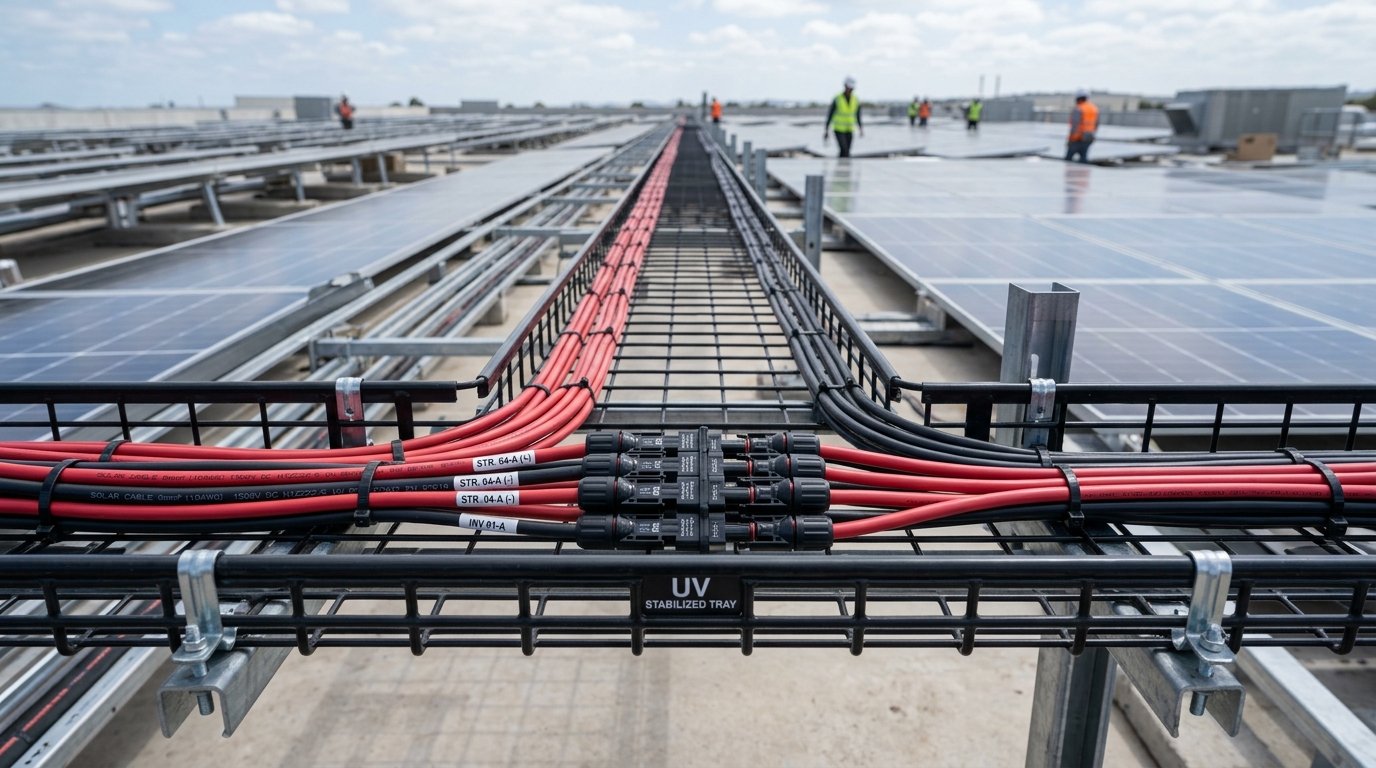
⚡ Why DC Cable Sizing Makes or Breaks Plant ROI: In a rooftop or ground-mount solar power plant, selecting the wrong DC cable gauge creates continuous resistive $I^2R$ power loss, overheats cable trays, and can cause hazardous DC arc fires. Keeping string voltage drop strictly under 1.0% to 1.5% ensures maximum energy reaches the inverter MPPT while safeguarding plant electrical safety under extreme Indian rooftop ambient temperatures (often reaching 60°C in metal conduits).
1. Solar DC Cable Standards: Why Standard AC Cables Must Never Be Used
Solar DC cables operate under continuous high direct current voltage (up to 1100V or 1500V DC) exposed to direct outdoor UV radiation and ozone for 25+ years. Standard PVC household wires degrade within months.
- EN 50618 / IS 17293 Standards: Certified solar cables feature dual-layer Cross-Linked Polyolefin (XLPO) electron-beam crosslinked insulation rated from -40°C to +120°C.
- Tinned Electrolytic Copper Conductors: Tin coating prevents copper oxidation and galvanic corrosion at MC4 connector crimp contact surfaces.
- Flame Retardant & Halogen-Free (LSZH): Ensures zero toxic halogen gas emission in the event of an electrical fire.
2. Voltage Drop Formula for Solar DC String Circuits
The percentage voltage drop in a single-phase DC string circuit is calculated using the standard formula:
$$\% ext{ Voltage Drop} = \left(
rac{2 imes L imes I_{ ext{mp}} imes
ho}{S imes V_{ ext{string}}}
ight) imes 100$$
- $L$ = One-way cable length from solar array to inverter (meters)
- $I_{ ext{mp}}$ = String maximum power current (Amperes, typically 13A to 18A for 580W+ modules)
- $ ho$ = Resistivity of tinned copper ($0.0183 \ \Omega \cdot ext{mm}^2/ ext{m}$ at 20°C, derated to $0.022 \ \Omega \cdot ext{mm}^2/ ext{m}$ at 60°C operating temp)
- $S$ = Cable cross-sectional area ($ ext{mm}^2$)
- $V_{ ext{string}}$ = Total string operating voltage (Volts, e.g. 10 panels $ imes$ 42V = 420V)
3. Cable Selection Matrix: 4 sq mm vs 6 sq mm vs 10 sq mm
| Cable Cross-Section | Max Current Carrying Capacity (at 60°C) | Max Recommended 1-Way Distance (<1.5% Drop) | Recommended Applications |
|---|---|---|---|
| 4.0 sq mm | ~32 Amps DC | Up to 25 – 30 meters | Residential rooftop systems (3kW to 10kW), short rooftop runs |
| 6.0 sq mm | ~42 Amps DC | Up to 45 – 60 meters | Commercial C&I rooftop arrays, multi-string combiners, 550W+ high-current panels |
| 10.0 sq mm | ~60 Amps DC | Up to 90 – 120 meters | Ground-mount plants, long runs from distant carports or sheds to main inverter room |
4. MC4 Connector Crimping Best Practices
- Use Calibrated Ratchet Crimping Tools: Pliers or manual compression crush connector pins unevenly, creating high-resistance hotspots ($>90^\circ ext{C}$) that melt connectors.
- Never Cross-Mate Different MC4 Brands: Mating Stäubli MC4 with generic third-party connectors violates IEC 62548 and causes 80% of rooftop DC arc faults.
- Observe Torque Tightening on Cable Glands: Ensure compression glands seal tightly to maintain IP68 water ingress protection.
5. Frequently Asked Questions (FAQs)
Q1: What is the maximum acceptable voltage drop in a solar DC circuit?
The standard industry best practice in India mandates a maximum voltage drop of ≤ 1.5% under full peak power operating current (Imp).
Q2: Can we use aluminium solar DC cables instead of copper?
For string cabling (<10 sq mm), copper is mandatory due to flexibility and MC4 terminal compatibility. Aluminium is only used in large DC feeder cables (>50 sq mm) from combiner boxes to central inverters.