 SolarCalculators
Solar Inverter Isolation Resistance (Low Riso) Faults: Causes, Testing & Fixes 2026
1. How Inverters Measure Isolation Resistance (Riso)
Before closing its internal AC grid relays at sunrise, every grid-tied transformerless string inverter executes an automated insulation integrity check as mandated by IEC 62109-2:
- The Test Voltage: The inverter applies an internal DC test potential across the PV array positive (\(\text{PV}+\)) and negative (\(\text{PV}-\)) rails relative to Earth ground (\(\text{PE}\)).
- Minimum Resistance Threshold (\(R_{\text{iso}}\)): According to IEC 62446-1 and DIN VDE 0126-1-1, the minimum acceptable insulation resistance is: \[R_{\text{iso,min}} = \frac{V_{\text{max}}}{30\,\text{mA}}\] For a 1000V DC system, \(R_{\text{iso,min}} = \mathbf{33.3\,\text{k}\Omega}\). However, most commercial inverter manufacturers (Sungrow, Huawei, GoodWe, Solis) enforce a far more stringent threshold of \(\ge 1.0\,\text{M}\Omega\) (or \(50\,\text{k}\Omega\) to \(100\,\text{k}\Omega\) per string) to ensure absolute personal safety.
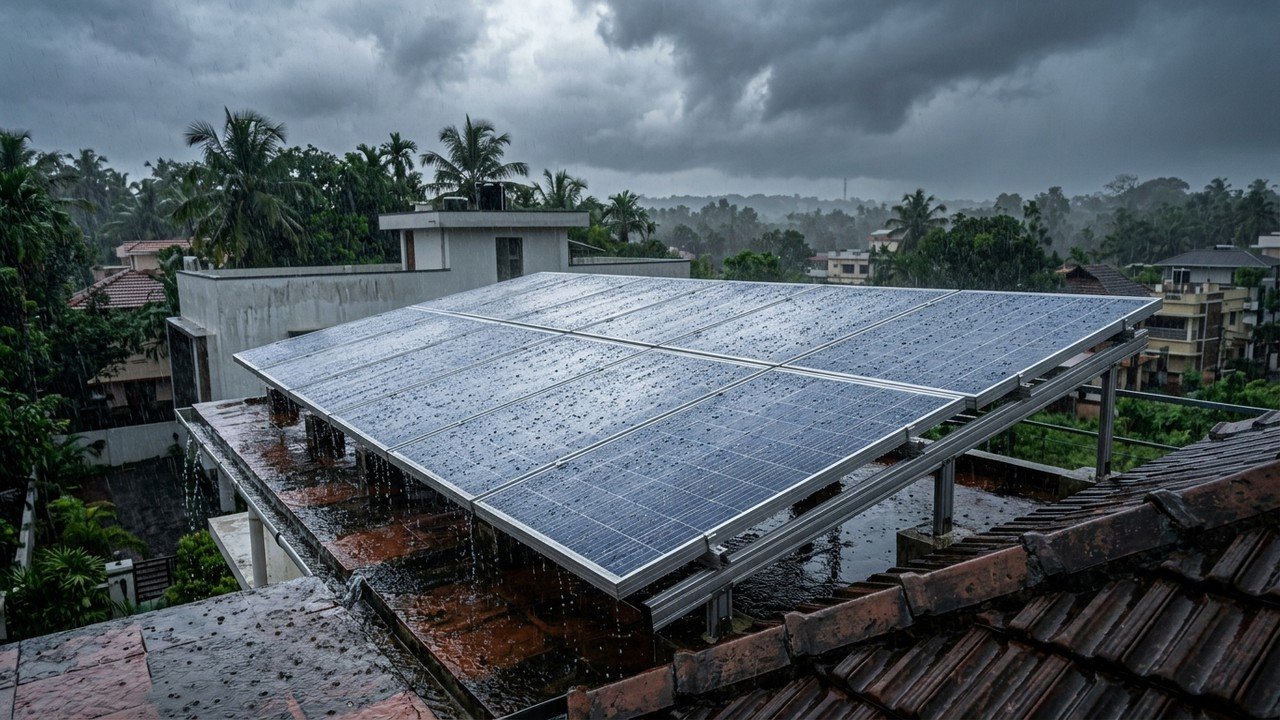
- Why Faults Clear by Midday: During early morning hours, high relative humidity (95%+) and morning dew deposit conductive moisture over micro-cracks in cables and junction boxes. By 11:00 AM, the heat of the sun evaporates the moisture film, the insulation resistance rises above \(1\,\text{M}\Omega\), and the inverter miraculously starts operating—masking an underlying progressive insulation failure that will trigger a disaster during the next heavy rainfall.
| Inverter Brand | Display Error Code | Internal Threshold | Manufacturer Recommended Action |
|---|---|---|---|
| Sungrow | Fault 039: Low Insulation Resistance | \(< 50\,\text{k}\Omega\) | Check DC cable jacket and DC combiner box earthing |
| Huawei FusionSolar | Alarm ID 2031 / Cause ID 1: Low Insulation | \(< 1.0\,\text{M}\Omega\) | Perform voltage-to-ground pinpointing measurement |
| GoodWe | Isolation Fault / Code E31 | \(< 100\,\text{k}\Omega\) | Isolate string inputs one-by-one to identify leaking loop |
| Solis / Growatt | ISO_FAIL / PV Isolation Low | \(< 100\,\text{k}\Omega\) | Verify module backsheet integrity and MC4 crimping |
2. Mathematical Pinpointing: The Two-Multimeter Method
Instead of manually inspecting hundreds of solar modules on a scorching roof, field engineers can pinpoint the exact module location of the ground fault in under 10 minutes using a standard digital multimeter set to DC Voltage (\(\text{V DC}\)):
Step 1: Disconnect the faulty DC string from the inverter DC input switches.
Step 2: Measure open-circuit voltage across string terminals: record \(V_{\text{oc,total}}\) (e.g., \(800\,\text{V DC}\)).
Step 3: Measure voltage between String Positive and Earth: record \(V_{\text{pos-earth}}\) (e.g., \(+500\,\text{V}\)).
Step 4: Measure voltage between String Negative and Earth: record \(V_{\text{neg-earth}}\) (e.g., \(-300\,\text{V}\)).
The Fault Location Formula:
\[N_{\text{fault}} = \frac{V_{\text{pos-earth}}}{V_{\text{module,oc}}} = \frac{500\,\text{V}}{49.5\,\text{V}} \approx \mathbf{10^{\text{th}}\text{ Module}}\]Interpretation: Starting from the positive string lead, count forward to the 10th module in the string. The ground puncture, pinched cable, or waterlogged MC4 connector will be located precisely at this module or the junction cable between modules 10 and 11!
3. The Top 4 Physical Causes of Isolation Breakdowns in India
- Unclipped Cables Resting on Metal Trays: During high-speed winds, unclipped DC solar cables rub against the sharp punched edges of galvanized iron (GI) cable trays. Over 1–2 years, vibration saws through the cross-linked polyethylene (XLPO) double insulation, exposing live copper to the grounded tray.
- Improperly Crimped or Cross-Mated MC4 Connectors: Water capillary ingress occurs when installer technicians crimp MC4 connectors using manual pliers instead of calibrated ratcheting dies, or mate Stäubli MC4 connectors with cheaper counterfeit clones.
- Rodent & Monkey Damage: Monkeys jumping on exposed module loops or roof rats biting cable jackets strip insulation down to bare copper.
- Module Backsheet Micro-Cracking: Older solar panels manufactured with sub-standard Polyamide (PA) backsheets suffer severe UV micro-cracking in hot Indian climates, allowing rain moisture to penetrate directly into live solar cell circuits.
4. Step-by-Step Restoration Protocol (Megger Insulation Test)
To verify that an array is 100% cured before re-energizing:
- Use a calibrated Insulation Resistance Tester (Megohmmeter) rated for 1000V DC (for 1000V strings) or 1500V DC (for 1500V utility systems).
- Short the string positive and negative leads together using a rated test bridge.
- Connect the Megger positive lead to the bridged string terminals and the negative lead to the station earthing bus.
- Apply test voltage for 60 continuous seconds. A healthy string must exhibit resistance strictly \(\ge 40\,\text{M}\Omega\) under dry conditions and \(\ge 1.0\,\text{M}\Omega\) under wet testing.