 SolarCalculators
Solar Net Metering Billing Explained: Energy Banking, Settlement Cycles & TOD Tariff in India (2026)
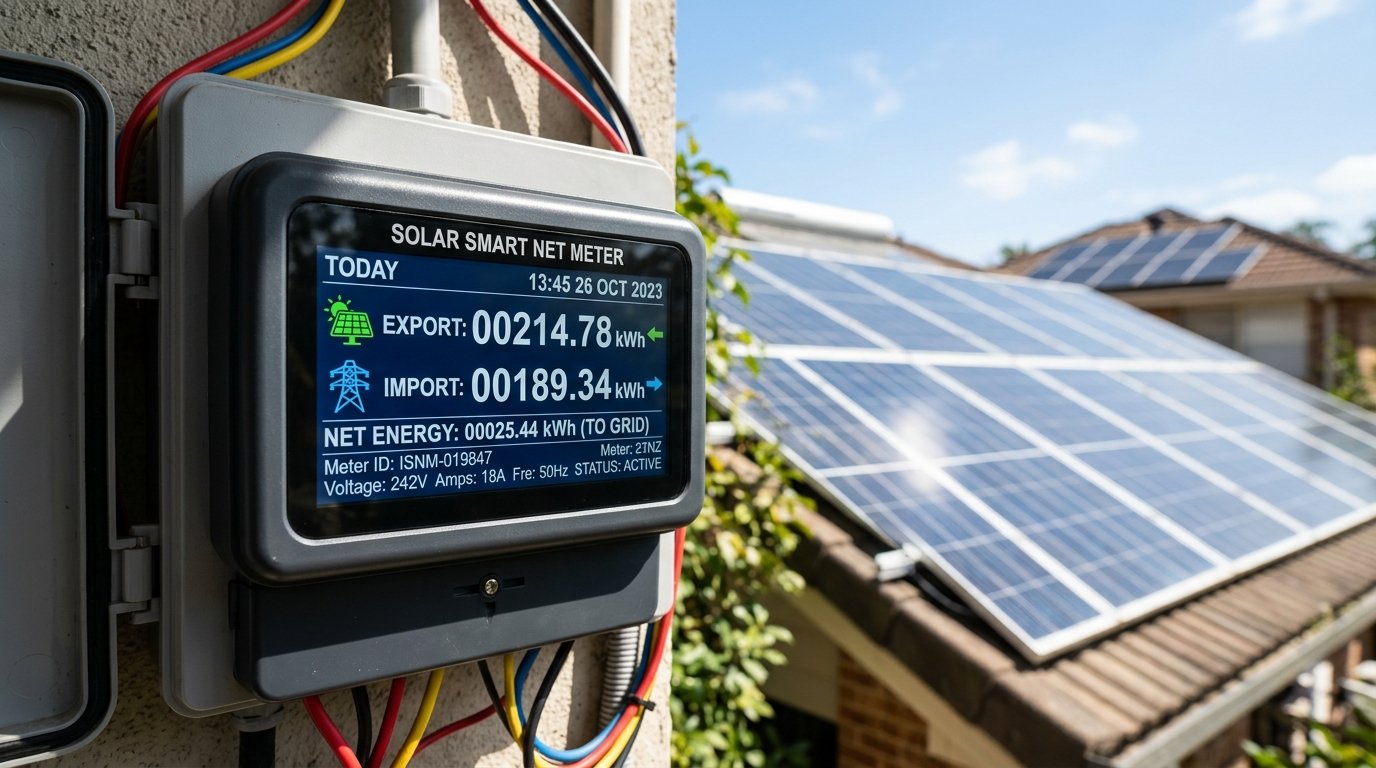
1. Anatomy of a Bi-Directional Smart Solar Meter Display
Your bi-directional net meter continuously cycles through digital display parameters:
| Meter Display Code | Parameter Name | What It Means |
|---|---|---|
| KWH (I / Imp) | Import Active Energy | Total grid electricity consumed when solar is not generating (Night / High load) |
| KWH (E / Exp) | Export Active Energy | Total surplus solar electricity sent back to the DISCOM grid during daytime |
| KWH (Net) | Net Energy (Imp - Exp) | If Import > Export: You pay for Net Units. If Export > Import: Surplus units are banked. |
| MD (kW / kVA) | Maximum Demand | Highest 15-minute peak power drawn from the grid during the monthly cycle |
2. Step-by-Step Net Metering Calculation Formula
Here is how your monthly DISCOM bill is computed:
Example: If you imported 450 units from grid and exported 600 units of solar generation, your Net Consumption is -150 units. Your energy charge for the month is ₹0, and 150 units are added to your energy bank balance for subsequent months.
3. Time-of-Day (TOD) Solar Energy Banking Rules
Most Indian states (Maharashtra, Gujarat, Karnataka, Haryana, Punjab, Tamil Nadu) implement Time-of-Day (TOD) tariffs for commercial, industrial, and high-consumption residential consumers:
- Solar Hours (09:00 - 18:00): Normal baseline tariff rates. 100% of solar generation occurs in this window.
- Peak Evening Hours (18:00 - 22:00): High tariff surcharge (typically +20% to +25%). Energy banked during solar hours is adjusted against peak hours with a conversion ratio specified by state regulatory commissions (SERC).
- Night Off-Peak Hours (22:00 - 06:00): Discounted tariff rebate (typically -15% to -20%).
4. Annual Settlement Cycle & Surplus Encashment (March 31)
Energy banking does not accumulate infinitely. Under standard State Electricity Regulatory Commission (SERC) regulations:
- Settlement Period: Runs from April 1 to March 31 each financial year.
- Surplus Unit Payout: Unadjusted surplus units remaining in your energy bank as of March 31 are purchased by the DISCOM at the Average Power Purchase Cost (APPC) rate (typically ₹2.50 to ₹3.80 per unit) and credited to your April bill.
5. 4 Common DISCOM Net Metering Billing Errors to Check
- Missing Solar Export Deduction: Verify that the meter reader recorded both Import and Export registers on the bill, not just Import.
- Fixed Demand Charges Billed on Full Solar Capacity: Fixed charges must be billed strictly on your sanctioned contract demand (kW/kVA), never on your connected solar plant capacity.
- Non-Adjustment of Carried Forward Banked Units: Always check the "Cumulative Banked Units" column on page 2 of your bill to verify past surplus balances.
6. Frequently Asked Questions (FAQs)
Q1: Can my electricity bill become exactly ₹0 after installing solar?
Your energy charge component can become ₹0. However, standard statutory fixed charges, meter rent, and electricity duty on net consumption are still payable as per DISCOM tariffs.
Q2: What happens if my solar export is higher than import every month?
Surplus energy credits roll over month after month and are settled in cash/bill credit at the end of the annual settlement cycle on March 31st.