 SolarCalculators
Solar Panel Cleaning Robots vs Automated Water Sprinklers: Cost, Water Savings & Yield Comparison 2026
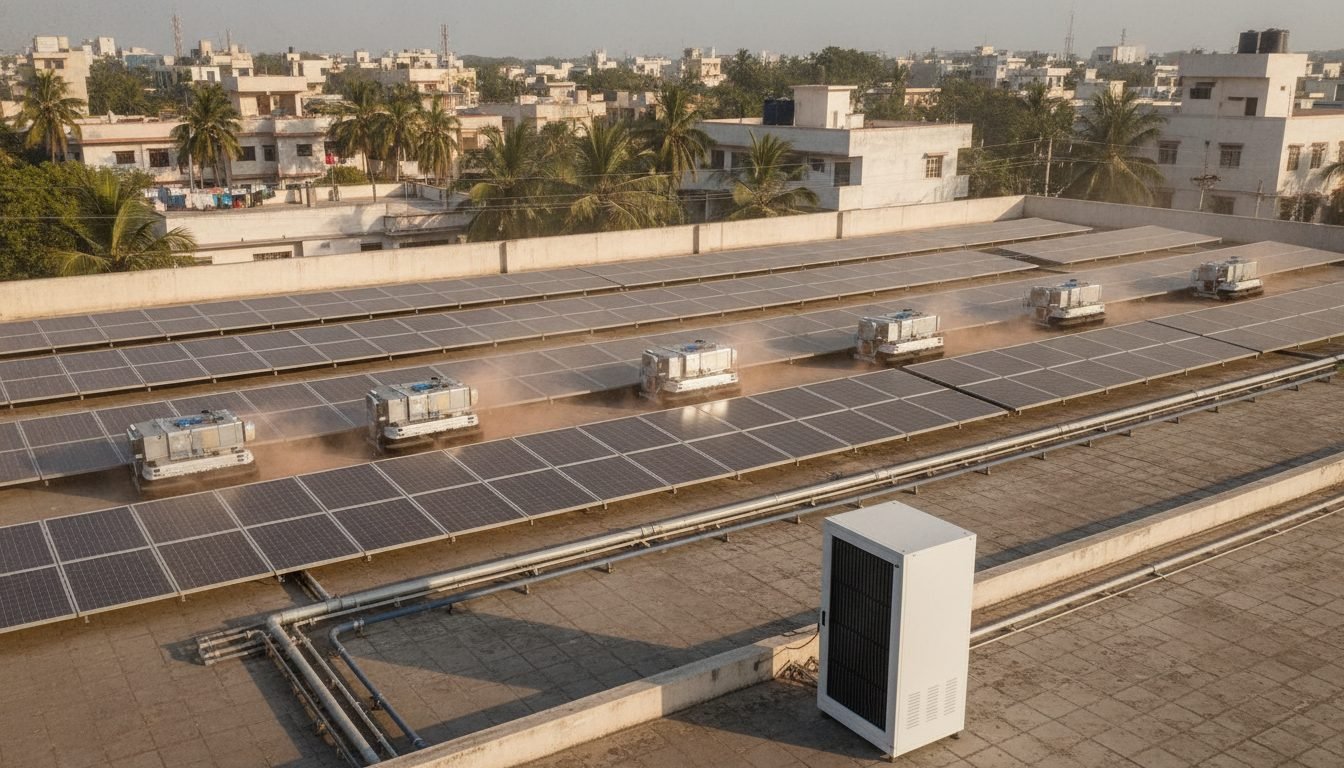
⚡ The Million-Liter Solar Dilemma: In arid, high-solar states like Rajasthan, Gujarat, and Madhya Pradesh, manual cleaning of a 10 MW solar power plant consumes over 1.5 to 2.5 million liters of fresh groundwater every year. With groundwater extraction facing strict Central Ground Water Authority (CGWA) regulations and module soiling cutting daily generation by 0.5% to 1.2% per day in dusty industrial corridors, asset owners are transitioning to automated cleaning. Here is the engineering and financial comparison between waterless robotic cleaners and automated nozzle sprinkler systems.
1. The Four Cleaning Paradigms Compared
| Operational Metric | Manual Pipe & Squeegee | Automated Hydraulic Sprinklers | Semi-Autonomous Portable Robot | Fully Autonomous Trackless Robot |
|---|---|---|---|---|
| Water Consumption | 3.0 – 5.0 Litres / module | 1.2 – 2.0 Litres / module | 0 Litres (Waterless dry clean) | 0 Litres (Waterless dry clean) |
| Cleaning Frequency | Once every 10–15 days | Programmed daily or bi-weekly | Once every 3–5 days (Manual shift) | Daily (Nightly automated patrol) |
| Average Soiling Loss | 6% to 12% yield loss | 2.5% to 4.5% yield loss | 2.0% to 3.5% yield loss | ≤ 1.0% to 1.5% yield loss |
| CAPEX per MWp (₹ Lakhs) | ₹0.50 L (Pipes & pumps) | ₹6.50 L – ₹9.00 L / MWp | ₹3.00 L – ₹4.50 L / MWp | ₹8.00 L – ₹13.00 L / MWp |
| Glass Scratching / Microcrack Risk | High (Foot trampling & hard brushes) | Nil (Contactless water spray) | Very Low (Specialized microfibers) | Very Low (Airflow & soft electrostatic wipers) |
2. Automated Hydraulic Sprinkler Systems: Engineering Analysis
Automated sprinkler systems utilize a network of high-pressure CPVC/UPVC pipelines, solenoid zone valves, booster pumps, and specialized 180° or 360° misting nozzles installed along the top edge of each solar module table:
- The Thermal Shock Danger: Sprinklers must never spray cold water on sun-baked solar panels during daylight hours. A sudden temperature differential (\(\Delta T > 30^\circ ext{C}\)) between \(65^\circ ext{C}\) module glass and \(22^\circ ext{C}\) groundwater induces catastrophic thermal shock, causing tempered glass explosion. System controllers must lock out spraying between 07:00 AM and 07:00 PM.
- Total Dissolved Solids (TDS) Hardness Scaling: If borehole water has TDS exceeding 200 PPM, water droplets evaporating in the dry air leave permanent white calcium carbonate (\( ext{CaCO}_3\)) and silica scaling on the anti-reflective coating (ARC), causing irreversible optical transmission loss. Costly Reverse Osmosis (RO) plants or demineralization filters become mandatory.
3. Waterless Cleaning Robots: Microfiber & Electrostatic Tech
Leading waterless solar cleaning robots (such as Ecoppia, Airtouch, and Solabot) utilize specialized mechanical dry-cleaning mechanisms:
- High-Speed Microfiber Rollers: Micro-fiber blades rotating at 300 to 500 RPM generate aerodynamic micro-air currents that lift unbonded dust particles off the glass without abrasive dragging.
- Self-Powered Solar & LiFePO4 Packs: Each robot carries its own onboard solar PV panel and lithium battery pack, docking in an automated base station to recharge during the day and executing cleaning runs at night.
- Zero Mechanical Glass Wear: Rigorous laboratory testing confirms that soft microfiber cleaning passes 10,000 cycles (equivalent to 25 years of daily cleaning) with zero degradation of the module's anti-reflective coating.
4. 5 MW Utility Solar Project Financial Cash Flow (Rajasthan)
Evaluating 10-year cumulative economics for a 5 MWp ground-mount plant generating 8,500,000 kWh annually at a PPA tariff of ₹2.85/kWh:
| Financial Dimension | Manual Cleaning | Waterless Automated Robots | Sprinkler System |
|---|---|---|---|
| Initial Equipment CAPEX | ₹2.50 Lakhs | ₹48.00 Lakhs | ₹38.50 Lakhs |
| Annual Water Cost (Tankers @ ₹800/5kL) | ₹3.20 Lakhs / yr | ₹0.00 / yr | ₹1.60 Lakhs / yr (plus RO O&M) |
| Annual Labor O&M Cost | ₹6.00 Lakhs / yr | ₹1.80 Lakhs / yr (Maintenance AMC) | ₹1.20 Lakhs / yr |
| Annual Energy Yield Captured | 7,820,000 kWh (8% soiling loss) | 8,372,500 kWh (1.5% soiling loss) | 8,160,000 kWh (4% soiling loss) |
| Annual Electricity Revenue | ₹222.87 Lakhs | ₹238.61 Lakhs (+₹15.74 Lakhs / yr) | ₹232.56 Lakhs (+₹9.69 Lakhs / yr) |
| Net Annual Value Gain | Baseline | +₹23.14 Lakhs / yr | +₹13.59 Lakhs / yr |
| Simple Payback Period | N/A | 2.07 Years | 2.83 Years |