Solar Rooftop Earthing & Lightning Protection (LA) Guide: Chemical Pit vs Copper/GI Rules (2026)

Solar Policy & Safety Analyst
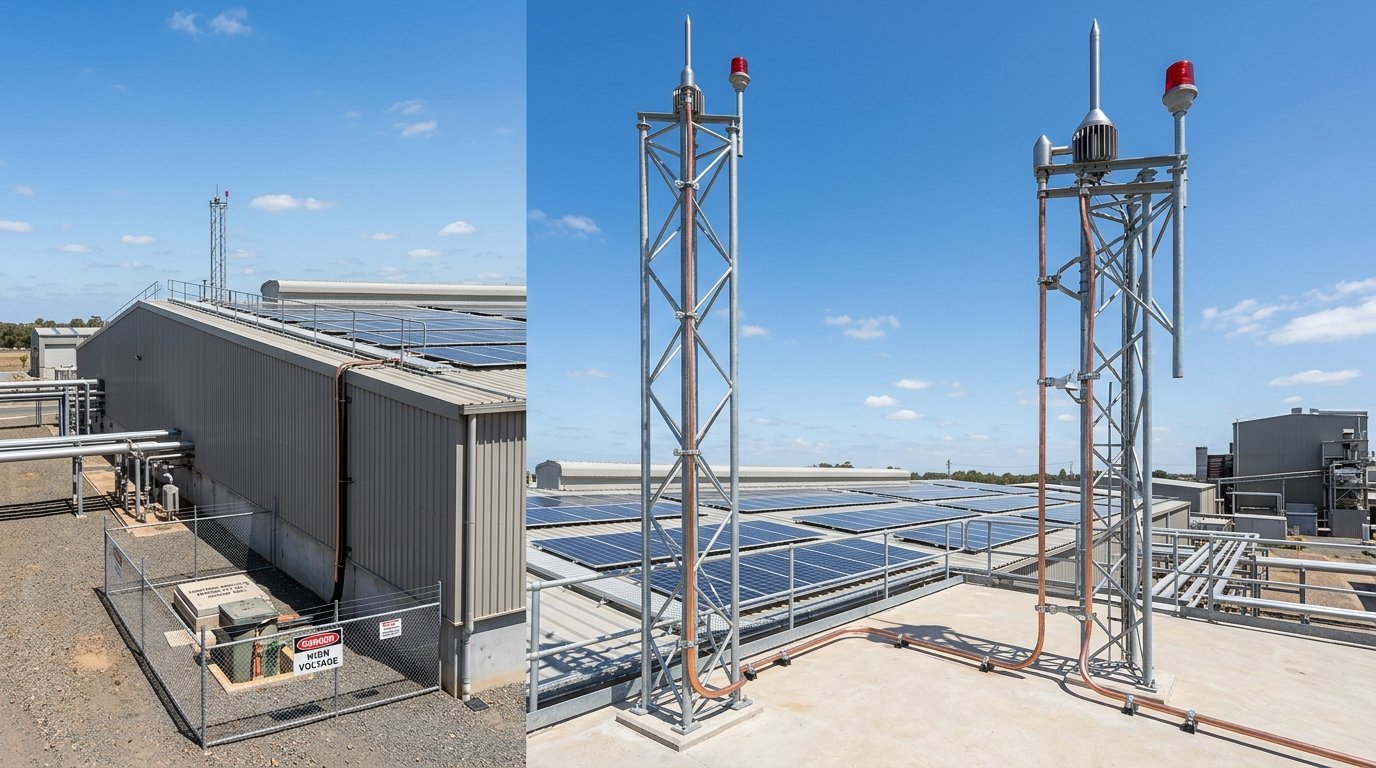
⚡ Mandatory Rule (CEA Regulation 2026): Every grid-tied rooftop solar power plant in India must maintain an earth loop resistance of less than 5 Ohms (ideally < 1 Ohm for commercial plants). DISCOM engineers conduct earth resistance testing before commissioning net meters. Inadequate earthing instantly voids equipment warranties on solar inverters and panel bypass diodes.
1. Why Rooftop Solar Needs 3 Dedicated Earthing Pits
A common mistake by inexperienced installers is bridging all earthing cables to a single domestic ground wire or water pipe. In a professional rooftop installation, 3 separate earthing pits must be installed to isolate distinct fault paths:
| Earthing Pit Type | Connected Equipment | Recommended Conductor | Primary Purpose |
|---|---|---|---|
| 1. DC Earthing Pit | Solar panel aluminium module frames & module mounting structures (MMS) | 6 sq mm to 10 sq mm Copper / 25x3 mm GI Strip | Dissipate DC leakage currents, prevent shock during panel maintenance & eliminate static build-up. |
| 2. AC Earthing Pit | Inverter AC casing, ACDB (AC Distribution Board), Neutral (where required) | 10 sq mm to 16 sq mm Multi-strand Copper Cable | Protect against grid surges, inverter internal ground faults & human contact safety. |
| 3. Lightning Arrester (LA) Pit | Dedicated ESE / Franklin Lightning Arrester mast at highest rooftop point | 25x3 mm or 25x5 mm Copper / GI Down Conductor Strip | Safely conduct direct atmospheric lightning strikes (up to 100,000 Amps) straight into deep earth. |
⚠️ CRITICAL SAFETY RULE: The Lightning Arrester (LA) down conductor must NEVER share an earthing pit with the inverter AC or DC solar panel earthing! Lightning discharge through a shared pit will back-feed high voltage into the inverter circuitry, incinerating the MPPT electronics.
2. Chemical Earthing Pits vs Traditional Charcoal & Salt Pits
| Comparison Parameter | Traditional Charcoal & Salt Pit | Modern Chemical Bentonite / Marconite Pit |
|---|---|---|
| Life Expectancy | 3 to 5 years (Salt dissolves & washes away in monsoons) | 15 to 25 Years Maintenance-Free |
| Earth Resistance Stability | Fluctuates wildly between wet monsoon and dry summer (>10Ω) | Stable & Consistent (< 2 Ohms year-round) |
| Electrode Corrosion | Severe corrosion on GI pipe due to corrosive salt ions | Non-corrosive, inert chemical compound shields copper rod |
| Watering Requirement | Requires regular manual watering via funnel pipe | Hygroscopic compound absorbs natural soil moisture |
| Compliance Standard | Legacy IS 3043 | IEEE 80 / IS 3043 / IEC 62561-7 Certified |
3. Lightning Protection: Conventional Franklin Rod vs ESE Arresters
- Conventional Franklin Spike: Passive copper/GI spike with a cone of protection of roughly 45° angle. Suitable only for small residential roofs (up to 3 kW - 5 kW) with limited surface area.
- Early Streamer Emission (ESE) Arrester: Generates an upward ionized streamer microseconds before a downward lightning leader strikes, expanding the protection radius up to 50 to 100 meters. Mandatory for large factories, hospitals, schools, and commercial multi-building complexes.
4. Step-by-Step Chemical Pit Installation Checklist
- Borehole Drilling: Drill a 6-inch to 8-inch diameter hole to a depth of 2.5 to 3.0 meters in undisturbed soil.
- Electrode Insertion: Insert a 2.5m or 3.0m copper-bonded steel electrode (minimum 250-micron copper coating) centered with spacers.
- Compound Backfilling: Mix the carbonaceous bentonite grounding compound with water into a slurry and backfill the borehole evenly around the electrode.
- Chamber & Testing: Install a heavy-duty poly-plastic or concrete inspection chamber with a removable test-link plate. Measure resistance with an earth tester (Megger).
Written by Shraddha
Solar Policy & Safety Analyst at SolarCalculators.in, researching MNRE PM Surya Ghar subsidy regulations, industrial C&I solar models, and renewable engineering across India.