Solar Panel PID (Potential Induced Degradation) Explained: Anti-PID Inverters & Recovery

1. How Does PID Occur in PV Systems?
Modern grid-tied solar systems operate with long module strings creating system voltages between 600V DC and 1500V DC. In ungrounded string inverter systems (transformerless inverters), modules near the negative pole of the string experience high negative potential relative to ground.
When combined with high ambient humidity and heat (common in coastal states like Gujarat, Tamil Nadu, Kerala, and Odisha), sodium ($Na^+$) ions from the soda-lime front glass migrate toward the silicon p-n junction. These mobile ions create carrier recombination centers that severely degrade the module's shunt resistance ($R_{sh}$), causing significant power loss.
2. Key Symptoms of PID Degradation
- Uneven String Degradation: Panels closer to the negative inverter terminal show severe yield drop, while positive-side panels operate normally.
- Low Open Circuit Voltage ($V_{oc}$) & Shunt Resistance: Inverter MPPT struggles to lock onto peak power during morning and evening low-irradiance hours.
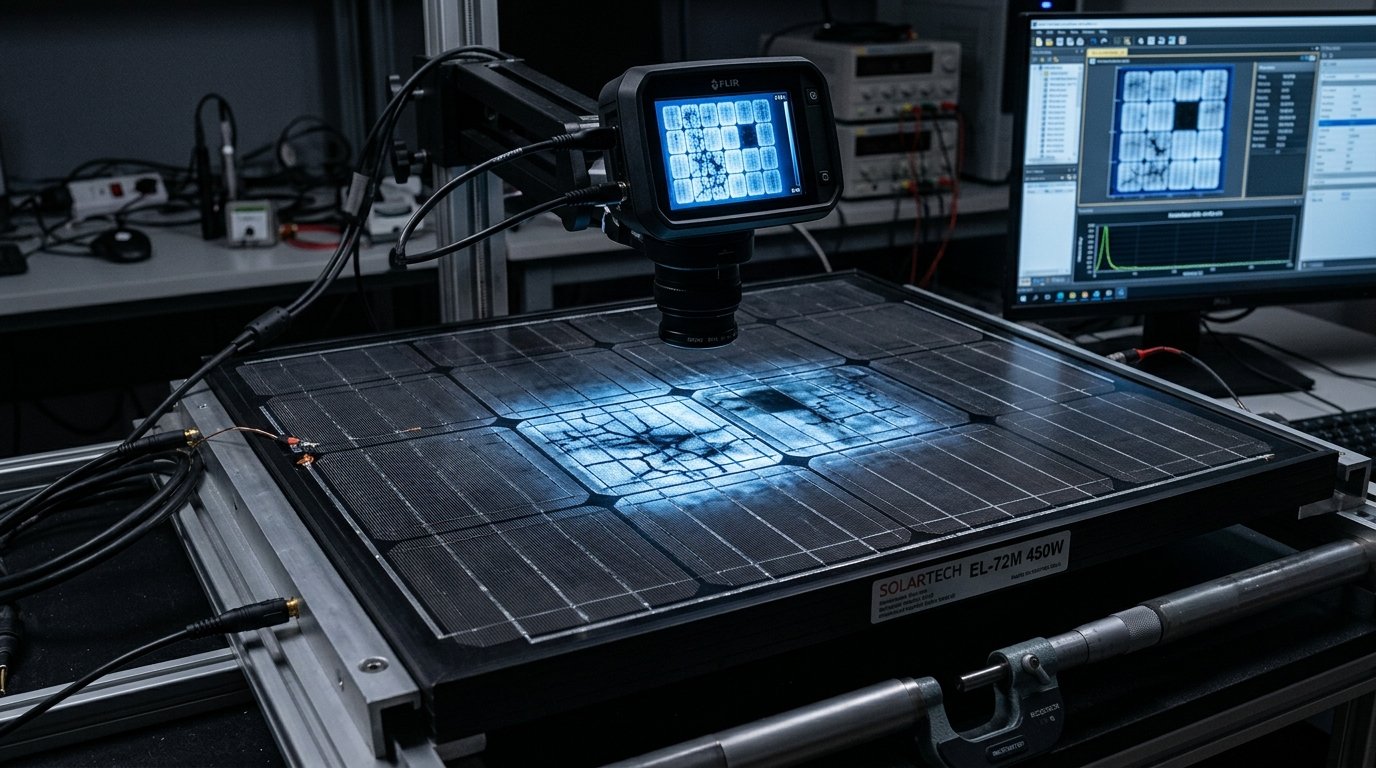
- Black Patching on Electroluminescence (EL) Imaging: Under EL camera inspection, PID-affected cells show distinctive dark, dead cell patterns along the edges.
| Factor | High PID Risk Conditions | PID-Resistant Solution |
|---|---|---|
| System Voltage | 1000V - 1500V DC ungrounded strings | Virtual grounding or negative pole bias |
| Climate | Relative Humidity > 75%, Temp > 40°C | Anti-PID POE Encapsulation |
| Cell Technology | Standard p-type PERC | n-type TOPCon / HJT (Inherent PID resistance) |
| Inverter Tech | Basic string inverter without offset | Anti-PID built-in night recovery module |
3. Anti-PID Technology & Nighttime Recovery Solutions
Fortunately, PID degradation is often reversible if diagnosed early before permanent electrochemical corrosion occurs. Leading remedies include:
A. Anti-PID Nighttime Voltage Inversion (Recovery Boxes)
Modern commercial inverters (Sungrow, Huawei, Growatt, Solis) feature built-in Anti-PID modules. At night when the sun sets, the inverter automatically applies a reverse positive high-voltage DC bias between the solar cells and the ground. This forces the migrated $Na^+$ ions back toward the glass surface, restoring up to 90-95% of lost module efficiency over several weeks.
B. Upgrading to n-Type TOPCon & Dual-Glass (Bifacial) Modules
n-type TOPCon and Heterojunction (HJT) solar panels use an n-type silicon wafer base that has significantly higher resistance to sodium ion polarization. Additionally, dual-glass bifacial modules with POE (Polyolefin Elastomer) encapsulation prevent moisture ingress far better than traditional EVA backsheets.