 SolarCalculators
Solar String Inverters vs Central Inverters: MW-Scale Cost, Yield & LCOE Comparison 2026
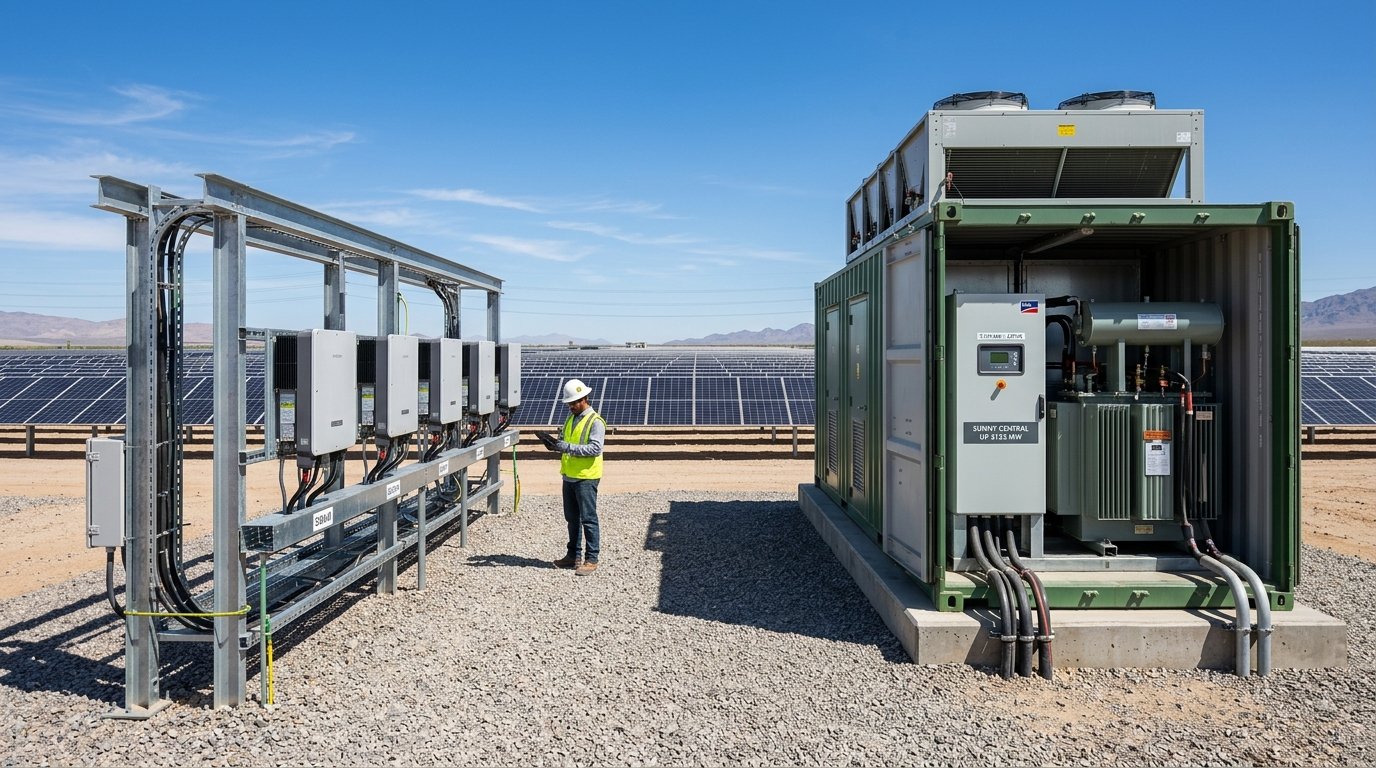
1. Architectural Comparison: Centralized vs Decentralized Topology
In a utility solar plant, your choice of inverter fundamentally dictates the civil foundations, DC and AC cabling philosophy, and substation layout:
| Engineering Feature | Central Inverter Skid (e.g. 3.125 MW / 4.167 MW) | Decentralized String Inverter (e.g. 330 kW / 350 kW) |
|---|---|---|
| MPPT Architecture | 1 to 2 Master MPPTs per 3.125 MW block | 8 to 12 Independent MPPTs per 330 kW unit (80+ MPPTs per block) |
| DC Combiner Boxes (SCB / SMB) | Required (array of 16-in/1-out or 24-in/1-out combiner boxes) | Eliminated completely (Strings plug directly into inverter) |
| DC Cabling Runs | Extensive long DC trunk cable runs to central skid | Very short DC string cables; long AC 800V collection lines |
| AC Output Voltage | Typically 600V to 690V AC | 800V AC (drastically cuts AC line losses and conductor cross-sections) |
| Mean Time to Repair (MTTR) | 1 to 7 Days (Requires manufacturer specialized engineer on-site) | 2 to 4 Hours (Unbolt and swap spare unit with site electricians) |
| Impact of Single Unit Failure | 3.125 MW completely offline (100% block loss) | 330 kW offline (only ~10% block loss; rest continues generating) |
2. Yield Advantage: Mismatch Losses & Irradiance Variance
Real-world solar fields are rarely perfectly uniform. In undulating terrain, dusty agricultural corridors, or areas with cloud shadow passages, module strings experience differing I-V characteristics:
- String Mismatch Elimination: In a central inverter, a single shaded string or soiled array pulls down the maximum power point for hundreds of parallel connected strings, resulting in significant clipping losses.
- Multi-MPPT Optimization: With 330 kW string inverters featuring up to 12 MPPTs (2 strings per MPPT), each string pair operates at its true peak operating voltage. Independent field trials across Rajasthan and Madhya Pradesh demonstrate a 1.5% to 2.8% higher annual energy yield (MWh/MWp) for string inverters over central inverters.
- Bifacial Albedo Variations: When using bifacial modules, rear-side ground reflection (albedo) varies significantly near access roads versus field interiors. String MPPT granularity captures this uneven rear gain with near-zero mismatch penalty.
3. CAPEX vs OPEX Financial Balance Sheet
| Financial Dimension | Central Inverter Solution | String Inverter Solution |
|---|---|---|
| Initial Equipment Cost (₹/Watt) | Lower by ~₹0.15 to ₹0.22/W | Slightly higher initial inverter purchase price |
| Installation & Civil Foundation | Heavy crane deployment + massive RCC plinth required | Mounts directly to existing solar MMS legs (no civil foundation) |
| DC String Combiner Boxes (SCB) | Adds ₹0.12/W for SCBs + monitoring hardware | ₹0.00 (Zero SCB cost) |
| Spare Parts & Replacement CAPEX | Expensive PCB boards, IGBT stacks, air filters & coolant | Keep 2 spare complete 330kW units in warehouse |
| 25-Year Inverter Replacement / Overhaul | Major factory overhaul required at Year 10–12 (~40% of Capex) | Unit-by-unit replacement as warranties expire |
4. The Verdict: When to Specify Which Inverter in 2026
Deploy Central Inverters (3.125 MW+) When: You are constructing a massive flat desert utility project (50 MW to 500+ MW in Rajasthan, Khavda, or Ladakh) where land is dead flat, soiling is uniform, CAPEX minimization is the primary metric to win tariff bidding, and a 24x7 resident OEM engineering team is stationed on site.
Deploy High-Power String Inverters (330 kW+) When: You are building projects from 1 MW up to 50 MW on undulating, hilly, or irregularly shaped terrain, rooftop/carport industrial plants, or floating solar projects. The higher energy yield (+2%), near-instant MTTR swap capability, and lower total 25-year O&M costs deliver a lower Levelized Cost of Electricity (LCOE).