 SolarCalculators
Textile Mill & Garment Factory Rooftop Solar: Lint Soiling, Humidity & Captive ROI 2026
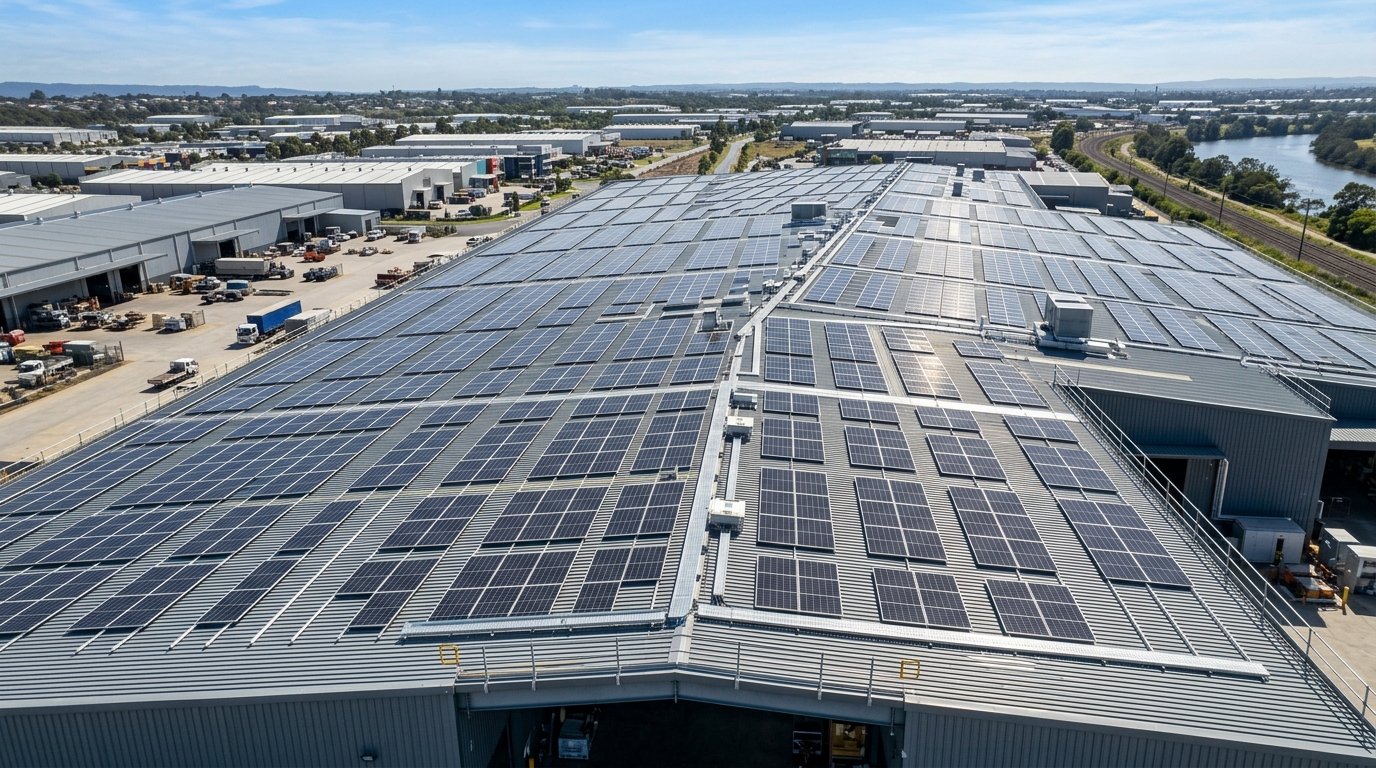
⚡ The Textile Power Equation: Electricity accounts for 15% to 22% of total production costs in Indian textile spinning, weaving, and garment processing units (Tirupur, Surat, Bhilwara, Ludhiana, Ahmedabad). With large industrial sheds offering 50,000 to 2,00,000 sq.ft. of unobstructed roof area, a 1 MWp rooftop solar installation offsets up to 35% of a mill's total power consumption, saving ₹85 Lakhs to ₹1.2 Crores annually with full capital payback in under 2.5 years under 40% accelerated tax depreciation.
1. The Unique Industrial Hazards of Textile Rooftops
Unlike standard automotive or engineering warehouses, textile mill rooftops present aggressive environmental challenges that can degrade solar equipment if not engineered correctly:
| Hazard Factor | Root Cause in Textile Operations | Solar Engineering Countermeasure |
|---|---|---|
| Airborne Cotton Lint & Fluff | Exhaust air from blowrooms, carding machines, and spinning frames vents cotton fibers to the roof | Lint mats over module glass, trapping dust and creating flammable felt sheets; requires weekly anti-static cleaning and IP66 inverters with positive-pressure heatsink fans |
| High Ambient Humidity & Steam | Dyeing, wet processing, and boiler steam exhaust create humid, micro-chemical atmospheres | Accelerates Potential Induced Degradation (PID) and EVA delamination; mandates Dual-Glass Glass-Glass POE encapsulation modules |
| Chemical Corrosivity (C4 / C5) | Sulfur and chlorine bleaching fumes from chemical wet processing | Aluminium mounting rails must feature 15-micron minimum anodization; all fasteners must be marine-grade Stainless Steel SS316 |
| Curved North-Light Shed Roofs | Traditional British-era sawtooth textile mill architecture designed for uniform daylighting | Requires specialized non-penetrative curvature-matching rail brackets to preserve natural north-light glazing without shading panels |
2. Captive Grid-Tied Integration with Captive DG & Gas Gensets
Most 24x7 spinning mills operate private heavy fuel oil (HFO) or natural gas generators alongside the state DISCOM grid to protect spinning rings from power blinks. Connecting a 1 MW rooftop solar plant into a multi-generator industrial bus requires dynamic Zero-Export and DG Synchronization:
- Reverse Power Protection: When mill looms or spinning frames trip instantaneously, factory load can plunge from 1,200 kW to 300 kW in seconds. Without high-speed controllers, surplus solar power back-feeds into the diesel generator, causing generator engine overspeed, reverse motoring, and catastrophic crankshaft failure.
- Fast Inverter Throttling: A dedicated Zero-Export Energy Manager (e.g., DEIF, ComAp, or Inverter Power Plant Controller) continuously samples the generator incomer via high-speed Rogowski CTs, curtailing solar inverter generation in less than 200 milliseconds to ensure the generator maintains a minimum 30% loading threshold.
3. 1 MW Turnkey CAPEX & Financial Modeling for Textile Mills (2026)
| Project Parameter | 1 MWp Turnkey Industrial Rooftop Installation |
|---|---|
| Solar PV Modules | 1,724 units of 580W Bifacial N-Type TOPCon Dual-Glass |
| Inverters | 8x 125 kW String Inverters (IP66, Smart AFCI, Anti-PID) |
| Total Turnkey EPC Project Cost | ₹3,60,00,000 (₹3.60 Crores) |
| Annual Generation (Yield 1,500 kWh/kWp) | 1,500,000 kWh / year |
| Displaced Industrial HT Tariff | ₹8.80 / kWh (Tirupur / Surat C&I average) |
| Annual Gross Electricity Savings | ₹1,32,00,000 (₹1.32 Crores / year) |
| Year 1 Tax Depreciation Benefit (40% Dep. @ 25% Tax) | ₹36,00,000 (Direct cash income-tax shield) |
| Annual O&M, Lint Cleaning & Insurance | ₹6,50,000 / year |
| Net Year 1 Financial Cash Flow | ₹1.32 Cr savings + ₹36L tax shield - ₹6.5L O&M = ₹1.615 Crores |
| Effective Post-Tax Payback Period | 2.23 Years |