 SolarCalculators
TOPCon vs HJT vs Bifacial Solar Panels (2026): India Price, Efficiency & High-Temp Test
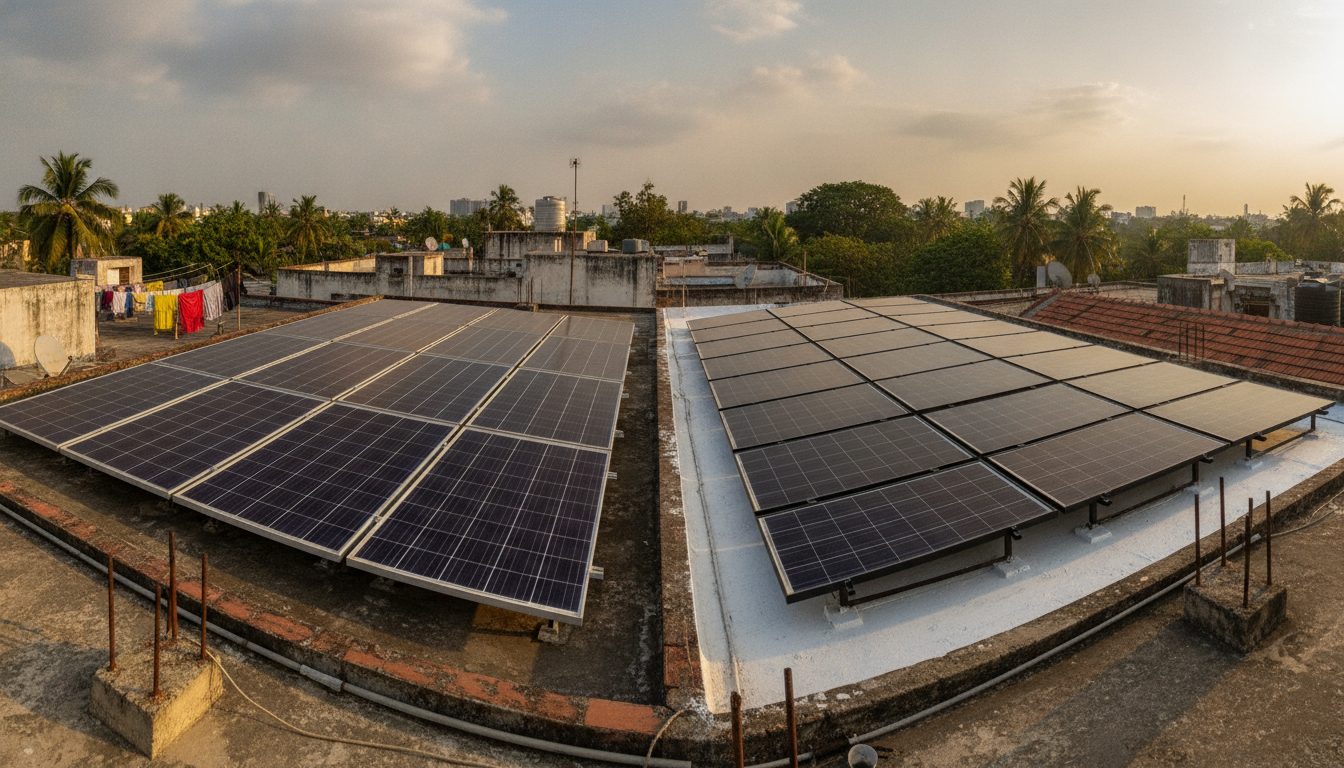
For years, P-Type Monocrystalline PERC (Passivated Emitter and Rear Cell) was the go-to panel technology across India. However, with the onset of the ALMM Phase-II domestic cell mandate and soaring solar adoption in high-temperature zones like Rajasthan, Gujarat, Maharashtra, and Delhi, N-Type silicon wafers have taken over the market.
If you are choosing between TOPCon, HJT, and Bifacial modules from tier-1 manufacturers like Waaree, Adani Solar, Vikram Solar, Premier Energies, and Goldi Solar, here is how they perform under real Indian operating conditions.
Head-to-Head Technical Matrix: TOPCon vs HJT vs Mono PERC
| Technical Specification | Mono PERC (P-Type) | N-Type TOPCon | HJT (Heterojunction) |
|---|---|---|---|
| Commercial Efficiency Range | 20.5% – 21.4% | 22.2% – 23.1% | 23.4% – 24.6% |
| Temperature Coefficient (Pmax) | -0.35% / °C | -0.30% / °C | -0.26% / °C (Best) |
| Bifaciality Factor (Rear Gain) | 65% – 70% | 80% – 85% | 90% – 95% (Highest) |
| First Year Degradation | 2.0% | 1.0% | 0.8% (Zero LID) |
| Annual Linear Degradation | 0.55% / year | 0.40% / year | 0.35% / year |
| Power Warranty (30 Years) | 84.8% Remaining | 87.4% Remaining | 89.5% Remaining |
| Average Retail Price (India 2026) | ₹18 – ₹21 / Watt | ₹22 – ₹26 / Watt | ₹27 – ₹32 / Watt |
Want to see what this means for your roof? Use our free solar calculator for India to estimate system size, cost after the ₹78,000 subsidy and payback period.
How Do They Perform in Extreme 45°C Indian Heat?
Solar panels are laboratory-tested at Standard Test Conditions (STC) of 25°C cell temperature. However, on a 42°C summer afternoon in Ahmedabad or Jaipur, dark rooftop solar cells easily reach 65°C (40°C above STC rating).
Here is the real mathematical power drop caused by temperature coefficient:
- Standard Mono PERC (-0.35%/°C): 40°C × 0.35% = 14.0% Power Loss. (A 550W panel drops to 473W).
- N-Type TOPCon (-0.30%/°C): 40°C × 0.30% = 12.0% Power Loss. (A 550W panel drops to 484W).
- HJT Module (-0.26%/°C): 40°C × 0.26% = 10.4% Power Loss. (A 550W panel drops to 492.8W).
The Takeaway: HJT produces nearly 4.2% more real electricity during peak summer peak-sun hours than conventional PERC, keeping air conditioners running with higher daytime efficiency.
Bifacial Solar: Maximizing Roof Albedo on Indian Terraces
Bifacial solar panels feature transparent tempered glass on both the front and back. The rear side absorbs reflected sunlight (albedo) from the roof surface.
Albedo Gain by Surface Type:
- Dark Grey RCC Concrete: 8% to 11% additional power.
- White Cool-Roof Heat-Resistant Paint: 18% to 24% additional power.
- Light Coloured Ceramic Tiles: 14% to 17% additional power.
Cost vs Payback Analysis (3 kW Residential System)
| System Option | Total Estimated Cost | PM Surya Ghar Subsidy | Net Customer Cost | Est. Annual Generation | Simple Payback |
|---|---|---|---|---|---|
| 3 kW Mono PERC (Monofacial) | ₹1,85,000 | ₹78,000 | ₹1,07,000 | 4,100 Units | 3.6 Years |
| 3 kW N-Type TOPCon (Bifacial) | ₹2,02,000 | ₹78,000 | ₹1,24,000 | 4,680 Units | 3.4 Years (Fastest ROI) |
| 3 kW HJT Dual Glass | ₹2,28,000 | ₹78,000 | ₹1,50,000 | 4,850 Units | 3.9 Years |
Final Recommendation: What Should You Buy in 2026?
- Best Overall for Homes & Small Commercial: N-Type TOPCon Bifacial (550W–590W) offers the sweet spot of high efficiency, robust high-temperature performance, and low price per generated unit.
- Best for Limited Roof Space or Extreme Heat: HJT Modules are ideal if you have a small terrace and need maximum kWh output per square foot, or live in desert/semi-arid regions with sustained 45°C+ summers.
- Best on Budget: Mono PERC remains functional for low-cost setups, but the small ₹2–₹3/Watt difference makes TOPCon the far superior long-term investment.
🔗 Related Sizing & Quotation Tools
Latest 2026 Solar Panel Price List Panel Efficiency Calculator Solar ROI & Payback Calculator Compare Installer QuotationsFrequently Asked Questions
Calculate System Sizing with TOPCon Modules
Find out how many high-efficiency TOPCon panels you need to eliminate your monthly electricity bill.
Start Solar Sizing Calculator →