Zero Export Controller & DG Synchronization for Commercial Solar (2026 Guide)

Verified Energy & Solar Policy Specialist
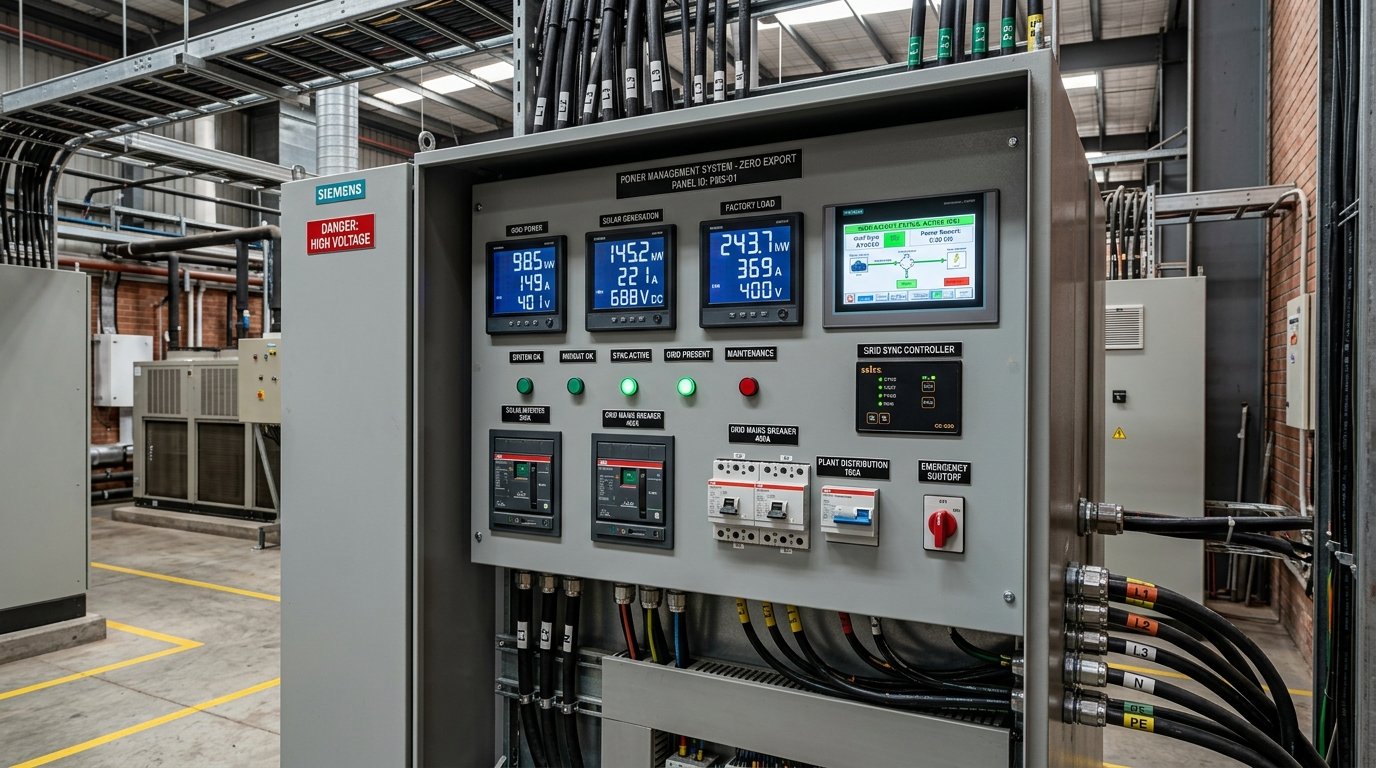
⚡ What is a Zero Export Device? A Zero Export Controller (also known as a Reverse Power Relay or Zero Injection Device) is an intelligent power management system that dynamically curtails solar inverter power output within milliseconds to ensure that zero surplus solar energy is fed back into the DISCOM grid or a running Diesel Generator (DG).
1. Why Zero Export is Mandatory for Many Indian Commercial Plants
Commercial and Industrial (C&I) consumers frequently face two major grid constraints:
- DISCOM Net Metering Denial: Many state utilities (such as in Maharashtra, Tamil Nadu, Uttar Pradesh, and Karnataka) restrict or deny net metering for high-tension (HT) connections above 500 kW, permitting only 'Behind-the-Meter' captive solar consumption.
- Heavy Fines for Unsanctioned Export: If a non-net-metered solar plant injects power into the grid, digital smart meters register reverse energy flow as imported consumption (charging the factory twice!) or trip anti-islanding safety relays.
2. How Solar-DG Synchronization Protects Generator Alternators
During power cuts, factories turn on heavy Diesel Generators (e.g., 250 kVA - 1000 kVA). If solar inverters are allowed to generate uncontrolled power during periods of low factory load, solar energy can backfeed into the DG alternator.
⚠️ Reverse Power Danger: Backfeeding power into a diesel generator turns the alternator into a synchronous motor. This causes reverse torque, severe crankshaft stresses, governor hunting, engine overspeed, and catastrophic generator failure.
A dedicated Solar-DG Sync Controller communicates via RS-485 / Modbus TCP with both the generator control panel (DSE / ComAp / Woodward) and the solar inverters to enforce a Minimum DG Loading Rule (typically 25% to 30%). This ensures the generator always operates smoothly with zero reverse power risks.
| Operational Mode | Grid Status | Controller Action | Solar Output |
|---|---|---|---|
| Normal Grid Connected | Grid Active | Solar matches factory load up to 100% capacity; curtails if load drops below solar generation | Maximized (0 to 100%) |
| DG Running (Power Cut) | Grid Down, DG On | Maintains minimum 30% baseline load on DG set; modulates solar inverter output to fill remaining 70% | Dynamic throttling |
| Complete Factory Idle | Grid Active | Instantly throttles inverter active power ($P$) to 0 kW via fast frequency/power commands | 0% Curtailment |
3. Core Components of a Zero Export System
- Class 0.2S / 0.5S Bidirectional Multi-Function Energy Meter: Installed at the main LT/HT incoming panel to monitor active power flow direction with millisecond polling rates.
- Current Transformers (CTs): Precision CTs on Phase R, Y, and B to measure exact line currents.
- Central Data Logger / Master Controller: Running dynamic control algorithms to calculate load deficits and broadcast active power limit commands ($P_{limit}$) to all connected inverters.
Written by Shraddha
Solar policy analyst and technical research specialist at SolarCalculators.in, tracking MNRE PM Surya Ghar subsidy regulations, industrial C&I solar models, and renewable engineering across India.