Solar Inverter Tripping at Peak Afternoon? High Grid Voltage (260V+) Causes & Complete FIX
 Rajesh Sharma · September 20, 2026 · 8 min read
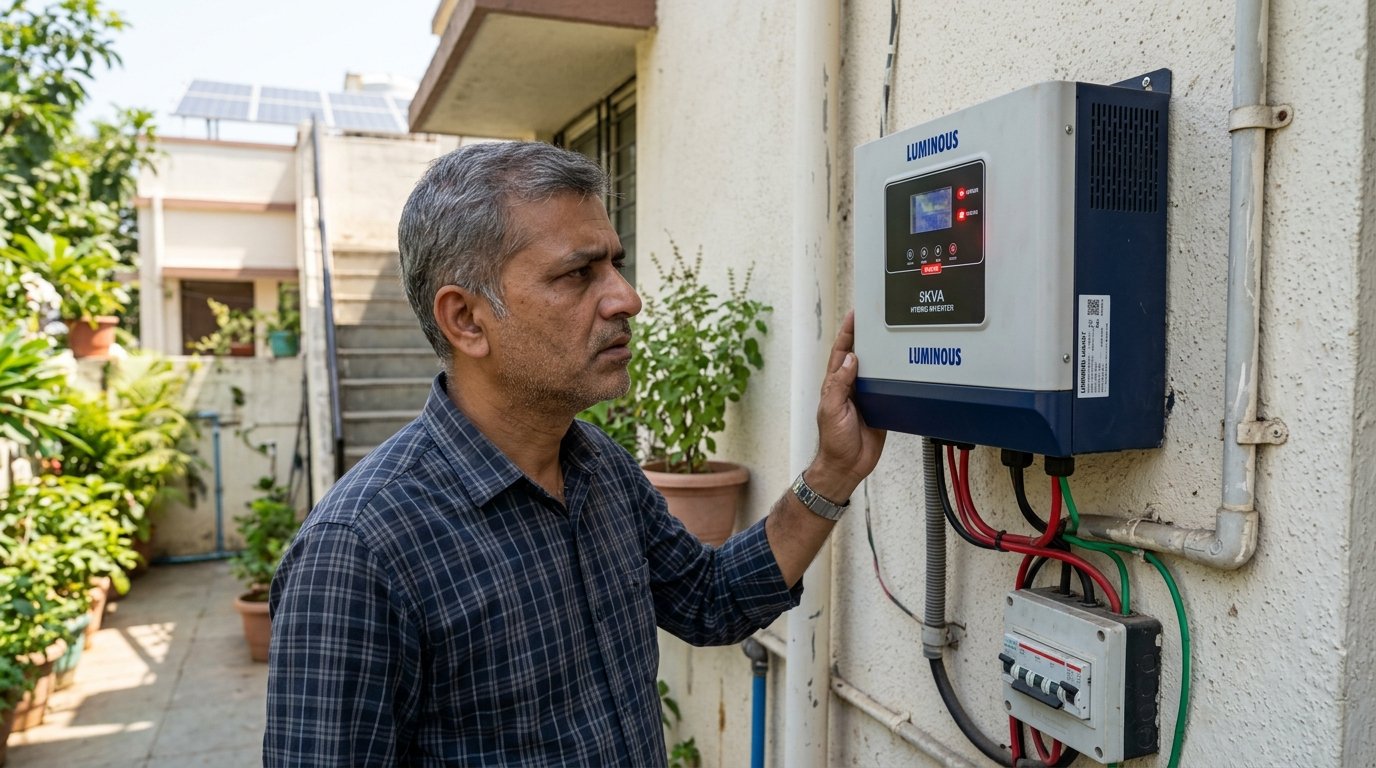
Why Does Your Inverter Trip Only at Peak Afternoon?
To feed solar power into the DISCOM grid, your solar inverter MUST push voltage slightly higher than the incoming grid voltage. For example:
- If DISCOM Grid Voltage is 240V, the Inverter will push at 243V–246V to export units.
- If DISCOM Grid Voltage is already high at 253V (common in transformer tail-ends or areas with high solar density), the inverter has to raise voltage to 258V–262V.
- Indian standard grid limit (CEA grid code) triggers inverter auto-shutdown when grid AC voltage exceeds 253V to 264V for safety.
5 Step-by-Step Solutions to Stop Inverter Overvoltage Tripping
1. Upgrade AC Cable Size (Reduce Internal Voltage Drop)
Undersized AC cables between the inverter and the net meter create high resistance. If you are using 4 sq mm cable for a 5kW inverter over 25 meters distance, you will suffer a 6V–10V internal voltage rise! Upgrading to 6 sq mm or 10 sq mm Copper/Aluminum AC cable drops resistance immediately.
2. Adjust Inverter Grid Voltage Protection Limits (Legally)
Most on-grid inverters (Sungrow, Growatt, Solis, Havells, GoodWe, Microtek) come factory-set to strict European grid defaults (253V). In India, DISCOM regulations allow upper limit adjustments up to 264V (10% limit). Contact your installer to adjust the grid upper threshold parameter via vendor app.
3. Request DISCOM Transformer Tap Changing
If your neighbors are also experiencing grid voltages over 255V even without solar, the local DISCOM distribution transformer (DT) tap setting is set too high. File a formal request with your local DISCOM SDO (Sub-Divisional Officer) to lower the transformer tap by 2.5% or 5%.
4. Phase Load Rebalancing (For 3-Phase Systems)
In 3-phase connections, if one phase has high voltage (e.g. R-Phase: 260V, Y-Phase: 235V, B-Phase: 238V), the inverter will trip on the single high phase. Ask a licensed electrician to rebalance household loads evenly across all 3 phases.
5. Enable Volt-VAR or Reactive Power Control Mode
Modern smart inverters support Volt-VAR / Q(U) control mode. When voltage climbs near 250V, the inverter dynamically absorbs reactive power to stabilize local grid voltage without completely shutting down generation.
| Inverter Capacity | Minimum Cable Size (Dist < 15m) | Recommended Cable Size (Dist > 25m) |
|---|---|---|
| 3 kW (Single Phase) | 4 sq mm Copper / 6 sq mm Al | 6 sq mm Copper / 10 sq mm Al |
| 5 kW (Single Phase) | 6 sq mm Copper / 10 sq mm Al | 10 sq mm Copper / 16 sq mm Al |
| 10 kW (Three Phase) | 6 sq mm Copper / 10 sq mm Al | 10 sq mm Copper / 16 sq mm Al |
👉 Solar Cable Sizing & Voltage Drop Calculator Guide
👉 ग्रिड वोल्टेज ट्रिपिंग समाधान (हिंदी)